Wisdom in Translation

4.30.24

In the anthology Another Room to Live In: 15 Contemporary Arab Poets (Litmus Press, 2024) edited by Omar Berrada and Sarah Riggs, multinational and multilingual poet-translators challenge foundational narratives and rework mythologies through poetic expression. Yasmine Seale’s poem “Conventional Wisdom (Arabic Saying Translated Twenty Ways)” is composed of translations of an ancient aphorism expressing the inextricable place of poetry within Arab cultural heritage. Each line presents a variation on the truism: “Poetry is the record of the Arabs / The art of poetry is Arabs, collected / Good poetry is a list of Arabs / To speak in verse is to remain in Arab memory / To surpass another poet is the Arab odyssey.” Write a poem inspired by this idea of translating a proverb or maxim—either from another language or from English into English. How might you creatively interpolate different “translations” of the saying by incorporating connotations and riffing on free associations and personal experiences?

Poetry in America: Phillis Wheatley

Caption: 

“When I sit down, I invite that muse, that ardor, that passion to get to some place of discovery.” In this preview for the season four premiere of the public television series Poetry in America, poets Richard Blanco and Amanda Gorman, among other writers and scholars, join host Elisa New to discuss two poems by pioneering Black poet Phillis Wheatley. Watch the full episode here.

Genre: 

First Look: One Hundred Years of Solitude

Caption: 

Watch this sneak peek of the first screen adaptation of Gabriel García Márquez's masterpiece One Hundred Years of Solitude. The Spanish-language series was filmed in Colombia with support from the author’s family and is written by José Rivera, Natalia Santa, Camila Brugés, María Camila Arias, and Albatrós González. The multi-generational tale follows the Buendía family and tells the story of the founding of the mythical town of Macondo.

Genre: 

Ada Limón Introduces You Are Here

Caption: 

In this inaugural Mary Oliver Memorial Event, U.S. Poet Laureate Ada Limón introduces her signature project which includes site-specific poetry installations in seven national parks and the anthology You Are Here: Poetry in the Natural World, published by Milkweed Editions in association with the Library of Congress. Limón is joined by poets Molly McCully Brown, Jake Skeets, Analicia Sotelo, and Paul Tran for a reading and conversation.

Genre: 

In Response

4.25.24

In a recent interview with Aria Aber for the Yale Review, when asked his thoughts on the responsibility of the poet, Jackson Prize–winning poet Fady Joudah says, “I often think that the responsibility of the poet is to strive to become the memory that people may possess in the future about what it means to be human: an ever-changing constant. In poetry, the range of metaphors and topics is limited, predictable, but the styles are innumerable. Think how we read poetry from centuries ago and are no longer bothered by its outdated diction. All that remains of old poetry is the music of what it means to be human.” Write a creative nonfiction piece that presents your personal theory of the responsibility of a writer or an artist. To construct an expansive approach, you might use observations about how different creative disciplines overlap in their goals, or consider what has remained resonant as the arts make their mark throughout various eras.

Nam Le: 36 Ways of Writing a Vietnamese Poem

Caption: 

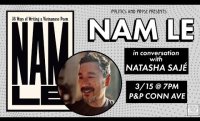
In this Politics and Prose event, Dylan Thomas Prize–winning author Nam Le reads from his debut poetry collection, 36 Ways of Writing a Vietnamese Poem (Knopf, 2024), and discusses the choice to write poetry rather than prose, and the sometimes questionable authority of writing about trauma in a conversation with Natasha Sajé.

Genre: 

Earth to You

4.24.24

In honor of Earth Week, write a scene that revolves around a character who experiences an unexpected moment in a natural environment that produces a sensation of wonder, perhaps an unusual encounter with wild flora or fauna. You might contrast the elements of this scene with others in your story in which the character is interacting solely with humans or only attuned to the sounds, rhythms, and sights of city life and densely packed civilization. Is the occurrence mind-bogglingly quick and then reflected upon in hindsight, or does time slow down in the scene? How do you manage or manipulate the pacing and rhythm of your prose to draw attention to the emotional and psychological response of the character?

Paul Murray in a Conversation With Colm Tóibín

Caption: 

“You’ve got one idea that excites you, and all these other ideas start to kind of come out of it.” In this Sligo County Libraries event, award-winning author Paul Murray discusses the middle-class challenges of the characters in his latest novel, The Bee Sting (Farrar, Straus and Giroux, 2023), in a conversation with Colm Tóibín.

Genre: 

From Dirt Level

4.23.24

In Sharon Olds’s poem “May 1968,” the speaker recounts the memory of spending the night with other protesting students, who lay down their bodies on a New York City street at a university’s campus gates in order to obstruct the mounted police force that had been called in. While “spine-down on the cobbles,” she observes the city and surrounding scenery—the soaring buildings and the police and horses’ bodies—as she gazes upward, thinking about the state of her pregnant body. Write a poem this week from the vantage point of lying face-up, “from dirt level.” What circumstances bring you into this position? How does this upward point of view transform what you see, and how you feel about your own body?

Fictions & Forms: Danielle Dutton

Caption: 

As part of the Fictions & Forms reading series hosted by the University of Chicago’s Program in Creative Writing, Danielle Dutton discusses her intricate relationship to genre and form, and reads from her hybrid collection, Prairie, Dresses, Art, Other (Coffee House Press, 2024), which is featured in Page One in the May/June issue of Poets & Writers Magazine.

Genre: 

Pages

Subscribe to Poets & Writers RSS