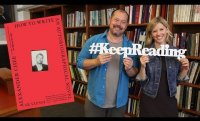
Ten Questions for Courtney Maum

“Listen, it can’t feel magical every day, of course, but writing does have the potential to be an act of joy.” —Courtney Maum, author of Costalegre
Jump to navigation Skip to content
“Listen, it can’t feel magical every day, of course, but writing does have the potential to be an act of joy.” —Courtney Maum, author of Costalegre
“I like questions, my imagination likes them too.” In this A Word on Word series video, Alexander Chee speaks about his essay collection, How to Write an Autobiographical Novel (Mariner Books, 2018), and his writing process which involves engaging in conversation with his fictional characters.
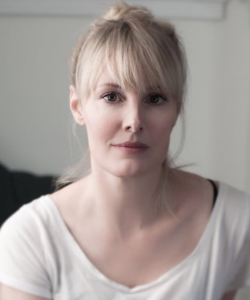
The author of the story collection Black Light explores the generative power of “the weird.”
Just a few days left to submit to the following writing contests, all with a deadline of July 14 or July 15. Each contest offers a first-place prize of at least $1,000 and publication. Good luck!
Cincinnati Review Robert and Adele Schiff Awards in Poetry and Prose: Two prizes of $1,000 each and publication in Cincinnati Review are given annually for a poem and a piece of fiction or creative nonfiction. Rebecca Lindenberg will judge in poetry and Michael Griffith will judge in prose. Entry fee: $20. Deadline: July 15.
Comstock Review Muriel Craft Bailey Award: A prize of $1,000 and publication in Comstock Review is given annually for a single poem. David Kirby will judge. Entry fee: $28. Deadline: July 15.
Literal Latté Poetry Award: A prize of $1,000 and publication in Literal Latté is given annually for a poem or group of poems. Entry fee: $10. Deadline: July 15.
Los Angeles Review Literary Awards: Four prizes of $1,000 each and publication in Los Angeles Review are given annually for a poem, a short story, a short short story, and an essay. Matty Layne Glasgow will judge in poetry, Tammy Lynne Stoner will judge in fiction, Brittany Ackerman will judge in flash fiction, and Adrianne Kalfopoulou will judge in nonfiction. Entry fee: $20. Deadline: July 14.
Narrative Poetry Contest: A prize of $1,500 and publication in Narrative is given annually for a poem or group of poems. The poetry editors will judge. Entry fee: $25. Deadline: July 14.
Rattle Poetry Prize: A prize of $10,000 and publication in Rattle is given annually for a poem. A Reader’s Choice Award of $2,000 is also given to one of ten finalists. Entry fee: $25. Deadline: July 15.
Santa Fe Writers Project Book Award: A prize of $1,500 and publication by the Santa Fe Writers Project is given biennially for a book of fiction or creative nonfiction. Carmen Maria Machado will judge. Entry fee: $30. Deadline: July 15.
The Word Works Tenth Gate Prize: A prize of $1,000 and publication by the Word Works is given annually for a poetry collection by a poet who has published at least two full-length books of poetry. Entry fee: $25. Deadline: July 15.
Visit the contest websites for complete guidelines, and check out the Grants & Awards database and Submission Calendar for more contests in poetry, fiction, and creative nonfiction.
“We can be unrelentingly hard to ourselves, and under such circumstances, it’s a shame to not let the world’s light stick to us when we have the chance.” Esmé Weijun Wang, author of The Collected Schizophrenias (Graywolf Press, 2019), speaks about the importance of prioritizing compliments over criticism in this PBS NewsHour video.
“We must believe in our souls that we are somebody, that we are significant, that we are worthful, and we must walk the streets of life every day with this sense of dignity and this sense of somebody-ness.” In Colson Whitehead’s seventh novel, The Nickel Boys (Doubleday, 2019), the protagonist, Elwood Curtis, replays these powerful words by Martin Luther King Jr. from a record album he received as a young boy in the early 1960s, which he considers “the best gift of his life.” Throughout the book Elwood repeatedly refers to King’s words as a source of guidance, inspiration, and morality. Write a short story in which your main character is similarly inspired by an important historical figure’s words—words of wisdom written or spoken by an artist, author, or activist. How did your character first come across these words? Are they comforting or provocative? Does the meaning or significance of the words change over time as the character evolves?
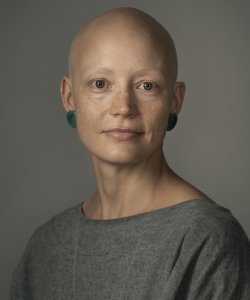
“I have never before written something where the primary challenge was not one of craft or character or structure but rather of emotion.” —Helen Phillips, author of The Need
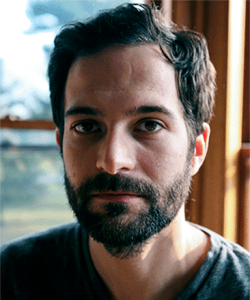
The author of Vincent and Alice and Alice discusses the challenge of plot and character development, the pros and cons of indie publishing, and what new risks he took in his new novel.
In this PBS NewsHour video, NPR’s Maureen Corrigan and the Washington Post’s Carlos Lozada highlight their favorite books for summer reading, which include Ocean Vuong’s On Earth We’re Briefly Gorgeous (Penguin Press, 2019), Jill Ciment’s The Body in Question (Pantheon, 2019), and José Olivarez’s Citizen Illegal (Haymarket Books, 2018).
“We think of the walls of a house as defining our domestic space, but in the novel these boundaries start to soften, for inside the house it’s as wild as outside,” says Chia-Chia Lin about her debut novel, The Unpassing (Farrar, Straus and Giroux, 2019), in an interview with Yaa Gyasi in the July/August issue of Poets & Writers Magazine. In the novel, an immigrant family lives in a house in Alaska and deals with isolation, grief, and the vulnerability of the house to infiltration. Write a short story in which the stability of a house as a domestic space has been compromised. What happens when what was once thought as safe and interior becomes blurred with what’s presumed to be wild and exterior?