Writing Desk Envy
Caption:
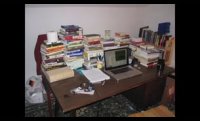
Writer Yuvi Zalkow made this short video about his desire for a beautiful, creative workspace. After you watch it check out John Casey's writing desk as well as snapshots of writing spaces submitted by our readers.
Tags:
Jump to navigation Skip to content
Writer Yuvi Zalkow made this short video about his desire for a beautiful, creative workspace. After you watch it check out John Casey's writing desk as well as snapshots of writing spaces submitted by our readers.
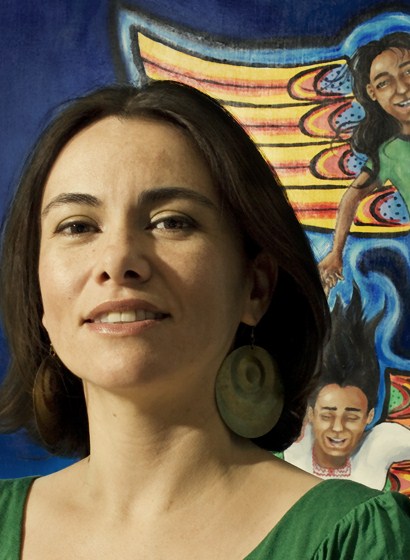
Poet Olga Garcia, author of Falling Angels: Cuentos y Poemas and the chapbook Lovely Little Creatures, blogs about her experience facilitating a P&W-supported workshop at Southwest Bakersfield Library in Bakersfield, California.
When the California Center for the Book's David Gernand first connected me with Southwest Bakersfield Library to facilitate a memoir writing workshop, I had a sudden flashback.
 When
I was eight, my parents packed all five of us kids into an old, avocado-green
station wagon and drove us to Bakersfield
to pick onions. Once there, we toiled in the vicious heat, snapping enormous green
scissors, filling coarse brown sacks with dusty white onions. One foreman came by
every so often to halfheartedly shoo us kids off the field. Within minutes after
he disappeared, we’d run back to our parents to help with the onion picking or the
dragging of sacks that inevitably grew heavier with each added onion.
When
I was eight, my parents packed all five of us kids into an old, avocado-green
station wagon and drove us to Bakersfield
to pick onions. Once there, we toiled in the vicious heat, snapping enormous green
scissors, filling coarse brown sacks with dusty white onions. One foreman came by
every so often to halfheartedly shoo us kids off the field. Within minutes after
he disappeared, we’d run back to our parents to help with the onion picking or the
dragging of sacks that inevitably grew heavier with each added onion.
We were supposed to work the fields for several weeks that summer, but at night while we camped out and fought over the bare mattress laid out at the back of the station wagon, we beseeched our parents to take us home. The smell of onions permeated our clothes, skin, and hair. It burned our eyes and lingered on our tongues. After a few days, my father shook his head in defeat, saying we were the worst workers he had ever seen. As we drove out of Bakersfield, we waved goodbye to the onion fields from the rear window, promising never to return.
Thirty-three years later I’m in Bakersfield again, standing before a group of workshop participants at Southwest Library. It’s a small, ethnically diverse group of nine and their ages range from twelve to sixty. Some of them have aspirations of memoir writing; others have come simply to practice writing. I share my onion story as a means to discuss memoir writing (how place, sound, smell, and taste trigger snapshots of what we’ve lived). We do several exercises to probe into the personal stories archived in their bodies.
One exercise asks participants to write about a memorable place. Another asks them to use one of Sandra Cisneros’s vignettes as a springboard to write about their names. Both exercises produce intimate recollections, and it is through the sharing of these intimate recollections that we connect with one another.
Maria, the library branch supervisor, reveals a long-kept secret. “Well, you see,” she says “my name isn’t actually Maria.” The name was given to her by a group of Catholic nuns in the Philippines and it stuck. A great beginning to a memoir. Maritza, from Guadalajara, Mexico, was named after a character in a Brazilian soap opera. And Gene, the middle-aged man whose Mexican parents didn’t speak a word of English, was named after Gene Autry, the American performer known as the "Singing Cowboy." As Gene shares his story, his wife leans into him and mumbles, “I never knew that.”
Photo: Olga Garcia. Credit: Weenobee.com.
Major support for Readings/Workshops events in California is provided by The James Irvine Foundation. Additional support comes from the Friends of Poets & Writers.
PBS NewsHour's Jeffrey Brown gives an overview of the Borders saga, the last chapter of which begins today when the bookstore chain enters liquidation and offers going-out-of-business sales at its remaining locations, and talks with Slate's Annie Lowrey about the demise of the forty-year-old company.
Earlier this month the Guardian revealed the one hundred thirty-six nominees for its annual First Book Award, posing the question, "what have we missed?"
After inviting readers to suggest fiction and nonfiction titles not yet entered by publishers—who must pay an entry fee of one hundred fifty pounds (nearly two hundred fifty dollars) to submit each title—the newspaper collected more than a hundred responses, but the forum for discussion is still open.
On Monday the Guardian posted responses from a group of literary bloggers weighing in on the question. Asylum's John Self named Teju Cole's novel, Open City (Random House) as his missing title, and Bookslut's Jessa Crispin suggested Vanessa Veselka's novel, Zazen, and nonfiction title Who Is Anna Mendieta? by Christine Redfern and Caro Caron (Feminist Press), among others. Nic Bottomley of Mr. B's Emporium of Reading Delights and Jonathan Ruppin of Foyles both called out the novel Snowdrops by A. D. Miller (Atlantic Books).
Fictionbitch blogger Elizabeth Baines, looking for "books that don't fit the conception of the 'market' but, with the oxygen of a prize win, have the power to capture readers' imaginations and indeed change the terms of the market," selected as one of her titles James Franco's "brilliantly written" story collection Palo Alto, published by Faber in the United Kingdom and Scribner in the United States.
For the bloggers' full lists and to offer your own nominations, visit the Guardian's website. The long- and shortlists for the prize, worth ten thousand pounds (roughly sixteen thousand dollars), will be rolled out in the coming months, with a winner announced in the late fall.
Next month Three Rivers Press will publish Suzanne Morrison's memoir Yoga Bitch: One Woman's Quest to Conquer Skepticism, Cynicism, and Cigarettes on the Path to Enlightenment. The book chronicles what happens when a coffee-drinking, cigarette-smoking, steak-eating, twenty-five-year-old student decides to travel to Bali for a two-month yoga teacher training program.
Okay, this is just about the best thing we've watched all summer. Check out this video of Brazenhead Books, a secret bookstore inside Michael Seidenberg's apartment on Manhattan's Upper East Side. Why is it secret? Just watch this.
In the latest installment of Picador's Big Ideas/Small Books series of paperbacks, poet and critic Wayne Koestenbaum takes readers on a tour of humiliating circumstances in history, literature, art, current events, music, film, and his own life.
Check out this time-lapse video of a new Half Price Books store being built in San Antonio. The store opens for business tomorrow.
Back in 2001 Shaun Winter bought a ticket for twenty-one days of unlimited travel on the Greyhound Bus Line. In three weeks he covered six thousand miles while making a film, Untitled Paintings, and writing a book, 21 Days on a Greyhound Bus.
In this blast from the past, School House Rock! presents "Lolly, Lolly, Lolly, Get Your Adverbs Here," which first aired in 1974 as part of the series of educational short films featuring music that, nearly forty years later, is still difficult to get out of one's mind. Remember "Conjunction Junction," which first aired in 1973? Who could forget?