Marianne Boruch on Her Process

Caption: 

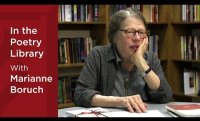
In this 2017 interview at Claremont Graduate University, Marianne Boruch talks about her 2011 collection, The Book of Hours, for which she won the Kingsley Tufts Poetry Award, and how poetry remains a “mysterious form” and creates a space where “it’s a pleasure to be elsewhere.” Boruch is the recipient of the 2026 Jackson Poetry Prize.

Genre: 

Music and Me

“When you mention music, you want that music to do the atmosphere work for you. But it’s really tricky,” says Sophie Strohmeier about linking music, compositions, and instruments to the characters in her novella All Girls Be Mine Alone (Joyland Publishing, 2025), in an interview for the Creative Independent. “It was more like creating a material palette with the evocation of what each instrument might convey.” Focus on infusing a scene in either a new personal essay or a work-in-progress with music. Allow the music to do the work of adding a fresh dimension to the atmosphere and recollection of your memories. You might recall the types of songs that would have been playing in your setting or brainstorm the sounds and instruments that most effectively convey the mindset or emotions of the people present in your retelling.

Beyond Baroque Book Launch: Alan Chazaro

Caption: 

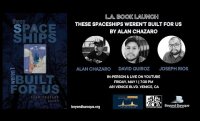
In this Beyond Baroque event, poets David Quiroz and Joseph Rios join Alan Chazaro for a reading to celebrate the launch of his second collection, These Spaceships Weren’t Built for Us (Tia Chucha Press, 2026). For more from Chazaro, read the latest installment of Literary MagNet in the May/June 2026 issue of Poets & Writers Magazine.

Genre: 

Lost Data

Recently, the New Yorker published an article by Julian Lucas about the devastation experienced when losing digital data and the experts who are able to repair and recover data for victims. Steve Burgess, a “data-recovery pioneer,” talks about how the value of a person’s data is dependent on whether or not they have it. “Once they have it, it really wasn’t worth anything,” he says. “But, if they don’t have it, it’s worth an arm and a leg and their children.” Write a short story that launches from the starting point of a character experiencing an unfortunate mishap with their phone or computer, resulting in the loss of irreplaceable photos, texts, audio files, writing, and contact information. Were the lost items something that they took for granted before? What is your character willing to do to retrieve the data?

Caregiving, Caretaking

What sort of emotional labor does one experience when caring for a parent or a child, a friend or lover, or someone who’s ill? This week compose a poem that details the gestures and actions, the commitments and complications involved in taking care of someone else. In Angela Jackson’s poem “Caregiving,” published in the April 2023 issue of Poetry magazine, the speaker recalls a time before the responsibility of caretaking when she would “rumble-race” and “haul-dash” to the gym to exercise twice weekly, and contrasts that dynamism with the slowed-down, zoomed-in attention spent on the person she is looking after who is “sitting on the gray stoop / like a lost little girl.” In your own poem, think about the resulting sacrifices and rewards of caretaking, and consider how to express that through sound and rhythm.

Emilie Lygren and Deema K. Shehabi

Caption: 

In this Green Apple Books event, Emilie Lygren, author of Once I Was a Stone (Wayfarer Books, 2025), and Deema K. Shehabi, author of Water to Water: Gaza Renga (Interlink Books, 2025), read a selection of their poems and discuss their experiences with writing communities and creating time and space for their writing.

Genre: 

Origins of Conflict

4.30.26

Can we learn how to avoid conflict by studying the behavior of other animals? A recent New York Times article reported that in the last decade or so, a group of chimpanzees in the forests of Uganda experienced an unprecedented uptick in large-scale violence, prompting scientists to question the origins of this civil warfare and consider whether these types of violent conflicts are a part of human evolution. Compose a personal essay that reflects on your thoughts about conflict, whether it be a large-scale conflict in the country you live in or more intimate between friends and family. How can sorting through your own beliefs and emotions help you reach new understandings about human social relations and behavior?

Diane Ackerman: The Planets

Caption: 

In this video, Diane Ackerman reads a selection of poems from the fiftieth-anniversary edition of her debut collection, The Planets: A Cosmic Pastoral, published by Marginalian Editions, and discusses her lifelong obsession with poetics in a conversation with Maria Popova for this McNally Jackson Books event at St. Ann & the Holy Trinity Church in Brooklyn.

Genre: 

Virtual Love

4.29.26

Early last year, a group of three thousand people across the United States were surveyed for a study published by Brigham Young University’s Wheatley Institute which found that nearly one out of five adults had chatted with an AI romantic partner. Considering this growing trend, write a short story that revolves around the unexpected consequences that arise when a character develops a romantic relationship with an AI-generated companion. Is there an inciting incident that prompts your character to turn to technology for comfort? Does anyone else know about this new love interest or is the relationship kept a secret? Aside from possible elements of sci-fi dystopia or tropes from mystery and thriller genres, consider incorporating some unexpected humor and satire into your story.

Pages

Subscribe to Poets & Writers RSS