Samara Elán Huggins

Caption: 

“We aren’t serious when we’re seventeen…” In this video, Samara Elán Huggins, the 2017 Poetry Out Loud National Champion from Georgia, recites “Novel” by Arthur Rimbaud, translated from the French by Wallace Fowlie. Anndee Hochman writes about Poetry Out Loud, a national recitation competition for high school students, in “The Poem Chooses You” in the March/April issue of Poets & Writers Magazine.

Genre: 

Tim Fredrick on Newtown Literary and the Queens Lit Scene

Tim Fredrick is the author of the short story collection, We Regret to Inform You (Ingram, 2012). His stories have been published in Burningword, Pif Magazine, Wilde Magazine, and Hamilton Stone Review. He is the founding editor and executive director of Newtown Literary, a nonprofit organization dedicated to supporting writers from and living in the Queens borough of New York City.

How did Newtown Literary begin? What prompted you to launch it?
I began Newtown Literary in 2012 after getting to know several writers in Queens and attending various literary events there. Something was definitely bubbling up at the time, and I was reading and hearing incredible work. Unfortunately, not much of that work was being associated with Queens; authors usually said they were from “New York City” in their bios. I decided that it was time for a written record of the work being produced in Queens and for “So-and-so is from Queens” to be a badge of honor in an author’s bio. The borough has a long history of the literary arts and some of the best literature being produced now is from writers living in Queens or who grew up there.

The literary events scene in Queens is going strong. What’s next?
One of the great things about the literary scene here in Queens is that it is grassroots. The people who organize reading series, events, literary journals, small presses, and so on are everyday writers who want to contribute to the community. So, in the larger literary scene, it’s hard to know what’s next. For Newtown Literary, we are going to continue with our journal and with our free classes and professional development program. Our focus lately has been on removing barriers to participation. Our free writing classes program—which offers twice-a-month, one-off, free writing classes taught by established Queens writers, such as Scott Cheshire, Jill Eisenstadt, Joseph O. Legaspi, and Min Jin Lee—was born out of a desire to make high-quality creative writing instruction available to everyone, no matter their income. We will continue in this vein.

In addition to being a literary organizer, you’re also a creative writer. What’s it like wearing two hats, so to speak?
It’s not easy! I often have to choose between my commitment to Newtown Literary—and by proxy, other writers—and my commitment to my own writing. I wish I could say that I chose my own writing more often, but it’s “easier” for me to choose my work at Newtown Literary because it doesn’t challenge me as much as writing does. Running a small nonprofit is so much easier than writing a novel!

Is there any advice you’d offer to creative writers who want to participate in the “behind the scenes” of literary organizing?
Do it. Reach out to people in charge and say, “Hey, I’d like to get involved.” At least at Newtown Literary, it’s that easy.

What has been the most rewarding experience in your work with Newtown Literary?
What I value most about Newtown Literary is our community—it’s not competitive and there are no hard feelings when one person succeeds. While working on the organization takes time away from my own writing, the friends and colleagues I’ve made working here are constantly asking me, “How’s your writing?” and if I respond, “Well...” I know I need to get to work. Some of my closest friends—the ones I go to when I need to talk or vent or celebrate—come from the organization, as well.

Support for the Readings & Workshops Program in New York City is provided, in part, by public funds from the New York State Council on the Arts, and the New York City Department of Cultural Affairs, with additional support from the Frances Abbey Endowment, the Cowles Charitable Trust, and the Friends of Poets & Writers.

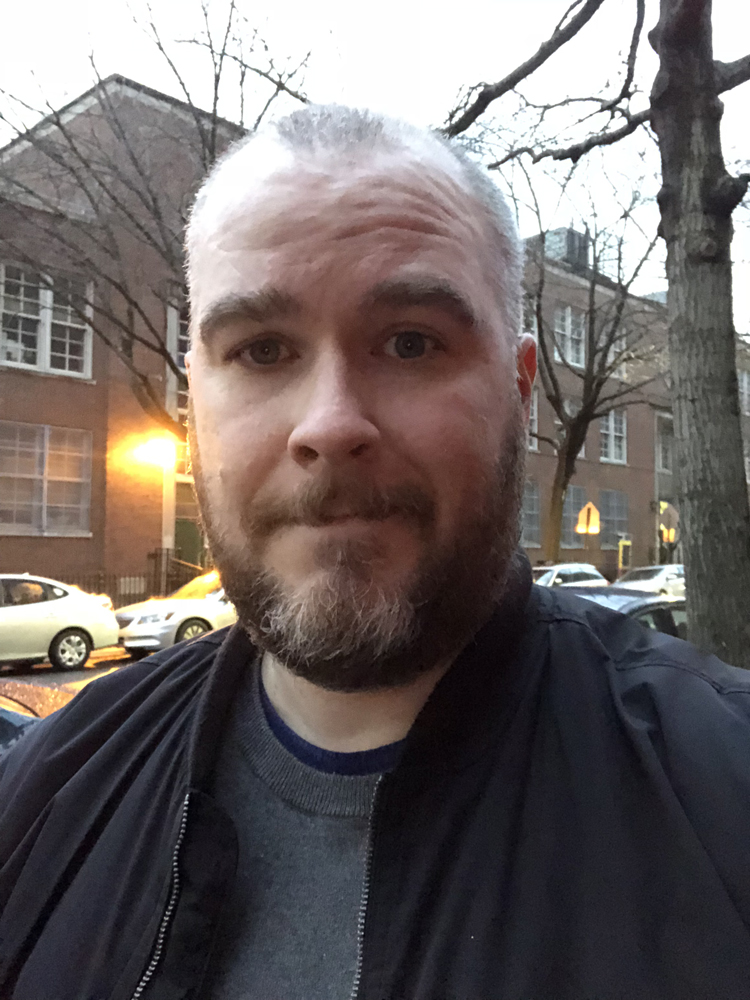
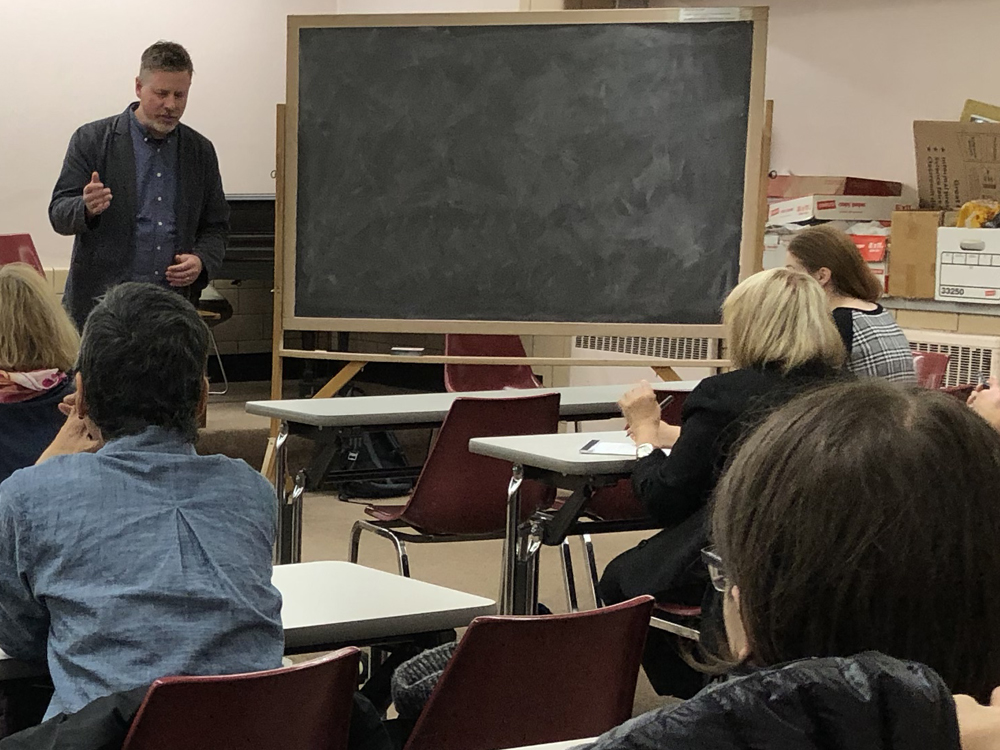
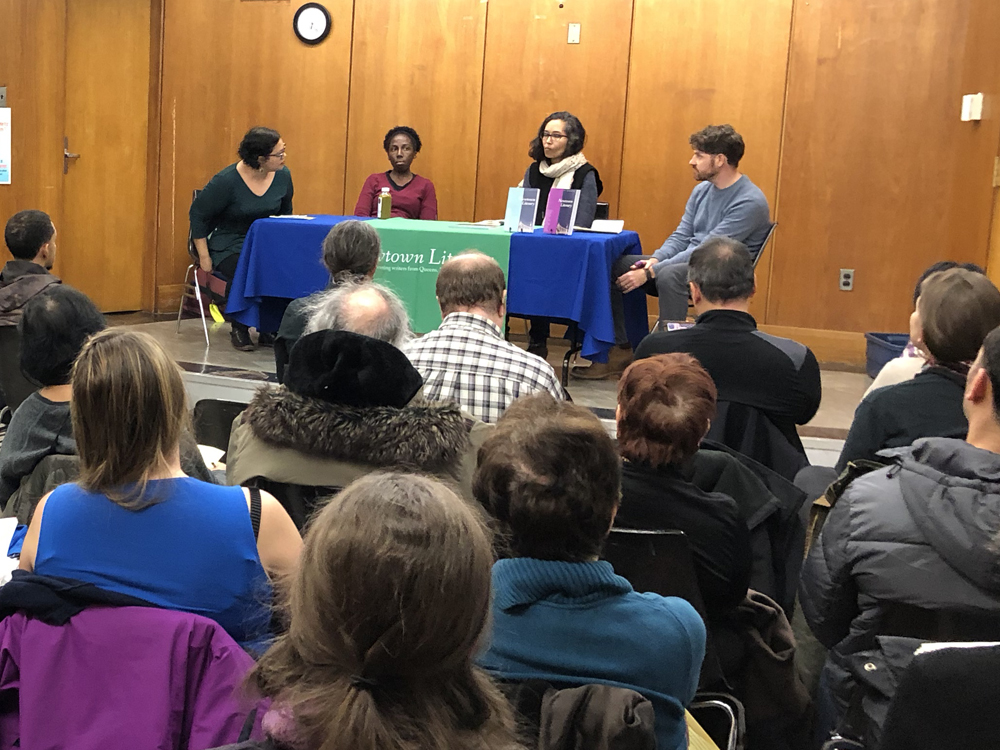
Photos: (top) Tim Fredrick (Credit: Tim Fredrick). (middle) Writer’s Block class led by Scott Cheshire (Credit: Newtown Literary). (bottom) Get Published panel (Credit: Newtown Literary).

I Have a Time Machine

Caption: 

Brenda Shaughnessy reads her poem “I Have a Time Machine” and discusses the role that poetry can play in recovering from traumatic experiences for a TEDx event at Harvard University. Shaughnessy is the author of Our Andromeda (Copper Canyon Press, 2012) and So Much Synth (Copper Canyon Press, 2016).

Genre: 

Tom Rachman

Caption: 

“Reading is an opportunity to see little aspects of the world and different periods that you can never access yourself...” Tom Rachman talks about how his literary inspirations, such as Dickens, Tolstoy, Virginia Woolf, and George Orwell, have evolved over the years. Rachman’s third novel, The Italian Teacher (Viking, 2018), is featured in Page One in the March/April issue of Poets & Writers Magazine.

Genre: 

Poets Speak With Bianca Stone

Caption: 

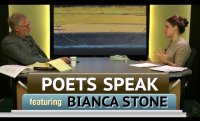
Bianca Stone talks to Vermont poet laureate Chard deNiord for Poets Speak about her poetry, life with her family in Vermont, and her work restoring the house of her late grandmother, poet Ruth Stone. Bianca Stone’s third poetry collection, The Möbius Strip Club of Grief (Tin House Books, 2018), is featured in Page One in the March/April issue of Poets & Writers Magazine.

Genre: 

David Tomas Martinez

Caption: 

David Tomas Martinez reads his poem “Hoodies” accompanied by musicians David Cieri and Mike Brown for the Gavagai music and reading series at Cornelia Street Café in New York City. Martinez is the author of Hustle (Sarabande Books, 2014) and Post Traumatic Hood Disorder (Sarabande Books, 2018), which is featured in Page One in the March/April issue of Poets & Writers Magazine.

Genre: 

The AfroSurreal Writers Workshop on Creative Community

Rochelle Spencer, founder of the AfroSurreal Writers Workshop, which meets monthly in Oakland, writes about the genesis of the workshop and an event with P&W–supported fiction writer Learkana Chong. Spencer’s book AfroSurrealism: The African Diaspora’s Surrealist Fiction is forthcoming from Taylor & Francis in July, and she is the coeditor of the anthology STEAM: Women on the Intersections of Science and Art with Jina Ortiz and Manjula Menon.

The AfroSurreal Writers Workshop—Audrey T. Williams, Thaddeus Howze, Dera R. Williams, Kelechi Ubozoh, Rochelle Robinson, Peter A. McKay, and Shannon Holbrook—were just a bunch of nerdy black folks who met at Oakland’s African American Museum and Library eager to discuss books and writing.

We meet monthly and aim to support writers of color creating weird, surreal, or absurdist art, and celebrate all people, including senior citizens, religious and ethnic minorities, people with disabilities, the LGBITQ communities, members of poor and working class neighborhoods, and of course, people of color.

Bay Area writers support each other, and we were encouraged by Gina Goldblatt, director of the Liminal Center, Manjula Menon and Meg Hayertz from the Surreal Women Writers Group, J. K. Fowler’s Nomadic Press, Vernon Keeve III and MK Chavez from the Association of Black and Brown Writers, and the Emergent Strategy (AK Press, 2017) reading group organized by Audrey T. Williams and Aryeh Shell—all of which either came out to our readings or provided space for us to talk and develop ideas. The Bay Area is the kind of place where literary community matters.
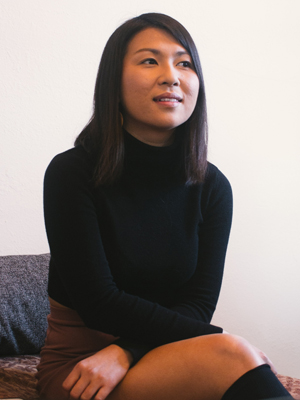
In the spirit of this tradition, with sponsorship from the Poets & Writers’ Readings & Workshops program, the AfroSurreal Writers hosted fiction writer Learkana Chong, along with Dera R. Williams and Shannon Holbrook, for a few hours of writing, AfroSurreal games, and vegetarian soul food last November.

Chong, who has a blog called lampshade on her head, enjoys seeing a live audience respond to her work. “I don’t get to experience that very often as a writer—usually I have to ask someone after I share something online what their thoughts were, and the response isn’t as exciting or visceral. Seeing and hearing people laugh at all the right parts reassured me that my story resonated the way I hoped it would.”

Williams describes sharing her work as empowering: “The reception to my work made me realize that I’m on the right path. I think people are interested in learning about different facets of Oakland and how the past has shaped—and is still shaping—Oakland. Working with the Emergent Strategy group, something came to me, and I decided to reclaim my space in Oakland. I was raised here and came here when I was two years old. This has been my life so I’m reclaiming it.”

In addition to the readings, there was a poem-generating game. “Playing games” recounts Holbrook, a speculative fiction writer who led attendees in the game, “is part of natural human interaction—it’s how we get to know each other from our earliest stage of development. Play is essential. We’re there to support each other creatively.”

“It’s incredibly gratifying to hear feedback from people who tell me they can relate to what I’ve written,” Chong says. “Or that they can vividly picture the narrative as it unfolds, or that the story tugged at their heartstrings or got them to think in some way. It affirms there is a place in the world for my storytelling after all, and that’s one of the best feelings to have as a writer.”

Support for Readings & Workshops in California is provided by the California Arts Council, a state agency, and the National Endowment for the Arts, a federal agency. Additional support comes from the Friends of Poets & Writers.

Photo: Learkana Chong (Credit: Laneè Mecca Woodard).

Self-Portrait as Slinky

Caption: 

In this video, Tarfia Faizullah reads her poem “Self-Portrait as Slinky” for the Brooklyn Poets Reading Series. Faizullah is the author of Seam (Southern Illinois University Press, 2014) and Registers of Illuminated Villages (Graywolf Press, 2018), which is featured in Page One in the March/April issue of Poets & Writers Magazine.

Genre: 

Maggie O’Farrell

Caption: 

“Everything you live through changes you, inevitably, and I think as you change, your writing changes.” Maggie O’Farrell speaks about receiving Specsavers Bestseller Awards for four of her novels, including The Vanishing Act of Esme Lennox (Houghton Mifflin Harcourt, 2007), and how she has evolved as a writer. O’Farrell’s debut memoir, I Am, I Am, I Am: Seventeen Brushes With Death (Knopf, 2018), is featured in Page One in the March/April issue of Poets & Writers Magazine.

Pages

Subscribe to Poets & Writers RSS