Awards Season

4.29.21

The ninety-third Academy Awards, also known as the Oscars, took place in Los Angeles this past Sunday, a celebration of the artistic and technical merits of this past year’s films. Known for its many snubs, scandals, and dramatic speeches, the annual awards ceremony is viewed by millions of people around the world and often features some of the most iconic pop culture moments in history. Write an essay that features an iconic moment from an awards ceremony that has stayed with you. What was happening in your life during that time, and what relationship do you have to that pop culture memory?

How Houston Leads the Way

Hey mi gente, I hope that you are well and reaching all your goals or if you have stumbled along the way, I wish you the strength to get back up. My last blog post was the last interview for the COVID Vivid series, in which I asked Houston writers what they’ve been doing since the pandemic started. I want to send a major thank you to everyone that participated in the series and shared their very personal experiences. I hope everybody who reads this blog has been able to benefit from these entries.

I will be switching gears as my time as literary outreach coordinator draws to a close. I’ll be focusing these last few posts highlighting all the ways that the literary experience in Houston points to the future. There are so many brilliant opportunities happening it’s hard to count. Each of these last posts will focus in on one or two (or three) things happening in the city.

While discussing the need to highlight major happenings in poetry during the month of April with Readings & Workshops program coordinator Ricardo Hernandez, I was reminded about what makes Houston such a brilliant place. I mentioned that I wondered why the Houston Poetry Fest happens in October when National Poetry Month is in April, and of course it should have made sense to me already—the Houston Poetry Fest predates National Poetry Month by a decade.

Established in 1985, the festival is held at our University of Houston-Downtown campus and is free and open to the public. There are readings and panels, and off-site events throughout the city to attend. Sadly, the festival had to be canceled last year due to the pandemic, but we hope to celebrate this October, which would mark the annual event’s thirty-sixth anniversary.

Continuing this celebratory vibe, I’d like to send congrats to Adriana Salazar who received a United States of Writing Project Grant from Poets & Writers for her upcoming workshop series. Salazar’s “Examining Oneself Through Self Portraits” will look at the building blocks of identity, examining the self both as a collective and as individuals using self-portraits to create new works. The three-part virtual workshop series will be in collaboration with fellow grantee Omer Ahmed and starts in May so keep an eye out in the Literary Events Calendar for more details.

Last but not least, major shout-out to the fifth and newest Houston poet laureate, Emanuelee “Outspoken” Bean! Bean’s two-year term began this month and runs through April 2023. As poet laureate, he will work closely with the Houston Public Library and the Mayor’s Office of Cultural Affairs to implement his community outreach project “Space City Mixtape,” an album of twenty-track spoken word and creative audio experiences by Houstonians. He will also conduct eight workshops in Houston’s public libraries, and create videos and poems to share on social media. Looking forward to seeing his work and events in the city.

Lupe Mendez is the literary outreach coordinator for Poets & Writers in Houston. Contact him at [email protected] or on Twitter, @houstonpworg.

Humor

4.28.21

“How can I repackage the initial premise of a joke in more colorful wrapping and offer it up to the reader as something brand-new?” writes Kristen Arnett in her first Craft Capsule essay on humor in fiction. In the essay she remembers a scene in Rebecca Dinerstein Knight’s novel Hex (Viking, 2020), in which the unexpected delivery of a mattress alters the activities of a dinner party. Arnett reflects on the use of the mattress in the scene and concludes that “when considering how humor can sit inside fiction, perhaps imagine it as the same strange and unexpected body wearing different disguises to a costume event.” Write a story in which an unexpected object inserts mischief and humor into the otherwise mundane lives of the protagonists.

Up to Astonishment

Caption: 

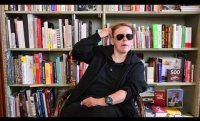
“To me all good poetry is experimental in some way,” says poet Susan Howe in this film about Emily Dickinson by poet and filmmaker Benita Raphan, filmed on location at the Morgan Library & Museum and the American Museum of Natural History in New York City. Raphan, a Guggenheim fellow known for her short experimental films, died at the age of fifty-eight on January 10, 2021.

Cinemascope

4.27.21

“In times of crisis, we must all decide again and again whom we love,” writes Frank O’Hara in his poem “To the Film Industry in Crisis,” in which the Beat poet writes an ode to his favorite movie stars and the magic of movies. Listing thirty actors from the Golden Age of Hollywood in relationship to one another, O’Hara describes, with humor, their personalities and appeal on the movie screen. “Mae West in a furry sled, / her bordello radiance and bland remarks, Rudolph Valentino of the moon, / its crushing passions, and moonlike, too, the gentle Norma Shearer,” he writes. Write an ode to your favorite movie or movie star. How can you employ techniques often seen on the screen through the language of the poem?

Rachel Cusk on Discipline in Writing

Caption: 

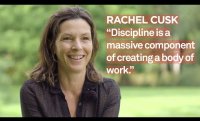
“Discipline is a massive component of creating a body of work, and the further I get, the more I see that that really is true,” says Rachel Cusk in this 2019 interview with Tonny Vorm at the Louisiana Museum of Modern Art in Denmark. Cusk’s novel Second Place (Farrar, Straus and Giroux, 2021) is featured in Page One in the May/June issue of Poets & Writers Magazine.

Genre: 

A Reading With Lilly Dancyger, Gina Frangello, and Jeannine Ouellette

Caption: 

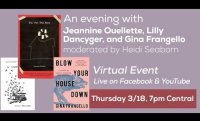
In this virtual reading hosted by Magers & Quinn Booksellers, authors Lilly Dancyger, Gina Frangello, and Jeannine Ouellette read from their memoirs and discuss the similarities between their writing processes. Dancyger’s Negative Space (Santa Fe Writers Project, 2021) and Frangello’s Blow Your House Down: A Story of Family, Feminism, and Treason (Counterpoint Press, 2021) are featured in Page One in the May/June issue of Poets & Writers Magazine.

Italics

4.22.21

“I love italics. They make me feel as if the author is whispering tremulous secrets to me,” writes Susan Stinson in her Craft Capsule essay “In Praise of Italics.” In the spirited and humorous essay, Stinson writes about all the different kinds of italics used in literature—from descriptions in Herman Melville’s Moby-Dick to epigraphs to the poetry of Adrienne Rich—arguing that the queerness of italics “is both in the way it looks—that tilt—and in how it brings attention to that which gets set aside.” Write an essay that explores your favorite aspect of the written word. Whether it be specific punctuation, a particular syntactical structure, or a grammatical mood, write about what excites you and why.

Pages

Subscribe to Poets & Writers RSS