Italics

4.22.21

“I love italics. They make me feel as if the author is whispering tremulous secrets to me,” writes Susan Stinson in her Craft Capsule essay “In Praise of Italics.” In the spirited and humorous essay, Stinson writes about all the different kinds of italics used in literature—from descriptions in Herman Melville’s Moby-Dick to epigraphs to the poetry of Adrienne Rich—arguing that the queerness of italics “is both in the way it looks—that tilt—and in how it brings attention to that which gets set aside.” Write an essay that explores your favorite aspect of the written word. Whether it be specific punctuation, a particular syntactical structure, or a grammatical mood, write about what excites you and why.

Crushed Marigold

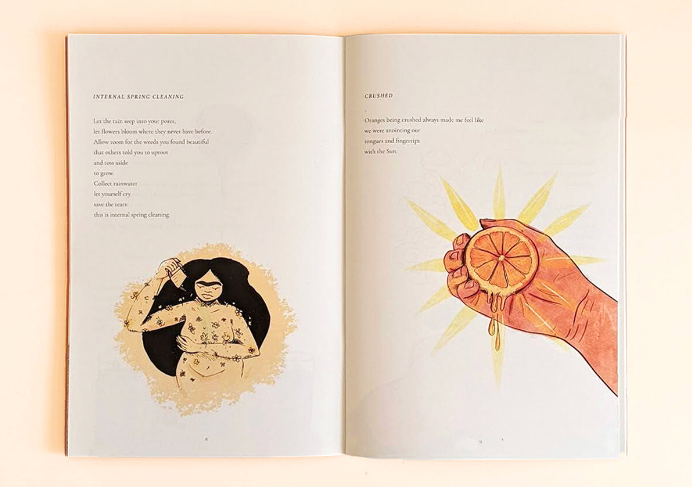
I am excited to share my thoughts after reading Christiana Castillo’s poetry chapbook, Crushed Marigold, illustrated by and Karla Rosas and published by Flower Press, a Detroit-based publishing practice centering womxn, femme, queer, and trans artists. Castillo is a Latina/Chicana poet, teaching artist, and gardener born in Rio de Janeiro, Brasil and living in the Detroit area. She is the recipient of fellowships from Room Project, Voices of Our Nation (VONA), and Disquiet International.

Castillo joined the Writing in Detroit virtual reading last October, sponsored by Poets & Writers, which offered an inspiring insight to her writing style and bright imagery. Crushed Marigold further expounds upon her writing with colors and textures juxtaposed against the theme of brown skin. In addition, the warm illustrations by artist Karla Rosas throughout the book leave the reader wondering what world we will be pulled into next with each poem.

A favorite poem of mine from Castillo’s collection is “Questions for the Moon,” which asks: “Does the Moon practice self care? / Does she have the time? / I know she controls the / tides / and the water within / us all / but / can she control herself?” The poem gently personifies the moon in a way that opens the reader’s mind to consider how the world around us not only responds to us, but how it responds to itself. The entire collection made me reconsider how we interact with the everyday aspects of our own cultures.

This collection also leaves me with a feeling of hope and perseverance with couplets like “in the midst of decay / there are always more seeds sprouting.” While Castillo touches on heavier topics such as colonization, there is always a sense of moving forward, of growth, of survival.

Crushed Marigold is available at Flower Press’s website and a percentage of the proceeds goes to American Indian Health and Family Services in Michigan, and Kooyrigs, an organization that provides resources to Armenian communities worldwide.

Photo: An open page of Crushed Marigold by Christiana Castillo, illustrated by Karla Rosas.
 
Justin Rogers is the literary outreach coordinator for Poets & Writers in Detroit. Contact him at [email protected] or on Twitter, @Detroitpworg.

Situation 5

Caption: 

In “Situation 5,” a short film by Jackson Prize–winning poet Claudia Rankine and photographer John Lucas, a history of racial oppression forms the backdrop to a lyrical meditation on racism, imprisonment, and identity. “My brothers are notorious. Though they have not been to prison, they have been imprisoned. But the prison is not a place you enter. It is no place.”

Genre: 

Big Bad Wolf

4.21.21

“First, grant me my sense of history,” writes Agha Shahid Ali in his poem “The Wolf’s Postscript to ‘Little Red Riding Hood’” in which he reimagines the classic fairy tale from the perspective of the story’s villain. “And then grant me my generous sense of plot: / Couldn't I have gobbled her up / right there in the jungle?” The poem offers a complicated portrait of the “Big Bad Wolf,” including disturbing confessions and provocative questions that reexamine this allegory and consider the power of perspective in storytelling. Write a story that explores the perspective of a villain in a children’s story you know well. What new information will you include about this character? What, perhaps, was left out of the story?

Lunch Poems With Arthur Sze

Caption: 

“Revelation never comes as a fern uncoiling / a frond in mist; it comes when I trip on a root, / slap a mosquito on my arm,” reads Arthur Sze from his poem "Earthshine" in this 2008 video for the Lunch Poems reading series at the University of California, Berkeley. Sze’s latest collection, The Glass Constellation: New and Collected Poems (Copper Canyon Press, 2021), is featured in Page One in the May/June issue of Poets & Writers Magazine.

Genre: 

Ghazal

4.20.21

Kayleb Rae Candrilli’s poem “Ghazal Connected as Though Cargo Freights,” winner of Winning Writers’ Tom Howard/Margaret Reid Poetry Contest for traditional verse, uses the Persian poetic form as a way of capturing the landscape in which the speaker grew up as a trans child while balancing the taut music of the line with a narrative propulsion that grounds the story. The ghazal, which originated in seventh-century Arabia, consists of at least five couplets that are structurally autonomous—the first stanza ending both lines with the same word and each stanza that follows repeating the same word at the end of the second line. This week, write a ghazal that explores your childhood. For more guidance on the history of the form and to read examples, visit the Poetry Foundation’s glossary entry on the ghazal.

Life of a Poet: Diane Seuss

Caption: 

In this 2019 video, Diane Seuss reads from her books of poetry and speaks about her writing with Washington Post’s Ron Charles at Hill Center in Washington, D.C. for a series hosted by the Poetry and Literature Center at the Library of Congress. Seuss’s essay “Restless Herd: Some Thoughts on Order—In Poetry, In Life” appears in the May/June issue of Poets & Writers Magazine.

Genre: 

Cadence: Video Poetry Festival

Caption: 

Watch this trailer for the Cadence: Video Poetry Festival, presented by Northwest Film Forum and programmed in collaboration with Seattle author Chelsea Werner-Jatzke and artist Rana San. The annual festival is a series of screenings, workshops, and discussions on the genre of video poetry held during National Poetry Month in April. Read more about the Seattle literary scene in our Seattle City Guide written by E. J. Koh.

Writers Speak Wednesday With Elizabeth McCracken

Caption: 

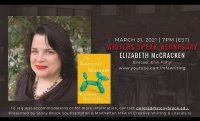
“It was sodden daylight. The rain had stopped, but she could hear water dripping off things.” In this Stony Brook University virtual event, Elizabeth McCracken reads from her new story collection, The Souvenir Museum (Ecco, 2021), which is featured in Page One in the May/June issue of Poets & Writers Magazine.

Genre: 

Rovering

4.15.21

Last summer a ten-minute video released by ElderFox Documentaries, a YouTube channel devoted to space exploration, went viral as users responded to its remastered and stitched-together images of the planet Mars, rendered in 4K resolution and captured by NASA’s high-tech rovers. What has been described as “the most lifelike experience of being on Mars” includes clear panoramas of the planet’s landscape—including the Gale crater, Cape Verde, the Santa Maria crater, and the entrance to the Marathon Valley, all named by NASA for their distinctive spaces, color schemes, and geological properties—as well as evidence pointing to possible signs of life. Using the landscape of Mars as inspiration, write an essay exploring uncharted territory from your past. Consider writing short vignettes that mimic the cut-and-paste techniques employed in the video.

Pages

Subscribe to Poets & Writers RSS