Quotable

In C. K. Williams’s poem “Marina,” published in the New Yorker in 2005, the speaker is reading essays by Marina Tsvetaeva as a bug makes its way across the table. As the poem progresses, lines from Tsvetaeva’s essays are interlaced with descriptions of the bug dragging its transparent wings behind it, and the bug becomes a metaphor for her difficult life. “‘The soul is our capacity for pain.’ // When I breathe across it, / the bug squats, quakes, finally flies. / And couldn’t she have flown again, / again have been flown?” Write a poem involving lines from a writer you admire. Try, as Williams does, to elucidate or challenge the featured lines.
Rita Dove and Natasha Trethewey at Emory University

Caption: 

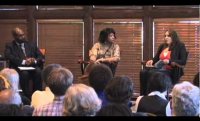
“When you’re judging a contest I’m looking for something to just knock me over, and that’s what happened when I read Natasha’s manuscript,” says Rita Dove about first encountering Natasha Trethewey’s poetry while judging a book contest. In this 2011 conversation at Emory University, the two former U.S. poets laureate discuss writing, mentorship, and literary ancestries. 

Genre: 

Dogfish Head Poetry Prize Open for Submissions

The deadline is approaching for the nineteenth annual Dogfish Head Poetry Prize, given for a book-length manuscript by a poet living in Delaware, Maine, Maryland, New Jersey, New York, North Carolina, Pennsylvania, Virginia, Washington, D.C., or West Virginia. Perfect for beer lovers, the award includes $500, publication by Broadkill River Press, 10 author copies, and two cases of Dogfish Head craft beer. The winner is expected to attend a reading and awards ceremony at the Dogfish Inn in Lewes, Delaware, on December 11. Lodging for a two-night stay at the inn is provided, but travel expenses are not included.

Submit a manuscript of 48 to 78 pages to [email protected] by August 15. Only writers over the age of 21 are eligible. Hayden Saunier will judge. There is no entry fee. Visit the website for complete guidelines.

The most recent recipient of the Dogfish Head Poetry Prize was Susan Rothbard, whose winning manuscript, Birds of New Jersey, was praised by Edgar Kunz, the final judge, as a “sometimes shocking, often bemused, and always insightful collection.”

Dickens vs. Tolstoy

Caption: 

In this 2018 Intelligence Squared video, a friendly and impassioned battle between nineteenth-century novelists Charles Dickens and Leo Tolstoy is carried out and argued by professor John Mullan and historian Simon Schama with readings by actors Zawe Ashton, Tom Hiddleston, Kit Kingsley, Julia Sawalha, and Timothy West.

Genre: 

Revision

7.29.21

“I had been thinking about this story for probably seven years before I drafted it,” says Sterling HolyWhiteMountain in an interview for Guernica’s Back Draft series about writing his short story “Featherweight,” which was recently published in the New Yorker. HolyWhiteMountain offers a glimpse into the first draft of the story’s opening paragraph and the final draft, and discusses his revision process for his story revolving around the breakup of a relationship. Write an essay that uses revision as a theme. Perhaps you might revise a family story you’ve been told, or consider different points of view of a memorable event. What will you leave out, and what will you add?

2021 Booker Prize Longlist

Caption: 

“Reading during lockdown created a really powerful sense of connection with the books.” In this video, Maya Jasanoff, chair of the judges for the 2021 Booker Prize, speaks about the “deliberate quality” of the thirteen longlisted titles, which include Second Place by Rachel Cusk, Klara and the Sun by Kazuo Ishiguro, and Bewilderment by Richard Powers.

Genre: 

Influencer

7.28.21

In an interview for the Creative Independent, Jackie Ess discusses how an Instagram account with nature photos started by her partner inspired the titular character of her debut novel, Darryl (Clash Books, 2021). “I started a Twitter account for Darryl,” she says. “I would do these little monologues as Darryl, and I think you see that the chapters are a little bit like Twitter threads.” This week, write a story with a protagonist inspired by a social media presence. Whether it be an influencer or somebody’s dad, how will their virtual mask fold into the conflict of the story?

Pages

Subscribe to Poets & Writers RSS