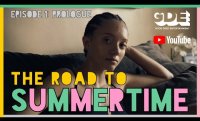
Summertime

Caption: 

“These poets really took me on a journey. Through each of their poems you got to essentially travel across L.A. into different neighborhoods, into different people’s spaces,” says director Carlos López Estrada about meeting the twenty-seven spoken word poets from the nonprofit Get Lit who cowrote and are featured in his new film, Summertime.

Paean to Place

In an interview for the Rumpus, Musa Okwonga, author of In the End, It Was All About Love, (Rough Trade, 2021), discusses the use of magical realism to address the complicated history of his book’s setting, Berlin. “I wanted the readers to sink into a place that unmoored them somewhat, I wanted to untether them from reality and be like, this is deeply surreal but also entirely real,” says Okwonga. Choose a city you have a deep connection with and write an essay that contends with its history, both personal and global, through a mythical or surreal lens. Try experimenting with form to bring attention to the complexity of the city’s history.

Stavros Niarchos Foundation Library

Caption: 

“It’s all about providing access, not only to education, not only to learning, but also to a free public space where people can actually come together and engage,” says copresident Andreas Dracopoulos of the newly renovated and transformed Stavros Niarchos Foundation Library, a branch of the New York Public Library in Midtown Manhattan that reopened in June.

Mythical Beast

In this week’s installment of Ten Questions, author Pajtim Statovci and translator David Hackston discuss the writing of Bolla (Pantheon, 2021), a novel with an unlikely love story set in Kosovo between two young men at the outbreak of a war. The novel’s title comes from the name of a demonic serpent that remains in a dark cave hidden from humans except for one day every year when it transforms into a dragon and is released, wreaking havoc and destruction. Through this legend, Statovci gives the love story a shape, as their conflict is refracted through the metamorphosis of this mythical dragon. Think of a fable from your childhood and consider ways you could use it as inspiration for your own story—as a template for your plotline, as a metaphor for your character’s conflict, or as a way to build the story’s setting.

The Other Black Girl

Caption: 

“I wrote this book for Black women who’ve been in those workspaces, but really anyone who’s been an other in these kind of spaces.” In this video, Zakiya Dalila Harris speaks about her debut novel, The Other Black Girl (Atria Books, 2021), and how her characters navigate through workplace politics with Robin Roberts for Good Morning America. Harris is featured in “First Fiction 2021” in the July/August issue of Poets & Writers Magazine.

Genre: 

Fourteen Lines

The sonnet form dates back to thirteenth- and fourteenth-century Italy where it was popularized by the poet Petrarch, whose work was translated and introduced in the sixteenth century to English poets. A new type of sonnet with a different rhyme scheme was then developed and made famous through the work of William Shakespeare. Poets such as Wanda Coleman, Diane Seuss, and Terrance Hayes have given voice to the more contemporary “American” sonnet, demonstrating the flexibility of the fourteen-line form. This week, write your own sonnet—either a traditional sonnet or one inspired by a contemporary poet.

Nine to Five

In a reading list published on Electric Literature, Elizabeth Gonzalez James, author of Mona at Sea (Santa Fe Writers Project, 2021), recommends stories about struggling under capitalism, such as Temporary by Hilary Leichter, The Fallback Plan by Leigh Stein, and And Then I Got Fired: One Transqueer’s Reflections on Grief, Unemployment & Inappropriate Jokes About Death by J Mase III. In introducing these books, Gonzalez James writes that “unemployment doesn’t actually make for great fiction” and that she is all the more impressed when writers express the experience well. Write an essay in which you discuss a time you struggled with employment. Peruse the list for ideas on how to do this in fresh and surprising ways.

Pages

Subscribe to Poets & Writers RSS