Alexis Pauline Gumbs and Tiya Miles

Caption: 

In this Library of Congress National Book Festival event, Alexis Pauline Gumbs, author of Survival Is a Promise: The Eternal Life of Audre Lorde (Farrar, Straus and Giroux, 2024), and Tiya Miles, author of Night Flyer: Harriet Tubman and the Faith Dreams of a Free People (Penguin Press, 2024), discuss their books in a conversation moderated by Martha S. Jones.

Documenting

In the documentary No Other Land, made by a Palestinian-Israeli collective of four directors over the course of five years, a group of Palestinian villages in the southern West Bank is overrun by the Israeli military as they raid and bulldoze homes while families are forced to witness the destruction. At a recent screening in New York, the filmmakers shared their thoughts in a written statement: “We as young activists offer this film to the world, which is both a document of a war crime happening now in the occupied West Bank, and a plea for a different future.” Write a personal essay that begins with recounting a recent significant event that you witnessed, noting as much granular detail as possible. If available, you might refer to photos or a paper trail to help you remember specifics. In addition to the event itself, reflect on your outlook after the event, documenting both for posterity’s sake.

Rejection Letter

The dreaded rejection letter, whether from a job application or a beloved literary journal, is often met with mixed feelings of inadequacy and disappointment. Something you worked hard on, had high hopes for, or saw a future in just didn’t pan out. Instead of imagining the receiving end, take the initiative to write a rejection letter to one of your characters. Consider the circumstance for the letter, if it’s professional or personal, and how well the writer knows the addressee. Is there room to infuse some humor or will you use this as an opportunity to write the letter you’ve always wished was sent to you? Write with truth and intent.

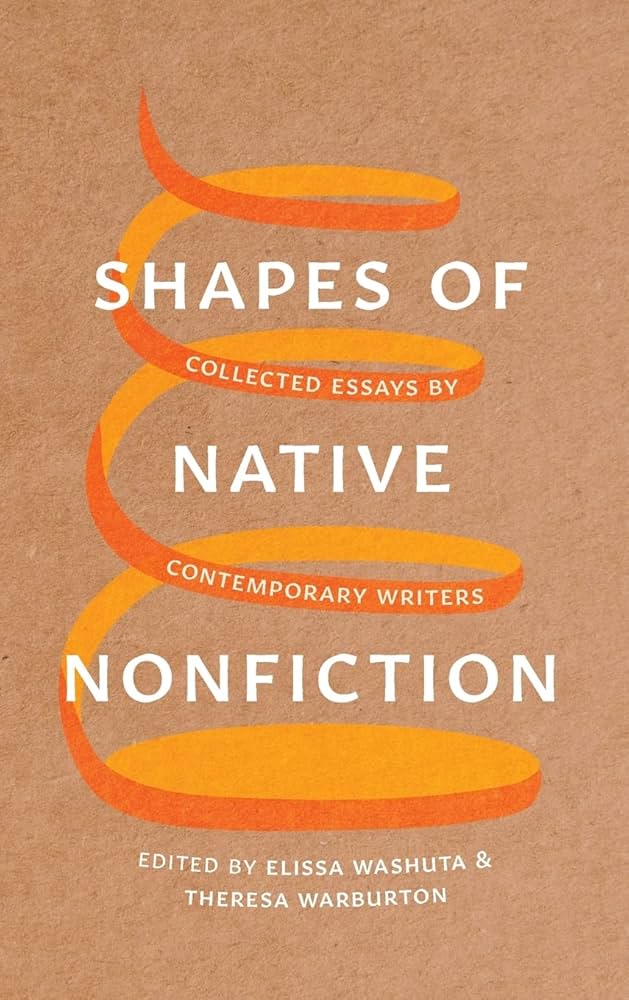
Shapes of Native Nonfiction: Collected Essays by Contemporary Writers

by
Author: 
Elissa Washuta and Theresa Warburton, editors
Published in 2019
by University of Washington Press

Editors Elissa Washuta and Theresa Warburton curate this collection of lyric essays by twenty-seven contemporary Native writers from tribal nations across Turtle Island, including Billy-Ray Belcourt, Stephen Graham Jones, Terese Marie Mailhot, Deborah Miranda, Eden Robinson, and Kim TallBear. Organized into basket-weaving themes such as “coiling” and “plaiting,” the essays challenge form and offer responses to broader questions of materiality, orality, spatiality, and temporality that affect the study and practice of Native literary traditions in North America. “For Native writers, who have long operated within a literary sphere in which most depictions of Native lives are created by non-Natives, nonfiction allows for a revision of the dominant cultural narratives that romanticize Native lives and immobilize Native emotional responses: the essay is the work of feeling and thinking,” write the editors in the introduction. “It is the flux of a character, not a frozen image of one.”

Something Missing

12.31.24

In her 2022 New York Times essay “The Shape of the Void: Toward a Definition of Poetry,” Elisa Gabbert writes about what makes language poetic. “I think poetry leaves something out,” she writes. “The missingness of poetry slows readers down, making them search for what can’t be found.” Write a poem that revolves around this idea of missingness and leaving something out. To facilitate a mindset of absence, you might choose a subject—a childhood memory, a relationship dynamic, a strange occurrence—that feels inherently cryptic, incoherent, or mysterious. Consider playing with line breaks, spacing, syntax, and diction, to make what’s absent hyper-present. How do the words on the page gesture toward the shape of what can’t be found?

Well Versed With Pádraig Ó Tuama

Caption: 

In this virtual reading from the Well Versed series hosted by StAnza, Scotland’s International Poetry Festival, and Open Book, Pádraig Ó Tuama reads from his collection Feed the Beast (Broken Sleep Books, 2022) and discusses the themes of place and nature within his poems. Ó Tuama’s fourth poetry collection, Kitchen Hymns (Copper Canyon Press, 2025), is featured in Page One in the January/February issue of Poets & Writers Magazine.

Genre: 

Sayaka Murata

Caption: 

In this 2022 Louisiana Channel interview, Japanese novelist Sayaka Murata talks about the imaginary worlds of her childhoood, her writing process involving character sketches, and the origin of her otherworldly stories. “My world of daydreams or the power of stories saved me, so I was able to survive. And this same strength is in my protagonists,” says Murata.

Genre: 

Mariana Enriquez and Megan McDowell

Caption: 

In this Center for Fiction event, author Mariana Enriquez talks about the supernatural themes and local Argentinian language and humor within her short story collection A Sunny Place for Shady People (Hogarth, 2024) with translator Megan McDowell in a conversation moderated by Melissa Lozada-Oliva.

Pages

Subscribe to Poets & Writers RSS