Winter of Our Discontent

1.22.25

“Now is the winter of our discontent / Made glorious summer by this sun of York; / And all the clouds that lour’d upon our house / In the deep bosom of the ocean buried.” In the soliloquy delivered by the title character in William Shakespeare’s play Richard III as he considers the outlook of his family’s reign, the “winter” refers to the lowest point of unhappy times. From this nadir, clouds will part and the sun will shine upon more fortunate circumstances. Taking inspiration from this metaphorical image, write a short story that begins with acknowledgment of a rock-bottom situation—a winter of sorts. What are the factors in place that convey to your characters that things can only go up from this moment forward?

In Real Life

1.21.25

Ariel Francisco’s poem “On the Shore of Lake Atitlán, Apparently I Ruined Breakfast,” published in the Academy of American Poets’ Poet-a-Day series, recounts a puckish remark which derails the upbeat mood of a meal with the speaker’s mother and aunt. Commenting about the poem, Francisco acknowledges his teenage immaturity returning to him as an adult on this trip to Guatemala, his mother’s homeland. “This poem tries to capture what I often do in real life: upend a beautiful moment with something flippant,” he says. This week write a poem that attempts to capture a tendency you have, perhaps one that you’ve been self-critical about in your life. Francisco’s poem strikes a lighthearted tone throughout, which you might decide to mirror, or you could magnify your behavior’s ultimate consequences for a dramatically darker note that turns unexpectedly bright.

Aria Aber: Good Girl

Caption: 

“I love when a character in a novel, or in a story, or even in a poem, experiences a sense of change that they cannot come back from.” In this Books Are Magic event, Aria Aber reads from her debut novel, Good Girl (Hogarth, 2025), and discusses themes of shame, self-destruction, and coming of age as an artist in a conversation with Leslie Jamison. For more from Aber, read her installment of our Ten Questions series.

Genre: 

In With the Old

1.16.25

During a time of year when many people are taking stock of the previous twelve months and preparing for new resolutions and fresh starts, take a brief contrarian turn and compose a personal essay that focuses on the well-trodden: old habits, die-hard routines, and tried-and-true tendencies. What are some things that you’d passionately never want to give up? Perhaps your essay is a compilation of a list of objects, behaviors, people, or traditions that have proven their worth over an extended period of time; or you might concentrate your essay on one specific subject, something dear you vow to hold onto. Are there trade-offs, sacrifices, or curiosities about the costs of keeping the old? How do you weigh any misgivings against your convictions?

Bobbitt Prize Winner Arthur Sze

Caption: 

“Poetry is our essential language, and it is as essential to me as breathing.” In this Library of Congress event, Arthur Sze accepts the 2024 Rebekah Bobbitt Johnson National Prize for Poetry for Lifetime Achievement, reads several poems from his career, and talks about his formal exploration of poetics in a conversation with Rob Casper.

Genre: 

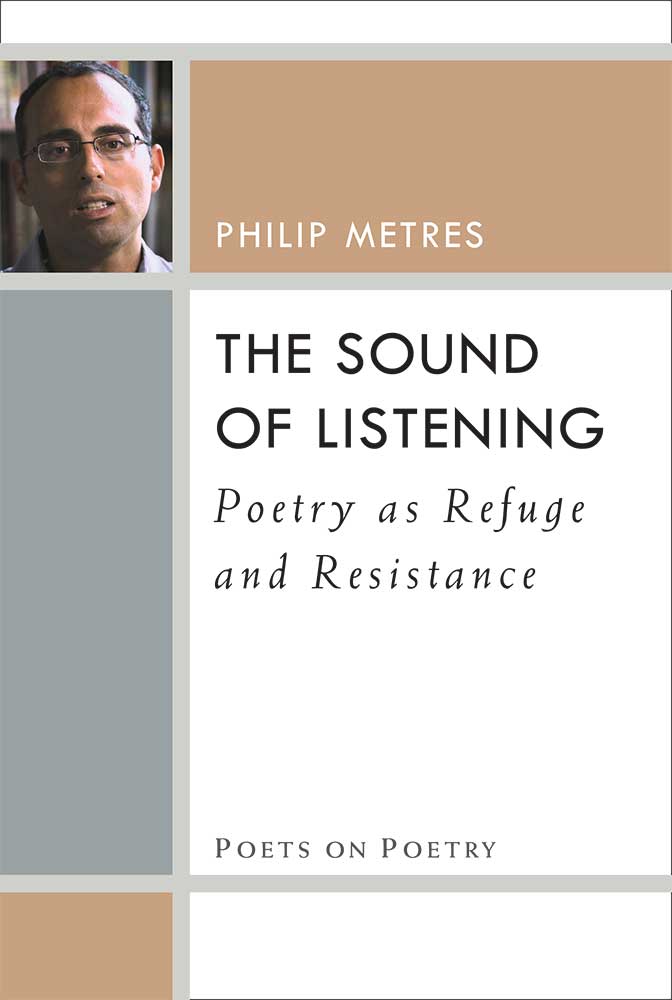
The Sound of Listening: Poetry as Refuge and Resistance

by
Author: 
Philip Metres
Published in 2018
by University of Michigan Press

“I am interested increasingly in poetry and the arts as a way of creating another life, of marking and embodying alternative ways of being and living,” writes Philip Metres in the introduction to this collection which gathers a decade of his writing on poetry. The book provides a historical context to poetry as resistance and explores subjects ranging from post-9/11 writing, to landscape and peace poetry, to personal examinations of poets such as Khalil Gibran, Adrienne Rich, and Lev Rubinstein. Writers will be inspired by Metres’s insightful questions and his expansive view of the different ways poetry has served as a tool for both challenging injustice and healing.  

Real Horrors

1.15.25

In the film Nightbitch, an adaptation of Rachel Yoder’s 2021 novel of the same name directed by Marielle Heller, a new mother contends with the growing feeling of being trapped in domestic caretaking, having left her job and put aside her pursuits as a visual artist in order to stay at home and take care of her small toddler. With her husband away for work, the repetitiveness, exhaustion, and difficulties of motherhood take a surreal turn, as her instincts begin to manifest in canine form. Write a short story that begins similarly with the acknowledgment of an element of horror in something very mundane and common, perhaps an aspect of a relationship, a job, or milestone that isn’t often depicted in gory detail or a negative light. You might find that adding a touch of fantasy or dark comedy will help illuminate your perspective.

A Mind of Winter

1.14.25

“One must have a mind of winter,” begins Wallace Stevens’s 1921 poem “The Snow Man,” which moves from describing iconically icy and desolate imagery of winter—“the pine-trees crusted with snow,” “the junipers shagged with ice”—to pointing out the human beholder’s subjectivity as the agent who projects this wintry outlook. This week, write a poem that takes inspiration from Stevens’s first line and explore what it means to you to have “a mind of winter.” Does it entail nothingness, quietude, withholding, generosity, cheer, beauty, love? How does your selection of seasonal associations determine your poem’s tonal direction? You might even experiment with approaching this prompt more than once, when your mood about the season feels distinctively different.

Pages

Subscribe to Poets & Writers RSS