Why We Love Books

Caption:
“A book to me is an escape into a different world.” For National Book Lovers Day, here are some booksellers from Waterstones in the U.K. expressing their love of books.
Jump to navigation Skip to content
“A book to me is an escape into a different world.” For National Book Lovers Day, here are some booksellers from Waterstones in the U.K. expressing their love of books.
Cargo shorts, which rose to popularity in the 1990s, have recently sparked heated opinions and reignited the debate of whether the fashion item should exist. Is there a particular style or article of clothing you have grown so attached to over the years that you refuse to part with regardless of new trends or the disapproval of loved ones? Write a poem inspired by the comforts of dressing in a familiar way. Include reminiscences about well-worn and long-cherished items from your wardrobe, and the people and events associated with them.
Virginia Bell is the author of the poetry collection, From the Belly (Sibling Rivalry Press 2012). She has been a Pushcart Prize nominee and a finalist for both the Lamar York Prize in Creative Nonfiction, sponsored by the Chattahoochee Review, and the Center for Women Writers’ Creative Nonfiction Contest. Her work is forthcoming in Hypertext Magazine and has appeared in Fifth Wednesday Journal, Cider Press Review, Gargoyle Magazine, Spoon River Poetry Review, Cloudbank, CALYX, Poet Lore, Pebble Lake Review, Wicked Alice, and other journals and anthologies. Bell is a senior editor at RHINO Poetry, and an adjunct professor at Loyola University Chicago and DePaul University. This fall, she is joining the faculty in the Creative Writing Conservatory at the Chicago High School for the Arts. She has a PhD in Comparative Literature and was the recipient of a Ragdale Foundation residency in 2015.
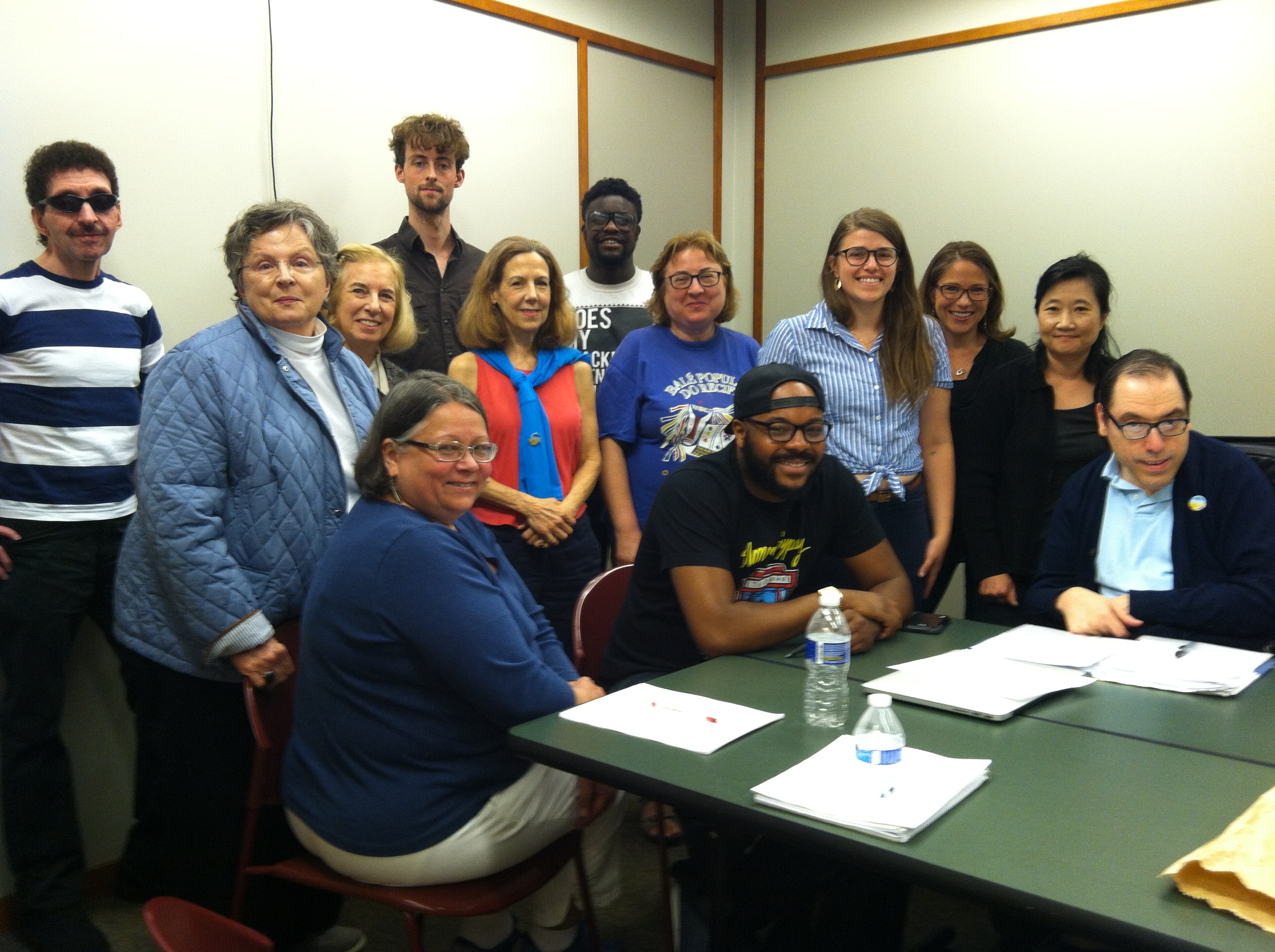
On June 5, 2016 at 1:30 PM, in a meeting room at the Evanston Public Library, poet Nate Marshall asked the thirteen poetry workshop participants to share their favorite words. The answers ranged from the minimalist “tin” to the Portuguese word for tenderness, “ternura,” and the vernacular “thing-a-ma-gig.” Marshall then spoke persuasively about the possibilities of using one’s own vernacular traditions, one’s own “slang,” in the production of a liberating poetic practice.
As the author of Wild Hundreds (University of Pittsburgh Press, 2014) and editor of The BreakBeat Poets: New American Poetry in the Age of Hip-Hop (Haymarket Books, 2015), Marshall described his own fascination with the word “finna,” as in “I’m finna go to the store,” a word that might translate as “fixing to” or “going to,” but that also carries the connotations of planning, intention, and agency. He then read one of his own poems that includes the word “finna.”
In the ensuing discussion, participants explored the difference between avoiding cliché or tired language on the one hand, and the personal and political energy derived from a contextually powerful deployment of vernacular words and phrases. There was also discussion of the idea that all humans, at any given time and place, practice and invent vernacular language, not just so-called “standard” language; in other words, emerging and changing vernacular traditions are a fundamental expression of human poetic creativity.
After this presentation and discussion, Marshall facilitated the peer critique of participants’ poems. Each participant circulated a poem, read it aloud, and then listened to the constructive feedback. Marshall led the group in a spirit of collaboration, with warmth, enthusiasm, and respect for diverse aesthetic practice, and wise suggestions for revision.
Indeed, RHINO has a long tradition of hosting poetry workshops in the spirit of collaboration. Founded in Evanston, Illinois in 1976 as a grassroots poetry workshop, RHINO began to publish an annual journal in 1978 to support the poetry community in Illinois. Since then, RHINO has become a nationally and internationally recognized journal of literature, publishing poems, flash fiction, and translations by new, emerging, and established writers. As an independent, all volunteer organization, RHINO continues to maintain an active local community presence, primarily through two programs: free monthly workshops led by accomplished poets and RHINO Reads!, a monthly reading series.
Other recent workshop leaders include Keith Leonard on “The Contemporary Ode,” Aricka Foreman on “Facing It: Memory, Melancholia and Waking,” and Cecilia Pinto on “Creating the World in Words: Poetry as Genesis.” Workshops are free and open to the public, and held on or near the fourth Sunday of the month, ten months a year.
Funding from Poets & Writers’ Readings & Workshops program has made this program a success! All the workshops are well attended and well received. Several adult participants are “regulars” who return month after month, while others may be attending the first poetry workshop of their lives. RHINO welcomes experienced and novice poets alike. In Dean Young’s terms, we like to encourage “the art of recklessness,” but in a supportive and informative environment. To find out about upcoming workshops and readings, how to host a RHINO reading in your area, how to donate to RHINO, and how to submit to the RHINO Poetry, please visit our website!
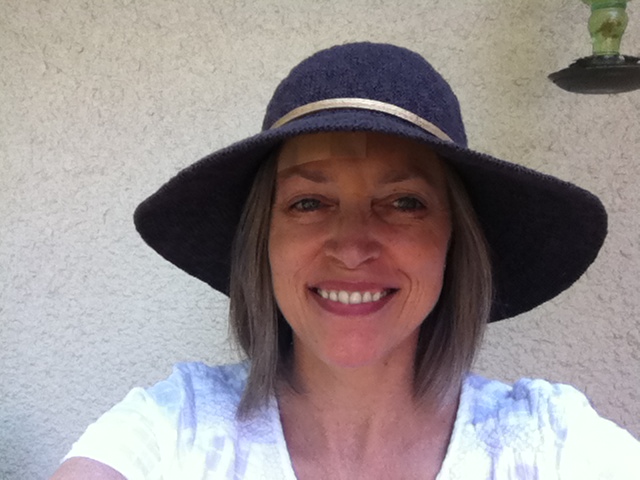
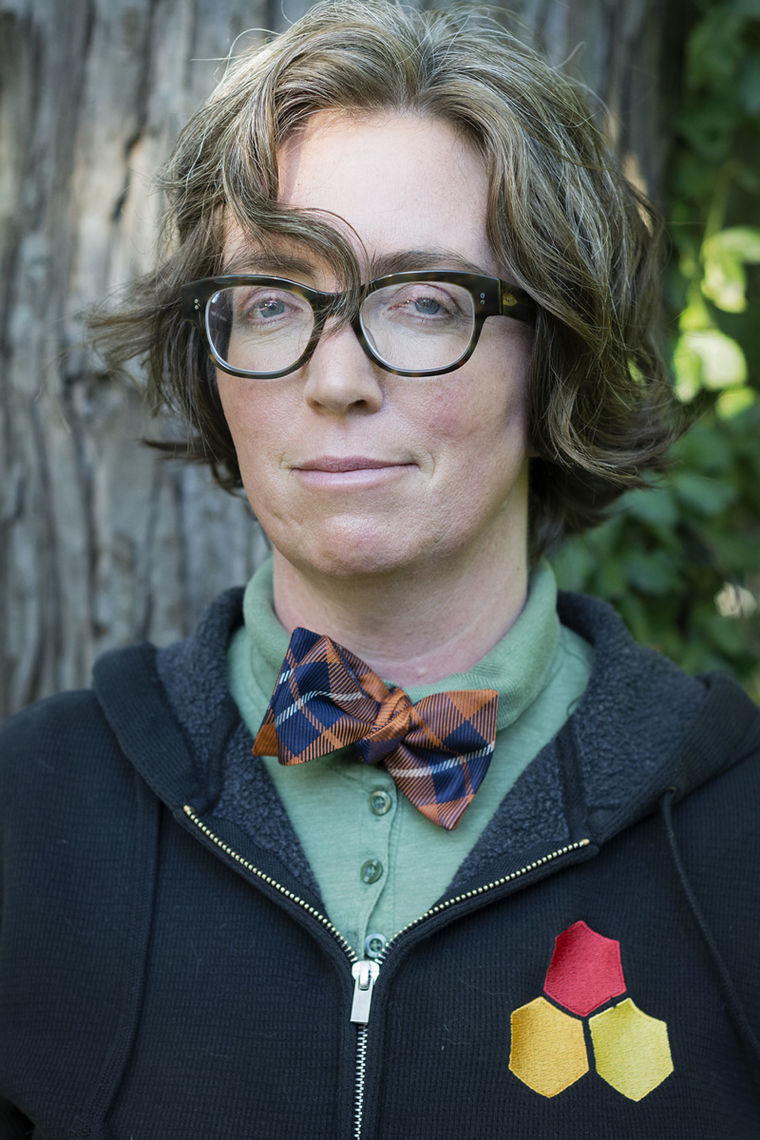
Photos: (top) Virginia Bell. (bottom) Nate Marshall with workshop participants. Photo credit: Virginia Bell
Support for Readings & Workshops events in Chicago is provided by an endowment established with generous contributions from the Poets & Writers Board of Directors and others. Additional support comes from the Friends of Poets & Writers.
Submissions are open for Radar Poetry’s Coniston Prize, given annually for a group of poems by a female poet. The winner receives $1,000 and publication in Radar. Gabrielle Calvocoressi will judge.
 Using the online submission system, submit three to six poems of any length with a $15 entry fee by September 1. The Radar editorial staff suggests that the poems should be “intentionally cohesive in some way, whether connected by subject matter, theme, voice, style, or imagery.” Ten finalists will be published along with the winner in the October issue of Radar. Visit the website for complete guidelines.
Judge Gabrielle Calvocoressi has published two poetry collections, Apocalyptic Swing Poems and The Last Time I Saw Amelia Earhart, both with Persea Books. Her third collection, Rocket Fantastic, is forthcoming. The senior poetry editor at the Los Angeles Review of Books, Calvocoressi teaches in the MFA program at Warren Wilson College and at the University of North Carolina in Chapel Hill.
Published quarterly, Radar is an online poetry journal focused on the “interplay between poetry and visual media.” Edited by Rachel Marie Patterson and Dara-Lyn Shrager, each issue of the journal pairs poetry with artwork.
Alexandra Lytton Regalado won last year’s prize, which was judged by Lynn Emanuel. Flower Conroy was selected for the 2014 prize by Mary Biddinger.
Photo: Gabrielle Calvocoressi
“You have to really free your mind from the word obligation.” During an event at the Center for Fiction, authors Francisco Goldman, Idra Novey, and Rivka Galchen answer questions from the audience about moving between fiction and other genres, which leads to a discussion about the importance of donuts.
Heat dome, corn sweat, thundersnow. Meteorologists and weather reports often coin new words and phrases for the purposes of both explaining and entertaining. Learn some new weather-related terminology, or create your own phrases that explain existing and made-up weather phenomena. Select one of these terms as the title of a poem, and allow it to guide your imagination as you write your lines. Do you end up with a poem that is somehow connected to meteorology, or does the title lead you toward a completely different direction?
“The first time I met him, I knew that I was in the presence of an extraordinary sensibility, an extraordinary mind, a profound soul.” University of Iowa Writers’ Workshop faculty member James Galvin reflects on the work and friendship of his colleague James Alan McPherson in this video from 2011. McPherson passed away on July 26 at the age of seventy-two.
Did this past winter seem to drag on interminably, while spring was over in the blink of an eye, and the summer months keep zipping on by? Sometimes days, weeks, and months feel like they pass at varying speeds, depending on factors such as the weather, travel obligations, school or work schedules, and personal tastes and moods. Write a poem that explores two or more distinctly paced periods of time that occurred in the past year or so. Manipulate the sound and rhythm of your language—as well as the expository or emotional content of your lines—to reflect the drag or rush of each period.
Estevan Azcona, PhD, is director of MECA Presents, the arts and residency program at Multicultural Education and Counseling Through the Arts (MECA) in Houston, Texas. A former curator for the National Performance Network's Performing Americas Program, he has also served on grant panels for organizations including the National Association for Latino Arts and Culture. Azcona is an ethnomusicologist by training and also serves as Music Director for MECA's AfterSchool Arts program. Below, he blogs about a P&W–supported reading that took place on April 7, 2016.
Multicultural Education and Counseling Through the Arts (MECA) is a Latino-based multicultural, multidisciplinary arts organization that has been serving low-income communities in Houston, Texas for almost forty years. Beginning in a local parish church to give "at risk" or "inner city'' neighborhood kids music, dance, and art classes after school and during the summer, MECA has since watched the inner loop of Houston change as gentrification played its part in the Sixth Ward neighborhood where the organization has always been located, as well as throughout the central part of the city, where it is becoming increasingly expensive to live. Instead of coming from down the block, or a mile or so away, families now bring their kids—some of them driving thirty minutes plus one way—to MECA from throughout the metropolitan area.
For some time now, Poets & Writers has been a welcome source of support for writers to come and read their work and give workshops to the kids, the families, and the public. Houston's first poet laureate, Gwendolyn Zepeda, is a MECA alumna from the Sixth Ward and has many times been central to bringing creative writing workshops to our students, with help from P&W, as have other local writers. As a predominantly performance and visual arts organization, this support has been critical in bringing letters into our programming.
In April of this year, we had the opportunity to present three Latina writers, each approaching their craft in different ways: local writer Jasminne Mendez is a powerhouse performance poet; Sarah Rafael García is a talented memoirist and youth writing advocate with her project, Barrio Writers; and Isabel Quintero is a gifted fiction writer who has recently garnered a lot of attention. We were lucky to have writer and poet, Edyka Chilomé, from Dallas, come to Houston to serve as emcee for the public reading.
When the authors came to us to do a project together, we were especially excited as the work of each of the writers eloquently addresses the experience of growing up and/or being Latina. While all youth from marginalized communities are challenged to have the opportunities other groups take for granted, at MECA we are not unaware of the obstacles for young women of color, and here was a great project to open the door for young Latinas to the work of these authors. Though we were concerned with turnout, as we do not often present writers, we had an audience of at least forty ready to hear the words and stories of this group of women, including a dozen or so youth who participated in the joint writing workshop. Virtually everyone stayed after the public reading to speak with the authors, buy books, and chat amongst themselves. And the sign was clear to MECA, do this again!
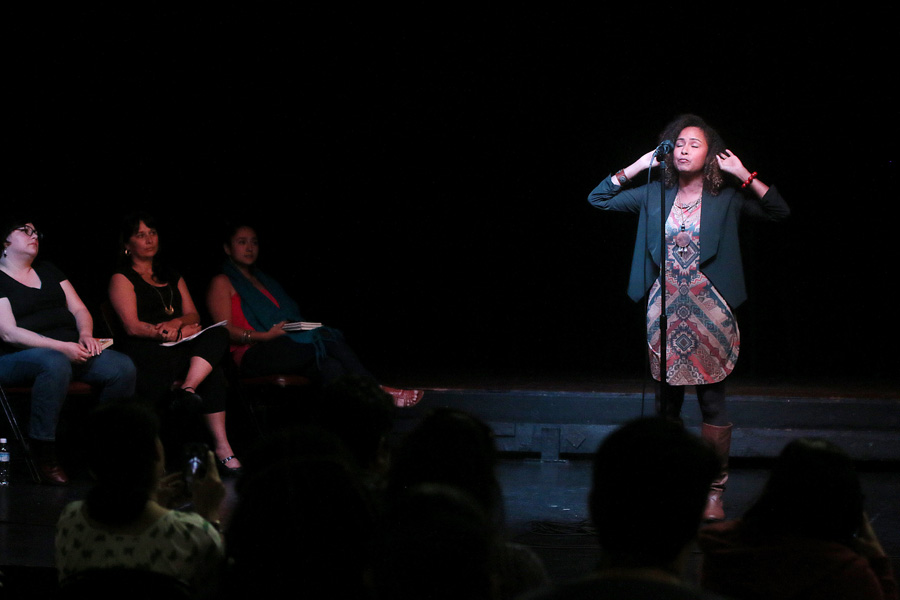
Photo: Jasminne Mendez. Photo credit: Pin Lim.
Support for Readings & Workshops events in Houston is provided by an endowment established with generous contributions from the Poets & Writers Board of Directors and others. Additional support comes from the Friends of Poets & Writers.
"Reading and writing allows us to be empathic. And without empathy, I think, our society would be at a total loss. I think in that way, writing can affect great change." Poets Nathaniel Mackey and Cathy Park Hong answer questions from New York City high school students about writing and inspiration at a live Writers at Work event hosted by 92nd Street Y with the Paris Review.