Genre: Poetry

Ben Lerner's First Time

Caption: 

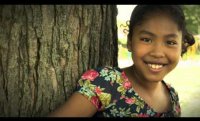
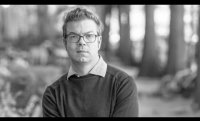
"I kind of always assume that you don't write the poem you want to write...that's actually quite freeing because it means you discover something in the act of composition that you didn't know in advance." Ben Lerner talks about his first poetry collection, The Lichtenberg Figures (Copper Canyon Press, 2004), for the Paris Review's "My First Time" video series. Lerner's first nonfiction book, The Hatred of Poetry (Farrar, Straus and Giroux, 2016), is featured in Page One in the July/August issue of Poets & Writers Magazine.

But This Body, It Remembers: The Intergenerational Workshop Exchange

Melissa Sipin, the McCrindle Foundation Readings & Workshops Fellow, reflects on the Intergenerational Workshop Exchange (IWE), a community project where teens and seniors wrote in response to each other, then shared their work at a reading. For the inaugural IWE, teens from St. Bernard High School and World War II Filipino American veterans and their family members from the Filipino American Service Group, Inc. (FASGI), took part in the collaborative workshop series over a three-month period this past spring. Below, Sipin reflects on her experience as organizer and cofacilitator, and shares a few excerpts from the participants. (Stay tuned for next week's companion post by Angela Peñaredondo, teaching artist for the senior workshop at FASGI.)

During the months of February and March, Poets & Writers supported two writing workshops as part of the first Intergenerational Workshop Exchange (IWE)—a rare writing exchange between seniors and youth that reached teens from St. Bernard High School and a group of World War II veterans and their family members from the Filipino American Service Group, Inc. The project culminated with a celebratory reading titled Connecting Generations on April 17 at Beyond Baroque in Venice, California.

The IWE was my passion project as the 2015-2016 McCrindle Foundation Readings & Workshops Fellow. I personally chose to focus on working with a unique and highly underrepresented senior population, World War II Filipino American veterans (learn more about their activism at Justice for Filipino American Veterans), as many are quickly aging and passing away without ever having their voices heard. My own grandfather, Major Diego A. Sipin, was a guerrilla fighter and officer in the U.S. Armed Forces in the Philippines, Northern Luzon, who passed away without receiving the full recognition of his wartime active duty service. Pairing the Filipino American veterans with St. Bernard High School students—many of whom are children of immigrants from all corners of Los Angeles—was a moving way to bring to light their shared and collective experiences.

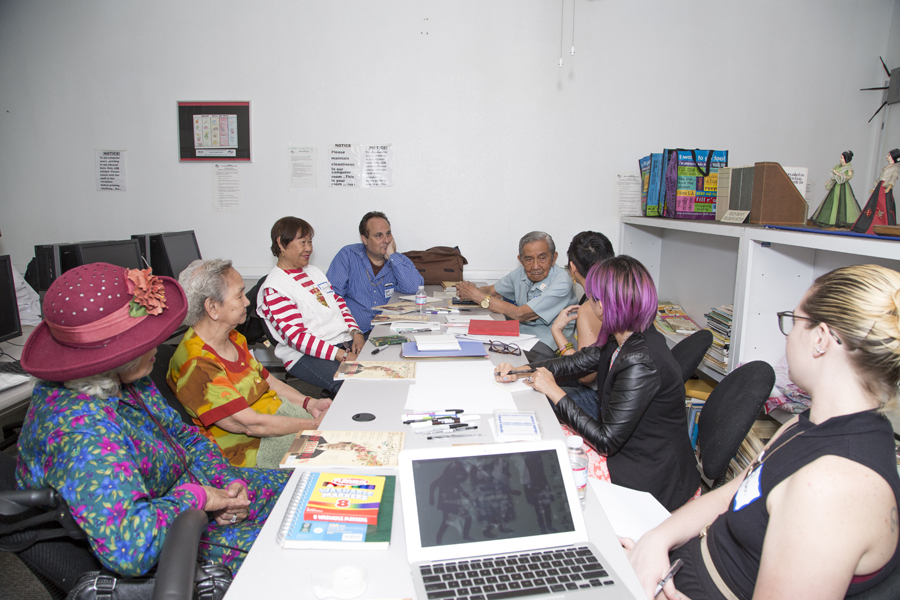
Traci Kato-Kiriyama and students During the workshops, teaching artist Traci Kato-Kiriyama had the St. Bernard High School students write a letter to their imagined grandchildren. In response, teaching artist Angela Peñaredondo had the seniors write to their actual grandchildren. After reading the seniors’ brief but poignant letters—which detailed their wartime experiences and migrations to America—the students then wrote to the seniors directly, sharing and exchanging their own family stories of migration. They described in visceral detail the smells, sights, and tastes of where they came from—the taste of hummus on a hot, balmy day in Beirut or how the sun shone on a small village near the border in Mexico—which in turn created a deep and touching connection across generations.

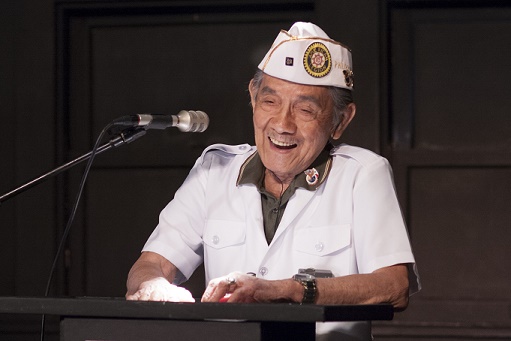
One of the most moving moments during the celebratory reading was Franco Arcebal’s letter to his great-granddaughter, Veronica. Before he read his letter, he shared a brief portrait of his life during the war—how he was tortured with electric shocks, baseball bats, and water; how he escaped the “monkey house,” a makeshift prisoner-of-war camp the Japanese soldiers used as an execution house. He told the crowd that he could never really answer his great-granddaughter’s questions about the war, and that every time she asked, he was filled with silence…until he participated in the writing workshop with his fellow lolas (“grandmother” in Tagalog), all of whom were widows of World War II Filipino American veterans. Here is an excerpt of his letter:

We were six in the monkey house.

I was the youngest. 20. What they considered fresh and young and robust, something that needed to be broken.

I was the most severely tortured. My body still remembers. Sometimes I want to forget. But this body, it remembers.

Franco ArcebalIn loving response, one of the high school students, Yonathan Dereje, dedicated his piece to Arcebal:

Your great-granddaughter will love you, and you will love her. She is your privilege.... Your love for her wasn’t scarred, but only made it even more resilient. Your experience made you tougher and teaches me how to be resilient, and will forever teach me how to love and never give up.

The three-month project could not have been successful without our community partnerships, and I would like to personally thank the following for their precious time: teacher and poet Mike Sonksen, St. Bernard High School, the Filipino American Service Group, Inc., Beyond Baroque Literary/Arts Center for hosting the celebratory reading, and teaching artists Traci Kato-Kiriyama and Angela Peñaredondo.

These intimate letters are a testament to the power of sharing stories across cultures and generations—we share them because it is proof that what we hold dear and what we call home tend to always be the deep, unbreakable bonds we form with each other.

You can read work produced by teen and senior participants of the inaugural Poets & Writers’ Intergenerational Workshop Exchange in a special issue of TAYO Literary Magazine titled “Connecting Generations.”

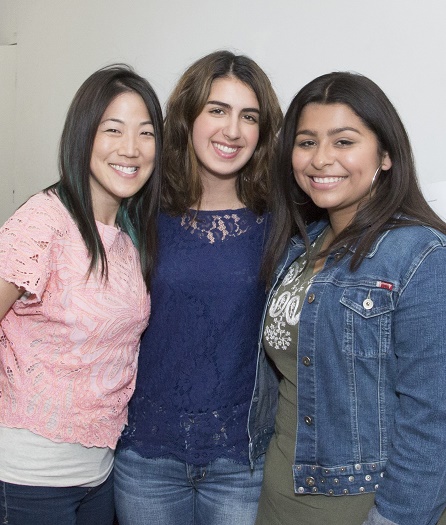
Photo 1: (from left) Workshop participants Beverly Siapno, Cleotilde Bisnar, Anacurita Santos, David Rockello, Franco Arcebal, workshop leader Angela Peñaredondo, and P&W staff members Melissa Sipin and Brandi Spaethe. Photo 2: Workshop leader Traci Kato-Kiriyama with St. Bernard High School students Rose Rteimeh and Rosalinda Flores. Photo 3: Senior workshop participant and World War II veteran Franco Arcebal. Photo credit: Tess. Lotta.

Major support for Readings & Workshops in California is provided by the James Irvine Foundation and the Hearst Foundations. Additional support comes from the Friends of Poets & Writers.

Found Poetry

6.21.16

“By entering a found text as a poem, the poet doubles its context. The original meaning remains intact, but now it swings between two poles," Annie Dillard wrote in Mornings Like This: Found Poems (Harper Perennial, 1996). "The poet adds, or at any rate increases, the element of delight." Many twentieth-century writers have experimented with found poetry, whether composing entire poems that consist solely of outside texts collaged together (David Antin, Blaise Cendrars, Charles Reznikoff) or incorporating pieces of found text into poems (T. S. Eliot, Ezra Pound, William Carlos Williams). Using these poets as inspiration, create a found poem using materials from street signs, newspapers, product packaging, legal documents, or e-mails. Play with different rearrangements and line breaks to form a new meaning that may be an unexpected juxtaposition to the original text. 

Upcoming Contest Deadlines for Poets

As we head into the second half of June, the deadlines approach for several poetry competitions. The contests included below—which are sponsored by organizations and schools based in places from Australia to Cape Cod—offer cash prizes from $1,000 to $10,000 for single poems.

The Cultural Center of Cape Cod offers a prize of $1,000 through its annual Poetry Competition. The submission deadline is Monday, June 20; the entry fee is $15.

With a deadline of Tuesday, June 21, the Troubadour International Poetry Prize, sponsored by London-based Coffee-House Poetry, offers a first-place prize of £5,000 (approximately $7,000) and a second-place prize of £1,000 (approximately $1,400). Glyn Maxwell and Jane Yeh will judge; the entry fee is $8 per poem.

Over in Australia, University of Canberra is currently considering submissions for its annual Vice-Chancellor’s Poetry Prize. The international contest, open to poets from any country writing in English, offers a hefty first-place prize of $15,000 AUD (approximately $11,100) as well as a second-place prize of $5,000 AUD (approximately $3,700). The winners will be published in an e-book anthology, and Simon Armitage will judge. The deadline is June 30, with an entry fee of $20 AUD (approximately $15).

For the musically inclined, String Poet is hosting its annual poetry competition with a deadline of June 30. Not only will the winner receive $1,000 and publication in String Poet, but the composer Richard Books will compose a piece of music inspired by the winning piece. The entry fee is $15. X. J. Kennedy will judge.

Visit the contest websites for complete submission details, including eligibility guidelines and poem length requirements. For a look at more writing contests with upcoming deadlines, visit our Grants & Awards database and submission calendar.


Anti-Ode

6.14.16

An ode is a poem that celebrates a person, an event, or object. But what if you don’t want to sing your praises for someone or something? Choose a person, event, or object with which you have a love-hate relationship, and write an anti-ode that examines the bases of your feelings of both opposition and attraction. How can you use diction and rhythm to reflect the complexity of tension between two extreme emotions for the subject of your poem? For inspiration, read Dean Young’s “Sean Penn Anti-Ode.”

Queens Lit Fest, A Happy Accident

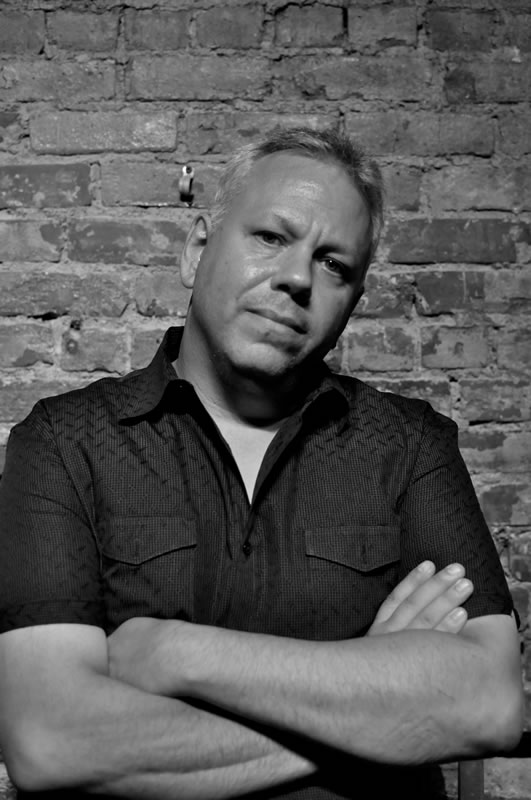
Mike Geffner is the founder and producer of the Inspired Word literary/performance series and the Queens Lit Fest. For thirty years, he was a professional journalist who published stories in USA Today, Details magazine, Village Voice, Texas Monthly, the Writer, and Sporting News. He’s won awards for both column and feature writing, and was acknowledged seven times for excellence by the annual anthology Best American Sports Writing. Geffner retired from journalism in 2011 and is currently working on a book of poetry, tentatively titled Slogging Toward Death.
This was late March 2015. I was chatting with the event booker of a charming pub in Long Island City called LIC Bar. The place was already hosting several literary events and I felt it had the potential for something wonderful of my own. I just wasn’t sure what.

LIC Bar has the uniqueness of being broken into three distinct areas: a bar in front with antique-wood floors, brick walls, and a tin ceiling; an outdoor garden patio in the middle under the peacefulness of willow trees; and a private room in the back with a fireplace.

I mulled over a ton of ideas in my head before the words that would change my life spilled out: “How about a Queens Literary Festival?” It seemed perfect—the readings in the private room, the vendors in the patio, the schmoozing in the bar.

The booker agreed and we set a date for the first weekend in August. However, the second I left the bar, the reality hit: What did I just sign up for? How do you put together a two-day festival for an entire NYC borough in just four months?

It was daunting to say the least, though as a former journalist, I was used to dealing with deadline pressure and getting things done quickly. And as someone who has lived all his life in Queens, who loves his borough, I believed in the mission: to bring together Queens’s diverse literary community, to honor our literary artists, to create a dynamic event that would be unpretentious, all-inclusive, and filled with heart.
With the help of Inspired Word assistant producer, Poetry Teachers NYC founder, and fellow Queens resident Megan DiBello, aka Make It Happen Megan, we made it happen. We produced a cool logo, postcards, and T-shirts. We put together excellent programming, which included several notable Queens-based reading series; the current and previous Queens poets laureate, Maria Lisella and Paolo Javier, respectively; and an open mic that would level the playing field and make everyone feel involved.

We were written about in all the Queens newspapers prior to the event, and Megan, Maria, and I even appeared in studio on NY1.

It ended up being a glorious event. We had two sunny days, drew over three hundred people, and I’m proud to say that despite the event being free we paid all the featured artists with sponsorship money, including generous dollars from Poets & Writers.
This year’s event (July 16 to 17, 11:00 AM to 8:00 PM, open to all ages this time) will be on a grander scale. For one, the site is the wondrous wide-open space along the waterfront called LIC Landing, a symbol of the new Queens and which offers a stunning, unfettered view of the Manhattan skyline. We’re also collaborating with Hunters Point Parks Conservancy (leading the building of an ambitious new Queens Library of Hunters Point) and COFFEED, a coffee chain that donates 10 percent of its profits to nonprofit foundations and which owns and donated the event space. We’ve added, as well, a tireless arts visionary, Mark Christie, president of Friends of Queens Library of Hunters Point, as an organizer/consultant. And, once again support from the Readings & Workshops program at Poets & Writers.

I know now what I’ve gotten myself into. We’re smack on the forefront of Queens’s culture renaissance, part of a movement to make Queens a literary destination, not just a pit stop to Brooklyn or Harlem. We’re forever on the timeline of Queens history. What an amazing thing from a few blurted out words.

You can follow the Queens Lit Fest on Instagram, Facebook, and Twitter @QueensLitFest. For more info, to RSVP, donate, or to sign up for the open mic, go here.

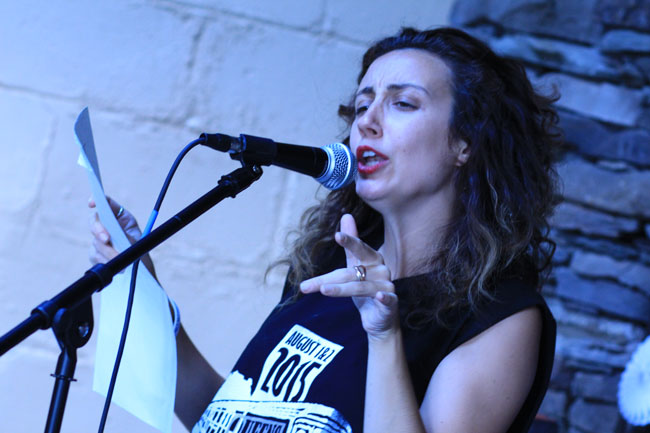
Photos: (top) Mike Geffner. (bottom) Megan DiBello.  Photo credit: (top) Jay Franco. (bottom) Mike Geffner. Artwork credit: Edward Cox.

Support for Readings & Workshops in New York City is provided, in part, by public funds from the New York State Council on the Arts, and the New York City Department of Cultural Affairs, with additional support form the Louis & Anne Abrons Foundation, the Axe-Houghton Foundation, the A.K. Starr Charitable Trust, and the Friends of Poets & Writers.


Pages

Subscribe to Poetry