Genre: Fiction

Valeria Luiselli, 2019 MacArthur Fellow

Caption: 

“My work often deals with dislocation, belonging, migration, of course, and I tend to create characters that are unnamed and not quite easy to place.” Valeria Luiselli, a 2019 MacArthur “Genius” fellowship recipient, talks about how she combines fiction and nonfiction to challenge conventional notions of authorship, and the ways in which the lives of others are documented.

Submissions Open for Lambda Literary Awards

The 32nd Annual Lambda Literary Awards (the “Lammys”) are currently open for submissions. The Lammys honor books in more than twenty genres ranging from literary fiction and poetry to speculative fiction, comics, and memoir, and are judged “principally on literary merit and content relevant to lesbian, gay, bisexual, transgender, and queer lives.” 

Submit three hard copies of a book and, if available, a .PDF version of the text, by November 15. Books put forward for consideration in this Lammys cycle must be published between January 1 and December 31, 2019, and may be nominated in no more than one category. Submissions may be made by authors as well as publishers or publicists. All authors, regardless of their sexual orientation or gender identity, are welcome to have their work considered, except in the case of the awards that mark specific stages of an individual LGBTQ writer’s career. The fee is $55 per book; for publishers entering eleven or more books, the fee is $45 per book. Visit the website for complete guidelines. 

Finalists will be announced in March 2020. Winners will be revealed at the Lambda Literary Awards gala ceremony on June 8, 2020 at the NYU Skirball Center for the Performing Arts in New York City. Tickets for the gala will go on sale in spring 2020.

Doctor Sleep

Caption: 

Stephen King’s novel Doctor Sleep (Scribner, 2013), the sequel to his 1977 classic The Shining, has been adapted into a feature film directed by Mike Flanagan. The movie picks up the story several decades later as a grown-up Danny Torrance, played by Ewan McGregor, meets a young girl with psychic powers similar to his own that he tries to protect from a supernatural cult of murderous nomads.

Genre: 

Cold, Hunger, Itches

10.2.19

“Sometimes the narrator tries to steer her thoughts in directions she prefers, or recoils from certain darker avenues of thought, but she can’t keep it up for long,” writes Lucy Ellmann in a Washington Post interview about her new novel, Ducks, Newburyport (Biblioasis, 2019), which is comprised of a single sentence that extends over a thousand pages. Write a short story that is entirely contained within one sentence. Allow for detours and interruptions—tidbits of song lyrics, physical sensations, flashbacks—to flow and come out. How do all the thoughts and distractions combine to form a bigger picture or statement?

Writers Justice League

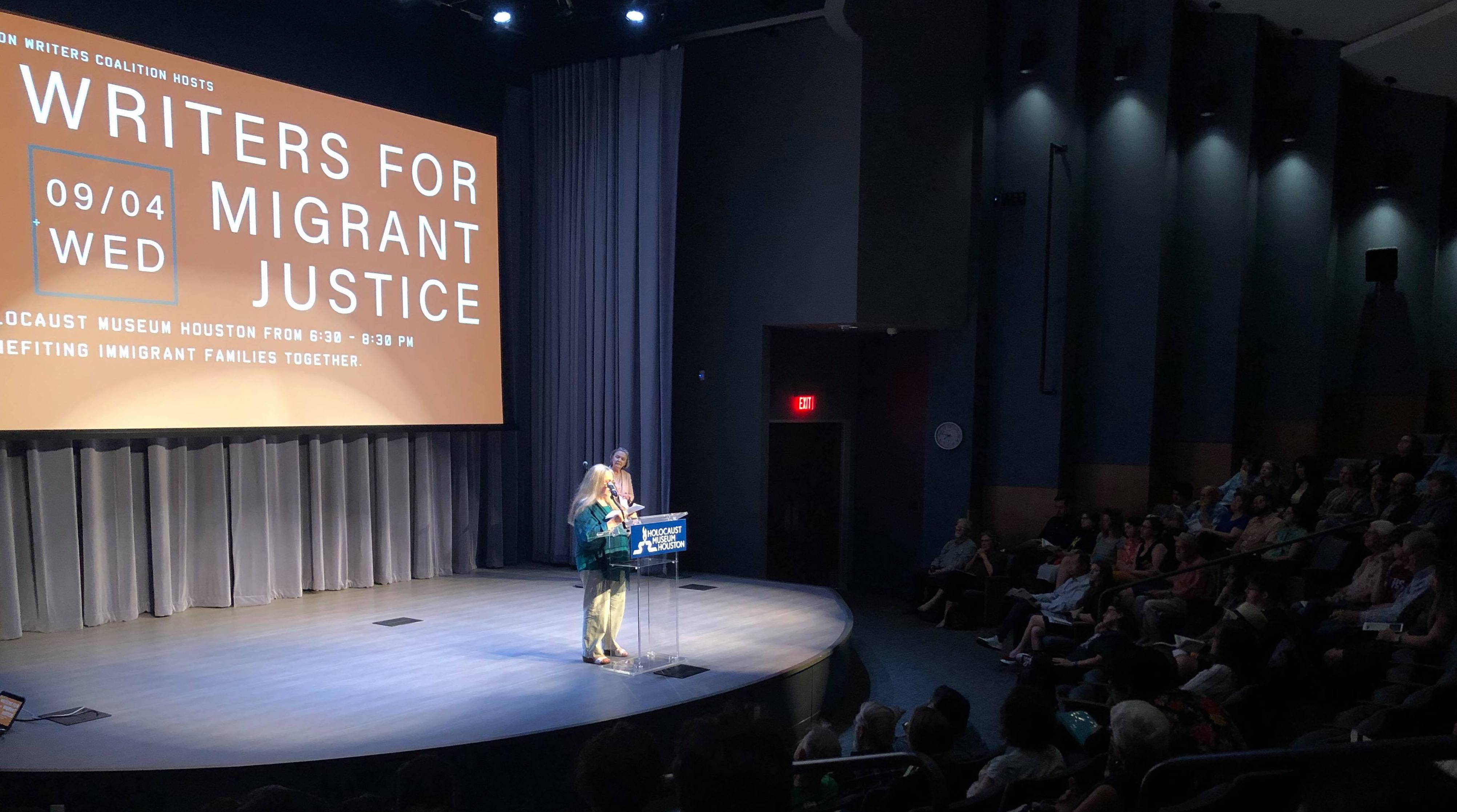
¿Que dice la buena vida, mi gente? On September 4, I joined the Houston Writers Coalition—a newly formed group of activist writers, professors, and creators—for an event supporting the Writers for Migrant Justice campaign. Organized by poets Christopher Soto, Jan-Henry Gray, Anni Liu, and Javier Zamora, the campaign brought writers together in more than forty cities across the United States to protest the government’s immigration policies and raise funds for the Immigrant Families Together Project, an organization that provides legal aid to undocumented families.

Here in Houston we participated by hosting a marathon reading—simply put, a reading with no introductions, prefaces, book signings, or discussions, just our words. Over forty writers gathered at the Holocaust Museum Houston, each of us reading an original piece or a piece from a notable writer on the topic of immigration. We raised a good deal of money for the campaign and auctioned off two mini-libraries, which each included a set of books signed and donated by local authors.

There are a few moments when a writer can say that they can make a direct impact outside of the written word, and that day, as we held simultaneous readings in multiple cities, writers stepped up to the plate and stood up for a just cause.

It was breathtaking.

Farnoosh Moshiri reads at the Writers for Migrant Justice event in Houston. (Credit: Lupe Mendez)
 
Lupe Mendez is the literary outreach coordinator for Poets & Writers in Houston. Contact him at Houston@pw.org or on Twitter, @houstonpworg.

Where to Write in Detroit

As a writer, I know how quickly our own writing seems to age. It often feels difficult to generate new work. Communing with fellow creatives is sometimes the best way to put pen to paper. With that in mind, I want to highlight a couple spaces for writers that I have found in the area.

Riverwise is a community-based magazine focused on highlighting local activism and personal Detroit stories. Alexis Draper has been organizing the Riverwise Writing Workshop series, which are held all over the city allowing for more accessibility to folks seeking out classes. The workshops range from general creative writing techniques to focusing on discussions about social issues in our community. A recent workshop called “Uncomfortable Spaces” was offered for free at the Artists Inn and was led by local poets Kahn Santori Davidson and Natasha T. Miller.

The Detroit Writing Room is an up-and-coming venue that opened in June offering coworking and event space in downtown Detroit. They have writing coaches that anyone can schedule an appointment with for feedback and editing on business materials or literary work. Many of the writing coaches are local creatives and professionals, including Anna Clark and Ashley Calhoun, both of whom I highly recommend! 

There are so many organizations and spaces that I could mention, but here are just a few more: Bottom Line Coffee House is home to a number of workshops led by local writers and visual artists, and they have great coffee and pastries. The Room Project is a work space for women and nonbinary writers and artists, and this October and November they will be offering creative nonfiction workshops. InsideOut’s after-school program, Citywide Poets begins this October for any teens looking to develop their writing. 

I hope these are resources that you can use and share with fellow writers! 

Justin Rogers is the literary outreach coordinator for Poets & Writers in Detroit. Contact him at Detroit@pw.org or on Twitter, @Detroitpworg.

Upcoming Contest Deadlines

The slightly crisper air signals the beginning of fall, and along with this seasonal change come contests with a deadline of September 30 or October 1. These literary magazine and university press awards (including one with no entry fee!) all offer either book publication or a prize valued at $1,000 or more.

University of Massachusetts Press Juniper Prizes: Five prizes of $1,000 each and publication by University of Massachusetts Press are given annually for a first poetry collection, a poetry collection, a short story collection, a novella or novel, and a book of creative nonfiction. The creative writing faculty at the University of Massachusetts in Amherst will judge. Deadline: September 30. Entry fee: $30.

Boulevard Nonfiction Contest for Emerging Writers: A prize of $1,000 and publication in Boulevard is given annually for an essay by a writer who has not published a full-length book in any genre with a nationally distributed press. The editors will judge. Deadline: September 30. Entry fee: $16, which includes a subscription to Boulevard.

Cave Canem Foundation Toi Derricotte & Cornelius Eady Chapbook Prize: A prize valued at approximately $2,500 is given annually for a poetry chapbook by a Black poet. The winner will receive $500, publication by Jai-Alai Books, and a weeklong residency at the Writer’s Room at the Betsy Hotel in Miami, Florida, and will give a reading at the O, Miami Poetry Festival in April 2020. Danez Smith will judge. Deadline: September 30. Entry fee: $12.

University of Arkansas Press Miller Williams Arkansas Poetry Prize: A prize of $5,000 and publication by University of Arkansas Press is given annually for a poetry collection. Billy Collins will judge. Deadline: September 30. Entry fee: $28.

University of Iowa Press Iowa Short Fiction Award: Two awards of publication by University of Iowa Press are given annually for first collections of short fiction. Writers who have not published a book of fiction are eligible. Deadline: September 30. Entry fee: none.

American Literary Review Literary Awards: Three prizes of $1,000 each and publication in American Literary Review are given annually for a poem, a short story, and an essay. Deadline: October 1. Entry fee: $15. 

LitMag Anton Chekhov Award for Flash Fiction: A prize of $1,250 and publication in LitMag will be given annually for a piece of flash fiction. The winning story will also be reviewed by literary agency Sobel Weber Associates. Deadline: October 1. Entry fee: $16.

Southeast Missouri State University Press Mighty River Short Story Prize: A prize of $1,000 and publication in Big Muddy, a literary journal published by Southeast Missouri State University Press, is given for a short story. The annual award will be discontinued after this year. Deadline: October 1. Entry fee: $20.

Missouri Review Jeffrey E. Smith Editors’ Prize: Three prizes of $5,000 each and publication in Missouri Review are given annually for a group of poems, a short story, and an essay. Deadline: October 1. Entry fee: $25, which includes a digital subscription to Missouri Review and a copy of the story collection A Faithful But Melancholy Account of Several Barbarities Lately Committed by last year's winner, Jason Brown.

Visit the contest websites for complete guidelines, and check out the Grants & Awards database and Submission Calendar for more contests in poetry, fiction, and creative nonfiction.


The Dearly Beloved

Caption: 

“My experience at church was of community....most importantly I got to be part of this community where everyone was searching for the meaning of life in their relationship with each other.” Cara Wall talks about the inspiration behind her debut novel, The Dearly Beloved (Simon & Schuster, 2019), a story about two couples navigating faith and social change in New York City’s Greenwich Village in the 1960s.

Genre: 

Gone Bird

9.25.19

A study published last week in the journal Science detailed findings that the North American bird population has dropped by three billion since 1970, a decline of twenty-nine percent in less than fifty years. Write a story that revolves around how an imminent extinction of all birds affects one specific character. Is there a moment of realization when this decimation impacts your character’s life? How does the disappearance of these creatures change the human relationships in your story?

Pages

Subscribe to Fiction