"As I Walked Out One Evening"
Caption:
W. H. Auden's beloved poem is set against London's Bricklane in this short film narrated by Tom O'Bedlam and directed, edited, and produced by Peter Szewczyk.
Genre:
Jump to navigation Skip to content
W. H. Auden's beloved poem is set against London's Bricklane in this short film narrated by Tom O'Bedlam and directed, edited, and produced by Peter Szewczyk.
Texas cowboy poet Andy Hedges recites "The Red Cow" by Larry McWhorter at the twenty-eighth National Cowboy Poetry Gathering in Elko, Nevada. Hedges will return to Elko for next year's event on January 31, 2013.
Select one of your poems that needs revision and transform it into a physical object, such as an imaginary map, a collage, a drawing, or a shadow box (for inspiration, check out Joseph Cornell’s shadow boxes).
Due to the recent effects of Hurricane Sandy, Ohio University Press has extended the deadline for the Hollis Summers Poetry Prize to November 15. The annual competition, which awards a $1,000 cash prize and publication by Ohio University Press, is given for a poetry collection.
Poets may submit previously unpublished manuscripts of sixty to ninety-five pages, along with a $25 entry fee, to Ohio University Press, 19 Circle Drive, The Ridges, Athens, Ohio 45701. The competition is open to poets who have published a full-length collection and those who have not. For more information and complete submission guidelines, visit the Ohio University Press website.
The annual prize is named for the poet Hollis Summers, who taught at Ohio University for many years and frequently wrote about the city of Athens in his poems.
Poet Nick Norwood won last year’s prize for his third full-length collection, Gravel & Hawk, published this past April by Ohio University Press. In the podcast below from the PBS NewsHour program “Art Beat,” hear Nick read the poem “A.M.” from his winning collection.
The author of Twenty-seven Props for a Production of Eine Lebenszeit (Grove, 2003) and The Cloud Corporation (Wave, 2010) reads "The New Hymns" as part of the Brooklyn Poets Reading Series on September 21.
Poet and cultural geographer Eric Magrane writes about his recent P&W-supported reading in Tucson for the POG: Poetry in Action reading series. POG also announced the Tumamoc Hill Writing project at this event, which will gather Tucson writers to explore Tumamoc Hill, a long term ecological research site and a natural and cultural treasure in the heart of Tucson. You can see Magrane’s interview with Paul Mirocha, artist in residence at Tumamoc and his co-presenter at this event, on Magrane’s Proximities blog on art, science, and environment, which he writes for the University of Arizona’s Institute of the Environment. Find Magrane’s Various Instructions for the Practice of Poetic Field Research here.
 What happens when we engage the spaces between poetry and science, between art and geography, between place and philosophy? What happens when all those categories get mixed up? I’d call the new arrangements that emerge a hybrid poetic geography, in which different fields of thought and knowledge collapse into each other.
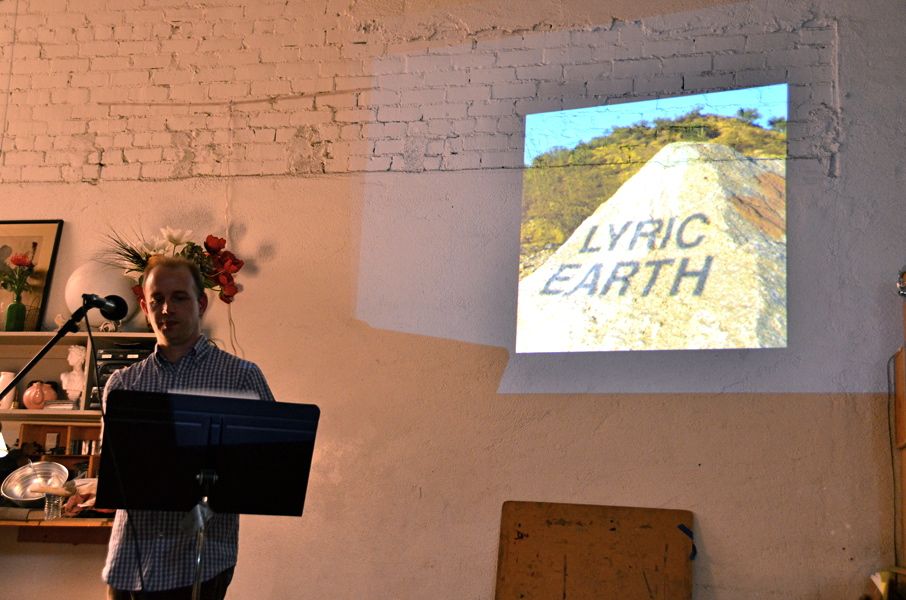
A recent reading that I gave for the experimental poetics series POG: Poetry in Action revolved around these questions. As part of my reading, I surveyed the audience. While I read sections of my poem Symbiosis-Nothing Separate-Lyric Earth, I asked the audience to respond to a survey that I designed for the event. I’d like to share a few of the questions and responses: What is the difference between poetry and science?
live wine // I have no idea. // poetry doesn’t prove? // one looks from the inside and the other looks from the outside // nothing // the beat // the observer // use of words to describe the process // prediction // science <--- language ---> poetry // weather // Lichen = algae + fungus; Lichen = poetry + science // everything but “E” // tools
I culled these responses above completely on my own whim. In other words, the results are not generalizable and are completely subjective. (Subjectivity is another question, and exploring where subject-object duality breaks down is crucial to explorations of poetry and science. Poetry, I believe, can be a method to rigorously collapse subject and object in a way that’s different from the rigor of science.)
The following quantitatively details the responses to a single question from all thirty-seven completed surveys. (Responses that occurred twice are coded with a 2 x.)
What is the first nonhuman species that comes to mind?
Bird (redbird) // 2 x Snake // 2 x Amoeba // Roses // 2 x Aardvark // Rocks // Bear // 2 x Birds // Stool // Cat // Sea anemone // 2 x Cats // Cypress tree // Robots // Worm // Lemur // Porcupine // Stone people // Crow // Pig // Man and Woman // Palo verde // Rabbit // Nematodes // Liquidamber // Feline // Lizard // Half the people I see on the street // Scissor-tailed flycatcher // Lizards – but I had a gecko // Mesquite // Birds, Dogs a close second
I was very surprised that two people responded both for amoebas and aardvarks! I was struck also by the number of responses that stepped outside of a traditional definition of species to include other matter (Rocks, Stool, Robots, Stone people, Liquidamber). I attribute this to the creative audience and to the embedded vibrant materiality of poetry.
Photo: Eric Magrane reads with Lyric Earth. Credit: Samuel Ace.
Support for Readings/Workshops events in Tucson is provided by an endowment established with generous contributions from the Poets & Writers Board of Directors and others. Additional support comes from the Friends of Poets & Writers.
Literary MagNet chronicles the start-ups and closures, successes and failures, anniversaries and accolades, changes of editorship and special issues—in short, the news and trends—of literary magazines in America. This issue's MagNet features Triple Canopy, Carve Magazine, Ploughshares, Prairie Schooner, and Sea Ranch.
With so many good books being published every month, some literary titles worth exploring can get lost in the stacks. Page One offers the first lines of a dozen recently released books, including Matthew Dickman's Mayakovsky's Revolver and A. M. Homes's May We Be Forgiven, as the starting point for a closer look at these new and noteworthy titles.
One of the few existing literary magazines in translation, Monkey Business is a new journal of Japanese writing, translated into English by founding editors Motoyuki Shibata and Ted Goossen and published annually in the United States and Canada by the Brooklyn-based A Public Space.