The Written Image: Walt Whitman
To celebrate the 150th anniversary of the publication of Leaves of Grass, the Washington Friends of Walt Whitman is cosponsoring a citywide festival from March 26 (the day of Whitman’s death) to May 31 (his birthday).
Jump to navigation Skip to content
To celebrate the 150th anniversary of the publication of Leaves of Grass, the Washington Friends of Walt Whitman is cosponsoring a citywide festival from March 26 (the day of Whitman’s death) to May 31 (his birthday).
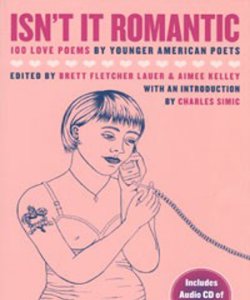
Despite the fluctuating aesthetics and ideologies espoused by critics, professors, and practitioners of poetry, there remain two general subjects that consistently offer poets inspiration: love and war; but with walentine’s Day just around the corner, three new anthologies of love poems are offering readers a respite from verse about violence.
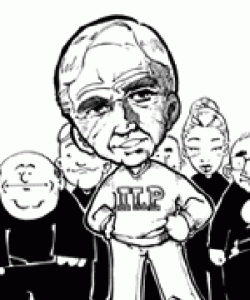
No entry fee? Little chance of rejection? Any poet worth her iamb has reason to be suspicious. And, indeed, the International Library of Poetry and its affiliates—the International Society of Poets, Watermark Press, poetry.com, and so on appears on several Internet-based contest-scam watch lists. Still ILP education director Len Roberts argues that the organization has its purpose and is taking steps to redeem its reputation.
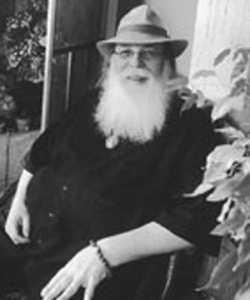
After a 10-year hiatus from publishing, Norman Dubie has returned with an award-winning volume of collected and new poetry, a 400-page sci-fi poem, and his latest, Ordinary Mornings of a Coliseum.
Last month Faber and Faber published Blinking With Fists, the first book of poems by Billy Corgan, the singer and songwriter for the defunct rock band Smashing Pumpkins.
The industry trade magazine Publishers Weekly this summer decided to stop publishing its monthly Poetry Forecast section, an editorial move that would have had deleterious effects on independent publishers. In response to complaints from many publishers, editors, and poets, the decision was reversed a few weeks later, before any changes were made to the magazine.
For nearly two years, WordTech Communications was one of the growing number of small presses using the contest model in which entry fees fund prize monies as well as the publication and promotion of winning books. Some would even say the Cincinnati-based press was gung ho about it, holding a different poetry contest every month. But in June, WordTech announced it was discontinuing its contest program and replacing it with an open-submissions policy, stating that there was more money to be made without contests.
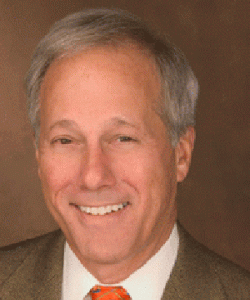
When John Barr was named president of the Poetry Foundation six months ago, most poets in the country were asking themselves, “John who?” Although Barr has published six books of poetry and served on the board of directors of Yaddo as well as that of the Poetry Society of America, many poets had never heard of him. His long career as an investment banker on Wall Street hadn’t raised his literary profile either. The worlds of high finance and poetry are totally unrelated. Not anymore. In 2002, Ruth Lilly’s unprecedented financial gift—$100 million over the next 30 years—to the Poetry Foundation, formerly the Modern Poetry Association, changed all that. Suddenly poets are paying attention to what an investment banker has to say.
Vijay Seshadri was born in Bangalore, India, in 1954, and moved to Columbus, Ohio, at the age of five. He has lived in various parts of the country, including Oregon, where he worked as a commercial fisherman, and as a biologist for the National Marine Fish Service. He drove a truck for a living in San Francisco, and worked briefly as a logger before coming to New York City to study with poet Richard Howard in the master's program at Columbia University.
Six months ago, John Barr was named president of the Poetry Foundation. While many poets had never heard of the former Wall Street investment banker (although he is the author of six books of poetry and served on the board of directors of Yaddo as well as that of the Poetry Society of America) many are now acutely aware of the leader of the organization that received a pledge of $100 million over the next thirty years from pharmaceutical heiress Ruth Lilly.