Reading and Lecture by Reginald Dwayne Betts

Caption: 

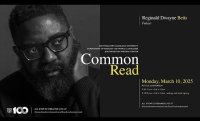
“I was doing nine years in prison, and poems became my way to see the world.” In this Common Read event hosted by the Sims Memorial Library at Southeastern Louisiana University, Reginald Dwayne Betts, author of Felon (Norton, 2020), answers questions from the audience and presents a lecture and reading introduced by Louisiana poet laureate Alison Pelegrin.

Genre: 

Last Dreams

4.24.25

In the introduction to his translation of Egyptian author Naguib Mahfouz’s I Found Myself…the Last Dreams, forthcoming in June from New Directions, Hisham Matar writes: “It is clear that Mahfouz, the professed realist, admired dreams, coveted their agile and wandering narratives, their convincing and often unsettling psychological and emotional power, and, perhaps most of all, their economy: how, in an instant, a world is evoked that is—no matter how unlikely or strange—convincingly compelling.” Matar goes on to describe the book’s short vignettes in which Mahfouz recorded his dreams in the last decade of his life. “Almost each starts with ‘I saw myself’ or ‘I found myself.’ And isn’t that the case, that we find or see ourselves in dreams…?” Try your hand at recording your own dreams for a stretch of time, perhaps beginning each entry with “I found myself…” Experiment with arranging them in an order that makes sense to you, through any type of thematic, narrative, or dream logic.


Torrey Peters: Stag Dance

Caption: 

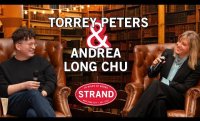
In this Strand Book Store event, Torrey Peters reads from her book Stag Dance: A Novel & Stories (Random House, 2025) and talks about the experience of transitioning and how literature can broaden understandings of self beyond identity in a conversation with essayist and critic Andrea Long Chu. “A lot of these stories are invitations to a reader to identify with these characters who are probably not like the reader,” says Peters.

Genre: 

Parental Relations

4.23.25

In the opening pages of We, the Casertas—a Gothic novel by the Argentine author Aurora Venturini first published in 1992 and translated from the Spanish by Kit Maude in a new edition forthcoming in May from Soft Skull Press—the main character declares with a youthful, fearsome confidence her damaged relationship with a cruel, rage-filled mother who misunderstands and mistreats her. With the use of this limited first-person point of view, Venturini sets up a complex, intensely subjective protagonist who is suffering yet defiant. “My mother knew that she could never tame me,” she writes. Write a scene in which a young person expresses their thoughts about a parental figure. How would things appear differently if written from the point of view of a young person, a parent, a complete stranger, or an elderly person looking back on a distant memory? Write one or multiple scenes to complete a short story.

Victoria Chang at Villanova University

Caption: 

In this Villanova University Literary Festival event, Victoria Chang reads from her poetry collections Obit (Copper Canyon Press, 2020) and With My Back to the World (Farrar, Straus and Giroux, 2024), and speaks about her ekphrastic poems and the power of writing in conversation with other artists and people in her life.

Genre: 

Lulled in Flowers

4.22.25

From the wildflowers of William Shakespeare’s A Midsummer Night’s Dream to the white lilies of Frances Hodgson Burnett’s The Secret Garden to Chimamanda Ngozi Adichie’s Purple Hibiscus, flowers have played a significant role in literature and are symbolic in many cultures. Floriography is known as the “language of flowers” and is a means of expressing emotion through the use of flowers—a method of discreet communication that has existed for millennia and saw heightened popularity during the Victorian era. Whether depicted in a painting, presented as a gift, used as commemorative decor, or worn as an accessory, a flower can symbolize gratitude, love, remembrance, trust, good health, or even danger. Spend some time looking into the language of flowers and write a poem that deploys floriography in some way, perhaps to express something you’ve kept secret until now.

Palestine, Minneapolis, and the Urgent Word

Caption: 

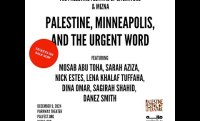
In this event hosted by the Palestine Festival of Literature and Mizna in Minneapolis, poets Mosab Abu Toha, Sarah Aziza, Nick Estes, Dina Omar, Sagirah Shahid, Danez Smith, and Lena Khalaf Tuffaha come together for an evening of performance, music, and conversation about the meaning and power of literature.

Genre: 

History of Display by Rob Macaisa Colgate

Caption: 

In this Lambda Literary video, Rob Macaisa Colgate reads “History of Display,” which appears in his debut poetry collection, Hardly Creatures (Tin House Books, 2025). The collection is featured in Page One in the May/June issue of Poets & Writers Magazine.

Genre: 

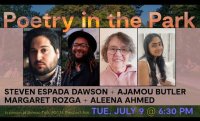
Poetry in the Park: Aleena Ahmed, Ajamou Butler, Steven Espada Dawson, and Margaret Rozga

Caption: 

In this Poetry in the Park event in Milwaukee’s Juneau Park hosted by Juneau Park Friends and Woodland Pattern, poets Aleena Ahmed, Ajamou Butler, Steven Espada Dawson, and Margaret Rozga read a selection of poems. Dawson, author of Late to the Search Party (Scribner, 2025), is featured in Literary MagNet in the May/June issue of Poets & Writers Magazine.

Genre: 

Dyeing Potatoes

4.17.25

Considering the record-high cost of eggs due to shortages, a recent USA Today article suggests a list of alternatives for the traditional Easter activity of dyeing eggs. A few of the creative contenders include dyeing potatoes or marshmallows, and painting Easter rocks. Think back to a time when you’ve had to alter a long-held tradition because of circumstances outside of your control. Write a personal essay that recounts the emotional trajectory you experienced, beginning with the backstory and memories of your relationship to the tradition. Were you able to preserve the core importance of the tradition? What was lost or gained?

Pages

Subscribe to Poets & Writers RSS