Nikia Chaney is a poet from the Inland Empire of Southern California and the author of two chapbooks, Sis Fuss (Orange Monkey Publishing, 2012) and ladies, please (Dancing Girl Press, 2013). She is founding editor of shufpoetry, an online journal for experimental poetry, and founding editor of Jamii Publishing, a publishing imprint dedicated to fostering community among poets and writers. Chaney has won grants from the Barbara Demings Fund for Women, Poets & Writers, and Cave Canem. She teaches at San Bernardino Valley College.
 A short while ago I would not have used the title activist. I would have just said that I loved community service and most times don’t think of volunteering, but this past fall, Lisa Henry asked me to help her teach a community workshop about art and activism.
Lisa’s nonprofit organization, SALT (Soul, Art, Literature and Time) + SPICE (Socially Productive and Inspirational Community Events), offers classes, workshops, readings, and other cultural events to the public in the Inland Empire. My favorite SALT + SPICE workshop series included a panel and reading that focused on art and motherhood, a family community workshop that involved creating a ragdoll, and a workshop dedicated to Maya Angelou.
During all these events, the community was allowed to create, write, speak, give voice, and engage with the subject matter and the writing. I loved watching participants laugh and enjoy themselves. I’ve always thought of SALT + SPICE workshops as joyful gatherings. So when Lisa asked me to lead a workshop on activism, I was deeply honored, but initially reluctant.
Being a workshop leader is actually quite fun—every class is different, and what the participants bring in always amazes me. However, I was reluctant because I didn’t consider myself an activist, and never looked at my own volunteer activities as a form of social protest. I teach poetry classes to individuals with mental illnesses and I volunteer at at-risk youth after-school programs. How is this activism, I thought? Isn’t activism holding signs and marching for a cause? Isn’t activism big and loud and full of righteous protest? I took some time to consider Lisa’s request and did a little research. This quote was one of the first things I found:
"I see protest as a genuine means of encouraging someone to feel the inconsistencies, the horror of the lives we are living. Social protest is saying that we do not have to live this way. If we feel deeply, and we encourage ourselves and others to feel deeply, we will find the germ of our answers to bring about change. Because once we recognize what it is we are feeling, once we recognize we can feel deeply, love deeply, can feel joy, then we will demand that all parts of our lives produce that kind of joy. And when they do not, we will ask, 'Why don't they?' And it is the asking that will lead us inevitably toward change." —Audre Lorde
I think we forget about the quiet, powerful moments of protest. Writing is protest. Each day we push past the immediate judgements and stereotypical assumptions we make. We write and challenge each other in that writing to see us and everyone else for who we really are.
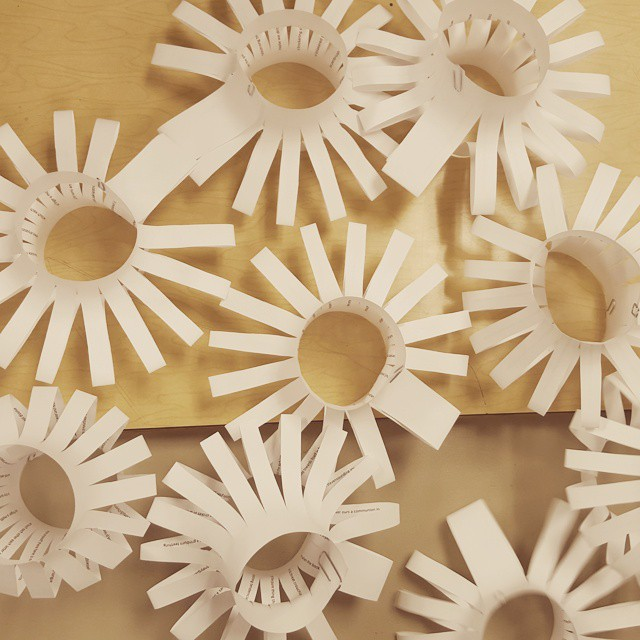
During the workshop, we explored Lorde’s ideas and questioned the nature of activism, diving into the “what” of what we individuals are doing to change the world, about how we won’t tolerate injustice. Everyone discovered they, too, were activists, fighting every day to make the world better. Lisa concluded the workshop by taking the participants on a field trip to downtown Riverside to the Center for Social Justice & Civil Liberties. Later, I created poetry pinwheels to honor the ideas.
It’s wonderful to teach others, help them write, and work with their poems, but sometimes you teach and learn more about yourself than you thought you would. I’m thankful to Lisa for accepting the title of activist and trusting me to give it to others in return.
Photo: poetry pinwheels Credit: Nikia Chaney
Major support for Readings & Workshops in California is provided by the James Irvine Foundation and Hearst Foundations. Additional support comes from the Friends of Poets & Writers.