The Little Drummer Girl

Caption: 

The Little Drummer Girl (Knopf, 1983), John le Carré’s spy thriller novel about a young English actress who works as a double agent for an Israeli intelligence agency in the 1970s, has been adapted into a television miniseries. The six-part series is directed by Park Chan-wook, and stars Florence Pugh, Michael Shannon, and Alexander Skarsgård.

Genre: 

Living Proof

Caption: 

“I can’t remember the last time / someone commented on my sunny disposition. / That doesn’t mean I’m not trying to juice / the sun for every holy drop.” In this video, Andrea Gibson reads “Living Proof” from their poetry collection Lord of the Butterflies (Button Poetry, 2018) at the Westcott Theater in Syracuse, New York.

The Girl in the Spider’s Web

Caption: 

The Girl in the Spider’s Web is a film adaptation of David Lagercrantz’s crime novel, translated from the Swedish by George Goulding, which continues the Millennium series originated by the late Stieg Larsson. Directed by Fede Alvarez, the film sees the return of the two primary characters in the series: computer hacker Lisbeth Salander, played by Claire Foy, and journalist Mikael Blomkvist, played by Sverrir Gudnason.

Genre: 

Meena Alexander

Caption: 

“There’s something in the lyric moment that really ruptures the taken for granted-ness of the world.” Meena Alexander discusses her writing process, artistic collaborations, and the sensory experience of being a poet in this 2015 interview for CUNY TV. The author of five books of poetry, including most recently Atmospheric Embroidery (TriQuarterly Books, 2018), Alexander died at the age of sixty-seven on November 21, 2018.

Genre: 

Pine Reads Review Invites Dhonielle Clayton to Tucson

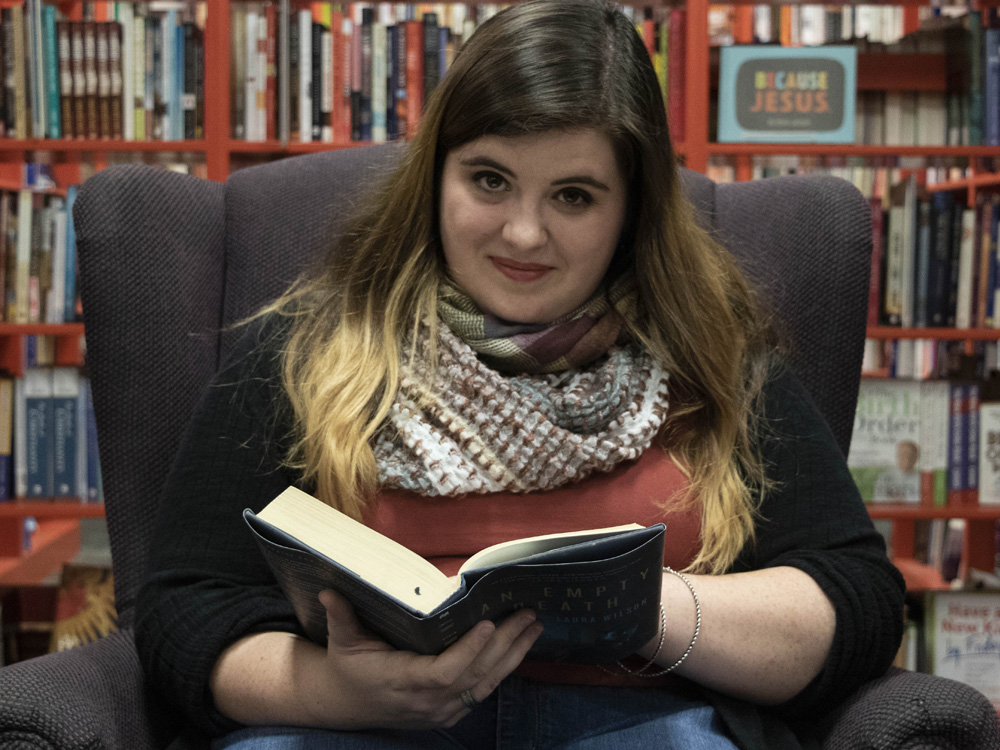
Christy Duprey is a graphic artist, and a staff writer and podcast producer for Pine Reads Review, an online publication for young adult literature showcasing new and established writers. She has also interned with Sonora Review and volunteered at the Champlain College Young Writers’ Conference. Currently a senior at the University of Arizona, Duprey created the podcast Pine Reads Pod Reviews, which invites their interns, and guest hosts, to review the best and latest young adult literature.
On September 27, author Dhonielle Clayton—cofounder of Cake Literary, a literary development company, and the chief operating officer of the nonprofit We Need Diverse Books—made quite the splash in the Sonoran Desert of Tucson, Arizona. Clayton, whose novel The Belles (Freeform, 2018) was recently recommended for the 2019 CILIP Carnegie Medal, came to Tucson at the invitation of Pine Reads Review and with the support of a grant from Poets & Writers’ Reading & Workshops program. She was able to organize two events at the University of Arizona, highlighting her accomplishments both as an author and an advocate for increasing diversity in children’s and young adult literature.

The evening event featured Clayton speaking about her journey into the literary world, focusing in particular on her mission to tell underrepresented stories. After an introduction from Pine Reads Review’s director Stephanie Pearmain, Clayton began by saying, “you can’t be what you can’t see,” pointing out that too few kids and teens see their own lives on the page. Not just lives centered around systemic struggles of race, sexuality, or disability, but lives that are about having fun. There are a great many stories out there of Black children facing down the horrors of slavery or civil rights abuses, she reminded the audience, but shockingly few about Black children discovering a magical land or going on a secret quest. When asked why her writing and the work published by her book developing company tend to skew more towards delightful adventure than inherited cultural pain, her answer was simple: “I want to create books that are just about kids doing fun stuff, and not dealing with drama.”
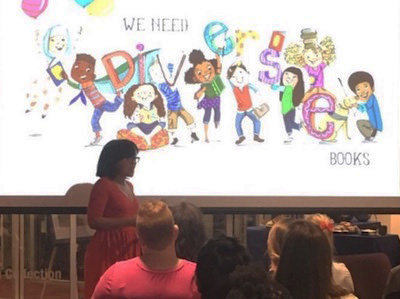
The evening talk attracted members of the community ranging from teenage fans to teachers and librarians, as well as local writers hoping for insight into the publishing industry.

In addition, Clayton held a workshop earlier in the day with the university’s publishing class to offer wisdom on the ins and outs of “the business” to juniors and seniors. In an environment where students are frequently pushed to—and often beyond—their breaking points, her advice was refreshing. She advocated for slowing down, for taking the time you need to get the writing right and take care of yourself. A round of chuckles followed her pronouncement: “There are days where you just have to be disgusting and watch Netflix, and then the next day you’re back to the grind.” It was a breath of fresh air to a room full of young writers hoping to enter an industry where burnout is common and stress levels are often high.

Clayton’s visit served as a reminder to aspiring writers that even when books are the focus, it’s the people who matter. She offered a vision of publishing that lifts others up. “As writers,” she said, “we have been given the great privilege to create something that gives people a space to explore who they are.”

Support for Readings & Workshops in Tucson is provided by an endowment established with generous contributions from the Poets & Writers Board of Directors and others. Additional support comes from the Friends of Poets & Writers.

Photos: (top) Christy Duprey (Credit: Victoria Pereira). (bottom) Dhonielle Clayton at the University of Arizona (Credit: Stephanie Pearmain).

Kwame Dawes on Writing

Caption: 

“I do come back to poets from the Caribbean especially, who gave me permission to be a writer.” In this interview with City of Asylum, Kwame Dawes talks about the writers whose work he revisits, his writing routine, and why he doesn’t use the word “inspiration.” Dawes is the editor in chief of Prairie Schooner and is featured in “Telling a Different Story: How to Cultivate Inclusivity at Literary Magazines” in the November/December issue of Poets & Writers Magazine.

Delighting in Independent Bookstores

Caption: 

“A good bookstore is your friend.” Ross Gay reads his essay about his love for independent bookstores and how they are a “laboratory for our coming together” at one of his favorite places, the Book Corner in Bloomington, Indiana. Gay’s essay collection, The Book of Delights, is forthcoming from Algonquin Books in February.

We Are Not Done Yet

Caption: 

“This poem is not a cry for help. This poem is not my broken pieces. And we are not done yet.” In this HBO documentary, a group of veterans and active-duty service members come together to write a collaborative poem and turn it into a stage performance. The film is directed by Sareen Hairabedian and coproduced by Jeffrey Wright and David Holbrooke.

Genre: 

Upcoming Prose Contest Deadlines

Planning to get some writing done over the break? There are a number of contests for fiction and nonfiction writers with upcoming deadlines.

Narrative Fall Story Contest: A prize of $2,500 and publication in Narrative is given annually for a short story, a short short story, an essay, or an excerpt from a longer work of prose. A second-place prize of $1,000 and publication in Narrative is also awarded. The editors will judge. Entry fee: $26. Deadline: November 30.

Fish Short Story Prize: A prize of €3,000 (approximately $3,400) and publication in the annual Fish Publishing anthology is given annually for a short story. The winner will also be invited to attend a five-day short story workshop at the West Cork Literary Festival in July 2019. Mia Gallagher will judge. Entry fee: $24. Deadline: November 30.

Dappled Things J. F. Powers Prize for Short Fiction: A prize of $500 and publication in Dappled Things will be given annually for a short story. The editors will judge. Entry fee: None. Deadline: November 30.

Quarter After Eight Robert J. DeMott Short Prose Contest: A prize of $1,008.15 and publication in Quarter After Eight is given annually for a prose poem, a short short story, or a micro-essay. Entry fee: $15. Deadline: November 30.

American Library Association W. Y. Boyd Literary Award: A prize of $5,000 is given annually for a novel published in the previous year that is set in a period when the United States was at war. Entry fee: none. Deadline: December 1.

David J. Langum Sr. Prize in American Historical Fiction: A prize of $1,000 is given annually for a book of historical fiction published during the previous year. Entry fee: none. Deadline: December 1.

Stanford University Wallace Stegner Fellowships: Ten two-year fellowships, five in poetry and five in fiction, are given annually to allow emerging writers to develop their craft in workshops with senior faculty members at Stanford University. Entry fee: $85. Deadline: December 1.

Visit the contest websites for complete submission details, including eligibility guidelines and poem length requirements. For a look at more writing contests with upcoming deadlines, visit our Grants & Awards database and submission calendar.

Barbara Kingsolver on Literature

Caption: 

“I didn’t know real people could be writers when they grew up. That would have been like saying that I wanted to be a fairy or a movie star.” Barbara Kingsolver, the author most recently of Unsheltered (Harper, 2018), talks to the Free Library of Philadelphia about how a childhood love of books made her a “citizen of the world” despite growing up in a small town in Kentucky. Kingsolver and Richard Powers speak about writing fiction in “A Talk in the Woods” in the November/December issue of Poets & Writers Magazine.

Genre: 

Pages

Subscribe to Poets & Writers RSS
