Resurrection

3.24.22

“Yes, I’m from rural Michigan. My people are those of TV dinners and bad luck. My landscape, silos, pissed-off cows, and the Elks Lodge Friday Fish Fry sign lighting up the night instead of the moon,” writes Diane Seuss in her commencement address to the Bennington Writing Seminars earlier this year, which was published on Literary Hub. “I invented myself, or a version of myself that could resurrect out of a cow pasture and become a poet. Unlikely, unlikely that I am here at all, and that you, indeed, are there,” she writes. Write an essay about your own “resurrection” into becoming a writer. What is the landscape you associate with home, and how does it influence your writing style?
Carina del Valle Schorske and Sheila Maldonado

Caption: 

“When I fell for the video girl in Omarion’s ‘Touch,’ I never thought I would come to know her name,” reads Carina del Valle Schorske from the first chapter of her debut essay collection, The Other Island, forthcoming from Riverhead Books, in this Poetry Project reading with poet Sheila Maldonado, author of that’s what you get (Brooklyn Arts Press, 2021).

What if?

3.23.22

In “The Art of Reading Philip Roth: Turning Sentences Around,” published in the September/October 2006 issue of Poets & Writers Magazine, Andrew Furman provides an analysis of the prolific writer’s work and legacy. “[Roth] seemed to know early on that to be a thoughtful Jewish writer in the twentieth century was to pose a series of ‘What if’ questions,” writes Furman. “What if Kafka survived tuberculosis, and then the Nazi death camps?” or “What if Anne Frank survived typhus in Bergen-Belsen?” This week, write a short story based on a “What if” question. Whether through a historical figure or your own life, what alternate reality can you see through to fruition?

Happy Poem

3.22.22

“They say a poet / can never write a purely happy poem about a dog / greeting the sun and what it has done to rain,” writes Analicia Sotelo in her poem “Grace Among the Ferns” published in the Academy of American Poets’ Poem-a-Day series. “I don’t know about that.” The poem is inspired by Sotelo’s dog Grace, who nuzzles her body through ferns on a sunny day, and how she seems to effortlessly enjoy the pleasures of springtime. Inspired by Sotelo’s poem, challenge yourself to write a joyful poem. Will your poem include a beloved pet?

Poetry in America: Evie Shockley

Caption: 

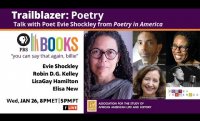
“blood tells the story,” reads Evie Shockley from her poem “you can say that again, billie” discussed in this PBS Books conversation about the history of racism, violence, and artistic tradition in the American South with historian Robin D. G. Kelley, actress LisaGay Hamilton, and professor Elisa New, director and host of the Poetry in America television series.

Genre: 

Celebrating Women

3.17.22

Last week, International Women’s Day was celebrated around the world, bringing attention to the cultural, political, and socioeconomic achievements of women as well as a call to action for gender equality. This year’s theme is “Break the Bias,” which aims to imagine a world free of bias, stereotypes, and discrimination, and encourages daily practice in one’s actions and thoughts. Inspired by this globally celebrated day, write an essay meditating on the women in your life who’ve helped you make personal strides. When cataloged, what are some patterns you notice?

Racing the Essay

Caption: 

In this AAWW conversation moderated by Piyali Bhattacharya, writers with debut essay collections recently published, including Cathy Park Hong, Aimee Nezhukumatathil, and Sejal Shah, discuss Asian American identity, genre, gender, race, publishing, and the ways that the essay form has allowed writers to tell important stories. 

Wanderings

3.16.22

“Under the wonderful influence of the painkillers coursing through me, I felt, in my iron-framed bed, like a balloonist floating weightless amidst the mountainous clouds towering on every side,” writes W. G. Sebald in Rings of Saturn, reprinted by New Directions in 2016 and translated from the German by Michael Hulse, in which an unnamed narrator speaks from a hospital bed about a trip he took walking across the landscape of Suffolk in England a year before. In the novel, Sebald’s narrator ruminates on a variety of subjects, including Rembrandt’s painting The Anatomy Lesson of Dr. Nicolaes Tulp, the skull of seventeenth-century physician Thomas Browne, French novelist Gustave Flaubert’s relationship to sand, and the sudden death of his friend. Write a story in which the protagonist never physically moves, but mentally travels through a variety of seemingly disparate subjects. Be it art, world history, geography, or music, how do the anecdotes connect to your subject’s personal conflict?

Pages

Subscribe to Poets & Writers RSS