5 Over 50: 2022 Virtual Reading

Caption: 

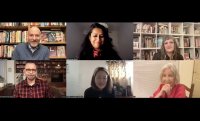
In this virtual reading, Poets & Writers editor in chief Kevin Larimer introduces the 2022 cohort of “5 Over 50” debut authors, Sari Botton, author of And You May Find Yourself: Confessions of a Late-Blooming Gen-X Weirdo (Heliotrope Books, 2022); Shareen K. Murayama, author of Housebreak (Bad Betty Press, 2022); Madhushree Ghosh, author of Khabaar: An Immigrant Journey of Food, Memory, and Family (University of Iowa Press, 2022); David Santos Donaldson, author of Greenland (Amistad, 2022); and Jane Campbell, author of Cat Brushing (Grove Atlantic, 2022).

Wrongness

12.13.22

“I first started writing poetry (and still write it) because the world, its people, and their ideas are wrong, insane, immoral, flawed, or unimaginably terrible. I write because I feel wrong, sad, crazy, disappointed, disappointing, and unimaginably terrible,” writes Rachel Zucker in “The Poetics of Wrongness, an Unapologia,” the first in a series of lectures delivered for the Bagley Wright Lecture Series in 2016 and collected in The Poetics of Wrongness, forthcoming in February from Wave Books. In the form of an unapologia, a reversal of the traditional apologia form that typically consists of a defense of one’s own opinions and actions, Zucker posits that “wrongness” is intrinsic to writing poetry and that poetry asserts “with its most defining formal device—the line break—that the margins of prose are wrong, or—with its attention to diction—that the ways in which we’ve come to understand and use words [is] wrong.” Write a poem in the form of an unapologia. Identify when you have been wrong in the past, and try not to defend yourself. Instead, speak through your feelings of wrongness.

Henri Cole Reads at the Hammer Museum

Caption: 

“Staggering out of a black-red peony, / where you have been hiding all morning / from the frigid air, you regard me smearing / jam on dark toast.” Henri Cole reads his poem “Face of the Bee” and other selections from his latest poetry collection, Blizzard (Farrar, Straus and Giroux, 2020), in this recent reading at the Hammer Museum in Los Angeles.

Genre: 

Spoiler Alert

Caption: 

Watch the trailer for the film adaptation of Spoiler Alert: The Hero Dies: A Memoir of Love, Loss, and Other Four-Letter Words (Atria Books, 2017) by Michael Ausiello, starring Jim Parsons, Ben Aldridge, and Sally Field with a screenplay by David Marshall Grant and Dan Savage.

Goblin Mode

12.8.22

Each year Oxford Languages names a Word of the Year that reflects the “ethos, mood, or preoccupations of the past twelve months” based on thorough analysis of statistics and data, but for the first time this year’s choice was open to a public vote. More than 300,000 people cast their vote and the overwhelming winner is “goblin mode,” a slang term defined as “a type of behavior which is unapologetically self-indulgent, lazy, slovenly, or greedy, typically in a way that rejects social norms or expectations.” Write an essay about a time you have gone into “goblin mode.” Was the period of unapologetic behavior necessary for you to recharge?

Quincy Troupe at the Schomburg Center

Caption: 

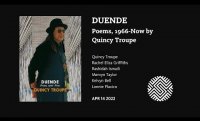
This Schomburg Center event celebrates a half century of poetry by Quincy Troupe, who reads from his collection Duende: Poems, 1966–Now (Seven Stories Press, 2022) with the accompaniment of musicians Kelvyn Bell and Lonnie Plaxico, along with an introduction by poets Rachel Eliza Griffiths, Rashidah Ismaili, and Mervyn Taylor.

Genre: 

Art by Bad People

12.7.22

What is the relationship between good art and bad behavior? In the essay “What Do We Do With the Art of Monstrous Men?” published in the Paris Review in 2017, Claire Dederer breaks down the mixed feelings she has when enjoying the art of abusive men, including her experience watching the films of Roman Polanski and Woody Allen. Using anecdotes from conversations with friends, Dederer also reflects on her own sense of “monstrosity” as a writer. “A book is made of small selfishnesses. The selfishness of shutting the door against your family. The selfishness of ignoring the pram in the hall. The selfishness of forgetting the real world to create a new one. The selfishness of stealing stories from real people,” she writes. Inspired by this moral quandary, write a story from the perspective of a writer considering their own monstrousness.

Pages

Subscribe to Poets & Writers RSS