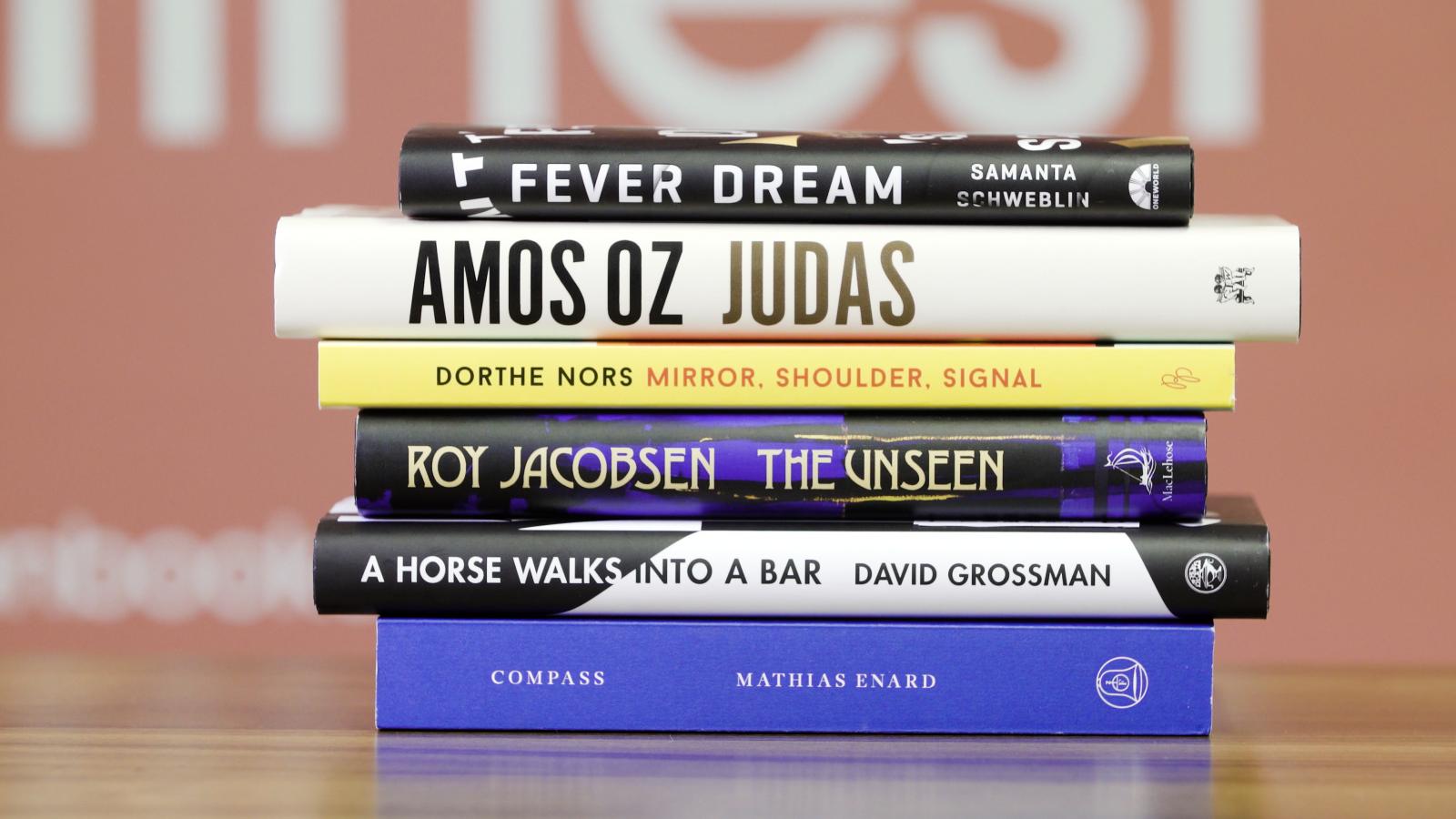
Man Booker International Prize Shortlist Announced

The shortlist for the 2017 Man Booker International Prize was announced yesterday. The annual award is given for a book of fiction translated into English and published during the previous year. The £50,000 prize (approximately $63,900) is split between the writer and translator of the winning book, which will be announced on June 14 in London.

Each of the shortlisted authors and translators will receive £1,000 (approximately $1,280). The finalists are:

Compass (Fitzcarraldo Editions) by Mathias Enard (France) and translated by Charlotte Mandell (US)
A Horse Walks Into a Bar (Jonathan Cape) by David Grossman (Israel) and translated by Jessica Cohen (US)
The Unseen (Maclehose) by Roy Jacobsen (Norway) and translated by Don Bartlett (UK) and Don Shaw (UK)
Mirror, Shoulder, Signal (Pushkin Press) by Dorthe Nors (Denmark) and translated by Misha Hoekstra (US)
Judas (Chatto & Windus) by Amos Oz (Israel) and translated by Nicholas de Lange (UK)
Fever Dream (Oneworld) by Samanta Schweblin (Argentina) and translated by Megan McDowell (US),

“Our shortlist spans the epic and the everyday,” says Nick Barley, the chair of the judging panel. “From fevered dreams to sleepless nights, from remote islands to overwhelming cities, these wonderful novels shine a light on compelling individuals struggling to make sense of their place in a complex world.” The four other judges for the 2017 prize are Daniel Hahn, Elif Shafak, Chika Unigwe, and Helen Mort. The six finalists were selected from a longlist of thirteen, which in turn was selected from 126 submissions.

The prize, which was formerly given biennially for a fiction writer’s body of work, combined last year with the Independent’s Foreign Fiction Prize to award a single book of translated fiction. Han Kang and Deborah Smith won the 2016 prize for Smith’s translation from the Korean of Han’s novel The Vegetarian.

Wearing Language as Clothing

4.20.17

“Thinking thought to be a body wearing language as clothing or language a body of thought which is a soul or body the clothing of a soul, she is veiled in silence,” writes Harryette Mullen in Trimmings (Tender Button Books, 1991). Mia You considers these words and the intersection of the body, language, and fashion in her essay “Sublime Deformations of Nature.” Write your own essay exploring thoughts, experiences, and inspirations on the relationship between language and fashion. How does this influence your ideas on what a body is? 

An Unusual Migration

4.19.17

For many species of animals, spring is not only a time of birth and renewal, but also a time of migration. Write a story in which a character witnesses a strange animal migration. Perhaps your character is also in transition—moving towards or away from someone or something. How does this experience affect the story’s plot? For inspiration, read and watch videos about unusual animal migrations in Smithsonian Magazine

Why Is the World So Messy?

4.18.17

Can girls be robots? How do you make water? What does extinct mean? Children have a curiosity for the world that can often inspire them to ask difficult questions like these from filmmaker Kelly O’Brien’s five-year-old daughter Willow. In the spirit of childish inquisitiveness, write a poem entirely of questions. How might you use a child’s persona to explore your own concerns and wonder for the world? 

Upcoming Deadline: River Styx Poetry Contest

Submissions are currently open for the 2017 River Styx International Poetry Contest. A prize of $1,500 and publication in River Styx is given annually for a single poem. This year’s judge is poet Carl Phillips.

Using the online submission system, submit up to three poems with a $20 entry fee, which includes a subscription to River Styx, by April 30. Paper submissions can be mailed to River Styx Poetry Contest, 3139 A, South Grand Blvd., suite 203, St. Louis, MO 63118. All entries are considered for publication; first-, second-, and third-place winners, as well as honorable mentions, will also be published in the winter 2017 issue of River Styx.

Established in 1975, St. Louis–based literary biennial River Styx publishes international poetry, fiction, essays, interviews, and art. The magazine also hosts writing workshops and a monthly reading series in St. Louis and sponsors annual poetry and flash fiction contests. Visit the website for more information.

Fit for a Fairy Tale

4.13.17

“When I read her the old fairy tales about stepmothers, I worried I was reading her an evil version of myself,” writes Leslie Jamison in a recent essay published in New York Times Magazine. “In the Shadow of a Fairy Tale” explores Jamison’s personal experience as a stepmother through the lens of stepmothers in fairy tales and cultural archetypes. Choose a fairy-tale archetype that feels resonant in some way to you, whether now or in the past. Write an essay examining the various connections between this archetype and its contemporary sociocultural counterpart, which may have resulted in certain expectations and anxieties. In what ways do you fit—and also not quite fit—into the role?

Sleep to Forget

4.12.17

Do we sleep to dream, or to forget? Earlier this year, scientists on two separate research teams published findings that we may sleep in order to forget, essentially paring back the synaptic connections that are formed over the course of a day’s worth of learning, and storing the important information. Write a short story inspired by these discoveries, perhaps imagining a society that has created a technology that can control this nighttime streamlining, or a character who attempts to manipulate this pruning process for her own advantage.

Crayon Colors

4.11.17

Last month, Crayola announced the retirement of one of their yellow crayon colors, Dandelion, which will soon be replaced by a blue crayon. Since Binney & Smith first began producing Crayola crayons in 1903, many colors have been cycled in and out. Some colors have remained the same shade but changed names over the years, such as Peach, which was previously named Flesh Tint, Flesh, and Pink Beige. Read more about the history of Crayola crayon colors, and write a poem inspired by some of the names you find most evocative, perhaps finding thematic potential in how the types of names have evolved over the years.

Jess, Whitehead Win 2017 Pulitzer Prizes

The winners of the 101st annual Pulitzer Prizes were announced today at Columbia University in New York City. Of the twenty-one categories, the prizes in letters are awarded annually for works of literature published in the previous year. Each winner receives $10,000.

Tyehimba Jess won the prize in poetry for his collection Olio (Wave Books). The finalists were the late Adrienne Rich for Collected Poems: 1950-2012 (W.W. Norton) and Campbell McGrath for XX (Ecco).

Colson Whitehead won the prize in fiction for his novel The Underground Railroad (Doubleday). The finalists were Adam Haslett’s Imagine Me Gone (Little, Brown) and C. E. Morgan’s The Sport of Kings (Farrar, Straus and Giroux).

Hisham Matar won the prize in autobiography for The Return: Fathers, Sons and the Land in Between (Random House). The finalists were Susan Faludi’s In the Darkroom (Metropolitan Books) and the late Paul Kalanithi’s When Breath Becomes Air (Random House).

Visit the Pulitzer Prize website for a complete list of winners and finalists in each of the twenty-one categories, including general nonfiction, journalism, and drama.

Hungarian-American newspaper publisher and journalist Joseph Pulitzer established the Pulitzer Prizes in 1911, and the first prize was administered in 1917. The 2016 winners included poet Peter Balakian and fiction writer Viet Thanh Nguyen.

Listen to Tyehimba Jess read an excerpt from Olio, and hear an interview with Colson Whitehead about The Underground Railroad in Ampersand: The Poets & Writers Podcast.


(Photo, from left: Tyehimba Jess, Colson Whitehead)


An Evening With Kelly Harris and Rodrigo Toscano at the University of New Orleans

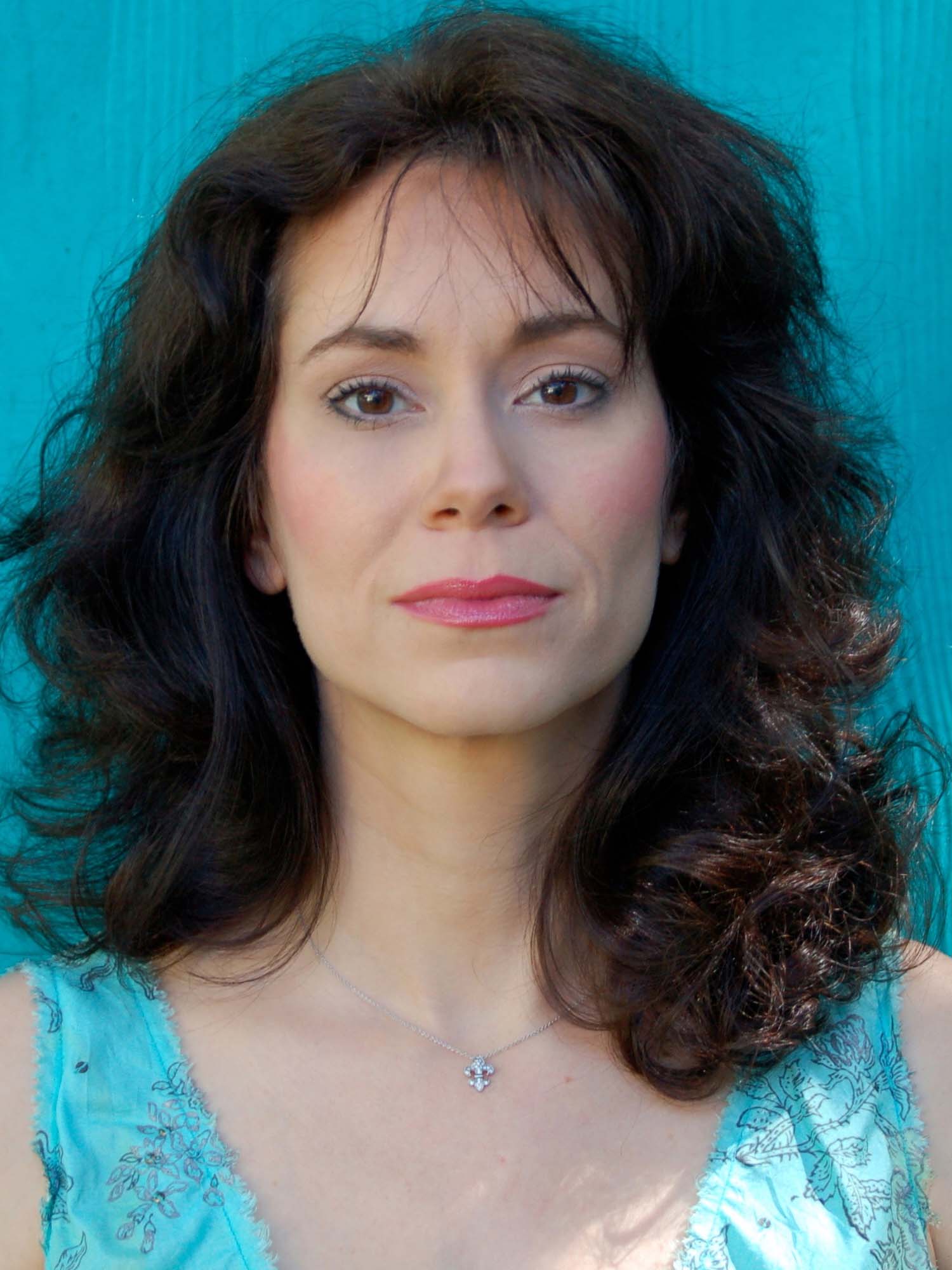
Carolyn Hembree’s debut poetry collection, Skinny, was published by Kore Press in 2012. In 2016, Trio House Books published her second collection, Rigging a Chevy Into a Time Machine and Other Ways to Escape a Plague, winner of the 2015 Trio Award and the 2015 Rochelle Ratner Memorial Award. Her work has appeared in Colorado Review, jubilat, Poetry Daily, and elsewhere. She has received grants and fellowships from PEN, the Louisiana Division of the Arts, and the Southern Arts Federation. An assistant professor at the University of New Orleans, Hembree teaches writing and is the poetry editor of Bayou Magazine.
The University of New Orleans (UNO) English Department and the Creative Writing Workshop, our MFA program, hosts readings and lectures by local and national poets. In recent years, Marilyn Chin, Shara McCallum, Laura Mullen, Marjorie Perloff, Metta Sáma, and Richard Siken have presented their work at UNO. Our poetry readings are held in the Liberal Arts building, Room 197, aka “the Lounge.” Complete with a kitchenette, restrooms, a brick courtyard, filled bookshelves, conference tables, couches, comfy chairs, restrooms, and seven entrances, this communal space serves as a casual dining area, a workshop classroom, and the site of the annual MFA prom. Reflective of the culture of our program and the city, a motto that suits our events might be: Come as you are. Bring what you can. Students and faculty arrange the furniture and contribute homemade food and refreshments.

Last fall, on the evening of October 26, “the Lounge” was packed with forty to fifty attendees. Current Creative Writing Workshop candidate Elle Magnuson introduced New Orleans poet Kelly Harris. One of our city’s most exciting talents, Kelly Harris opened with her cri de coeur, an elegy comprised of the names and lines of “lost black poets”—names and lines Harris variously scatted and sang. She read from loose pages spread across a table—as she later demonstrated during the Q&A—she scored the poem to indicate her vocal inflection. Kelly spent two years studying music to improve upon her poetry and performance skills. Social consciousness characterized the work she shared, particularly poems from Shame on Her, a manuscript on body politics and African American women. Embracing the public role of the poet, Kelly Harris told the audience, “I want to have an audience that’s janitors, poets, everybody—and that comes at a cost.”
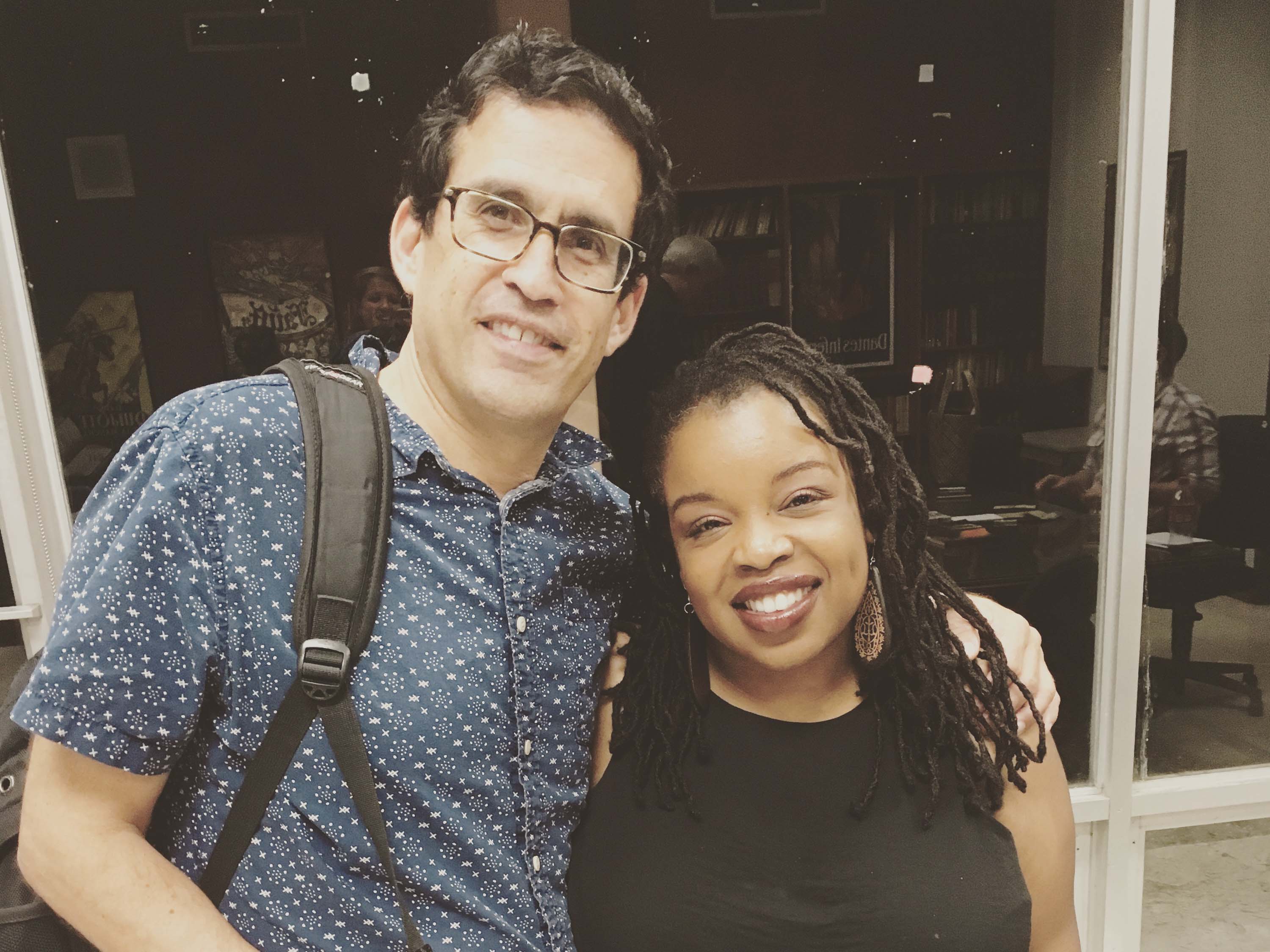
Creative Writing Workshop alumnus Spencer Silverthorne then introduced Rodrigo Toscano. A polyphonic poet with an experimental bent, the longtime Brooklyn resident and recent New Orleans transplant gave a memorable performance from his fifth poetry collection, Explosion Rocks Springfield (Fence Books, 2016). Like Harris, Toscano read from a stack of loose pages. A line from a newspaper article, “The Friday evening gas explosion in Springfield leveled a strip club next to a day care,” serves as the title of each of the book’s eighty poems—a title he delivered with varied nuance each time.

As interrogations of language, Toscano’s text and performance compelled us to consider the impact of words written and spoken, private and public. His fine performance emphasized the contrast of appropriated language from industrial reports and newspapers, and with interjections, onomatopoeia, demotic idioms, interjections, and lyric imagery he engaged listeners. He interacted with the audience frequently, even directing us to repeat the refrain of one poem. However, the most effective moments of his performance may have been the counterpoints to the multiple registers of diction as he ruminated about the language, “What is care exactly?”

Thanks to Poets & Writers’ consistent support and publicity, event attendance by the university and larger community has doubled. Come as you are. Bring what you can. Care.

Support for Readings & Workshops in New Orleans is provided by an endowment established with generous contributions from the Poets & Writers Board of Directors and others. Additional support comes from the Friends of Poets & Writers.

Photos: (top) Carolyn Hembree (Credit: Lynda Woolard). (bottom) Rodrigo Toscano and Kelly Harris (Credit: Mimi Miller).

Pages

Subscribe to RSS - blogs