Once Upon a Tree

5.10.17

One of the oldest trees in the United States—a white oak in a church cemetery in New Jersey estimated to be six hundred years old—was cut down last month after it began failing and was ultimately declared dead. According to local stories, George Washington and the Marquis de Lafayette met and picnicked under the tree during the American Revolution. Write a short story that revolves around a series of imagined encounters that took place under this tree. You might experiment by combining fictional moments with historical events, or write from the point of view of the tree to provide a fresh perspective.

You Come to Me

“I was young when you came to me. / Each thing rings its turn…” begins Meena Alexander’s poem “Muse.” Write a poem of direct address to a muse—any specific object, memory, person, moment, or idea that invokes wonder and reflection. Read the rest of Alexander’s poem for inspiration derived from sensory pleasures, multiple languages, and the associations between words and images.

Fiction and Nonfiction Contest Deadlines

The following contests for fiction and creative nonfiction writers are open for submissions until May 15. Whether you have a short story, an essay, or a novel or memoir manuscript ready to submit, these contests offer prizes of $1,000 to $50,000 and publication.

Ploughshares Emerging Writer’s Contest: Two prizes of $2,000 each and publication in Ploughshares are given annually for a short story and an essay of up to 6,000 words. Writers who have not published or self-published a book or chapbook are eligible. Entry Fee: $24 (no entry fee for current subscribers)

Carve Magazine Raymond Carver Short Story Contest: A prize of $1,500 and publication in Carve Magazine is given annually for a short story of up to 10,000 words. Entry Fee: $15 ($17 for electronic submissions)

Zone 3 Press Creative Nonfiction Book Award: A prize of $1,000 and publication by Zone 3 Press is given biennially for a memoir or essay collection of 150 to 300 pages. Janisse Ray will judge. Entry Fee: $25

Del Sol Press First Novel Competition: A prize of $1,500, publication by Del Sol Press, and 20 author copies is given annually for a debut novel of 200 to 450 pages. Hallie Ephron will judge. Entry Fee: $30

St. Francis College Literary Prize: A prize of $50,000 is given biennially for a third, fourth, or fifth published book of fiction. Story collections and novels (including self-published books and English translations) published between June 2015 and May 2017 are eligible. Jeffery Renard Allen, Ellen Litman, and Rene Steinke will judge. There is no entry fee.

Leeway Foundation Transformation Awards: Awards of $15,000 each are given annually to women and transgender, transsexual, genderqueer, or otherwise gender-nonconforming fiction writers and creative nonfiction writers in the Philadelphia area who have been creating art for social change for five or more years. Writers who have lived for at least two years in Bucks, Camden, Chester, Delaware, Montgomery, or Philadelphia counties, who are at least 18 years old, and who are not full-time students in a degree-granting arts program are eligible. There is no entry fee. 

Visit the contest websites for complete guidelines and submission details. Visit our Grants & Awards database and Submission Calendar for more upcoming contests in poetry, fiction, and nonfiction.

When Soul and Poetry Meet, A Revue Takes Place

Cynthia Manick is the author of Blue Hallelujahs (Black Lawrence Press, 2016). A Pushcart Prize nominee with an MFA in creative writing from the New School, she has received fellowships from Cave Canem, the Callaloo Creative Writing Workshop, Hedgebrook, Poets House, and the Vermont Studio Center. She serves as East Coast Editor of Jamii Publishing and is founder and curator of the reading series Soul Sister Revue. Her work has appeared in the Academy of American Poets’ Poem-a-Day series, African American Review, Bone Bouquet, Callaloo, Muzzle Magazine, Tidal Basin, the Wall Street Journal, and elsewhere. She currently resides in Brooklyn.

At the end of 2013, I wanted a change. I had been going to traditional poetry readings for years and they all felt the same—the same writers and their friends, people with an MFA reading with similar graduates, or people with published books. And more troubling, I didn’t see people who looked like me, on stage or in the audience. People of color were hard to find and when I did find them, there was usually only one on stage with a couple of their friends in the audience for support. Fortunately, I’ve never been the kind of person to wait for things to happen, so I created Soul Sister Revue.

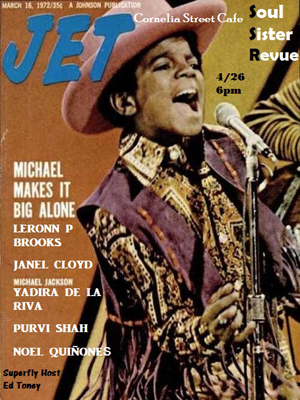
Revue is such a strange name, but it reminded me of vaudeville acts, Motown singers performing together, and theatrical sketches of the 1960s and 1970s that told a story. Soul music and poetry go hand in hand, and when you add the African American oral tradition of storytelling, a revue takes place. People put down their phones, and focus on readers of all ages, gender, and race, as they tell their story through poetry. The first reading took place in April 2014 with Hettie Jones (author of Drive and How I Became Hettie Jones), Evie Shockley (author of a half-red sea and the new black), JP Howard, and me, with T’ai Freedom Ford as host. I had positive experiences with poetry residencies and workshops, so I asked people I admired and they responded. I also set a precedent of established writers (Hettie and Evie) reading on stage with emerging writers (JP and I). To gain interest and connect the Revue to music, I advertised using remastered covers of Jet, Blues and Soul, and Ebony; a practice that still continues. 

Old-fashioned revues came and went like rent parties or pop-up shows, so Soul Sister follows that trend by performing four times a year, one show per season. Each show asks, “What is soul?” Recent audience member Terrance Hayes (author of Lighthead and How to Be Drawn) yelled out, “James Brown!” Others answered, “a feeling,” “music in the veins,” and “connection to the universe.” The answers lay in all of that and in poetry. Soul Sister has read at the NYC Poetry Festival, the HiFi Bar, and with the help of a Poets & Writers’ grant, it goes back to Cornelia Street Cafè every year.

Readers have included Pulitzer Prize–winning poet Gregory Pardlo, Cathy Linh Che, R. Erica Doyle, Ebony Noelle Golden, Charlene McClure, Hanif Willis-Abdurraqib, Elana Bell, and Kamilah Aisha Moon. Some poets e-mail poems to soulsisterrevue@gmail.com and others I find through readings across the city, small online journals, poet recommendations, and if I see an audience member that connects to the work, I’ll put them on the list. At the end of the night, I tell the audience that their story has yet to be written, so go out and write a poem. I like to believe that the soul helps them listen.

Support for the Readings & Workshops Program in New York City is provided, in part, by public funds from the New York State Council on the Arts, and the New York City Department of Cultural Affairs, with additional support from the Louis and Anne Abrons Foundation, the Axe-Houghton Foundation, the A.K. Starr Charitable Trust, and Friends of Poets & Writers.

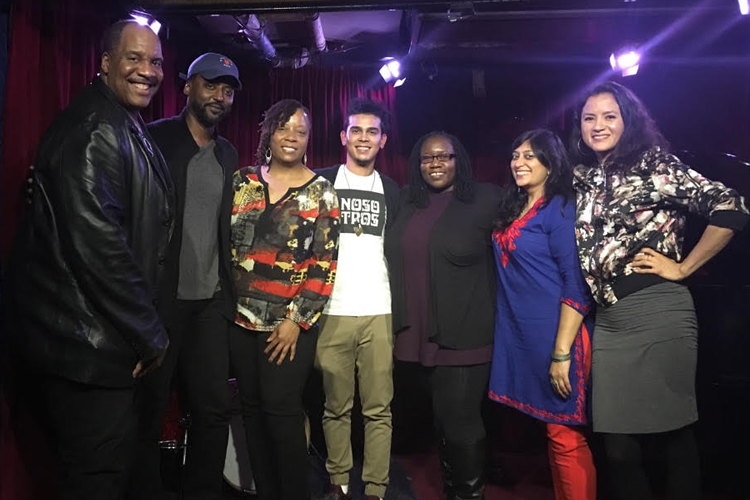
Photo: (left to right) Ed Toney, LeRonn Brooks, Janel Cloyd, Noel Quiñones, Cynthia Manick, Purvi Shah, and Yadira De La Riva at the Fourth Anniversary Show (Credit: Cynthia Manick).

Submissions Open for BOMB Fiction Contest

Submissions are currently open for BOMB Magazine’s 2017 fiction contest. A prize of $1,000 and publication in BOMB’s literary supplement, First Proof, is given in alternating years for a group of poems and a short story. This year’s contest will be given for a short story. Novelist and essayist Paul La Farge will judge.

Using the online submission system, submit a story of up to 5,000 words with a $20 entry fee, which includes a one-year subscription to BOMB (for U.S. entrants), by May 31.

Previous winners of the fiction contest, whose winning work you can read on the BOMB website, include Jen George, Michael Baptist, Karen Walker Thompson, and Sean Madigan Hoen.

Established in 1981 as a quarterly magazine of conversations and interviews between interdisciplinary artists, BOMB is now a “multi-media publishing house that creates, disseminates, and preserves artist-generated content from interviews to artists’ essays to new literature." E-mail firstproof@bombsite.com or visit the BOMB website for more information. 

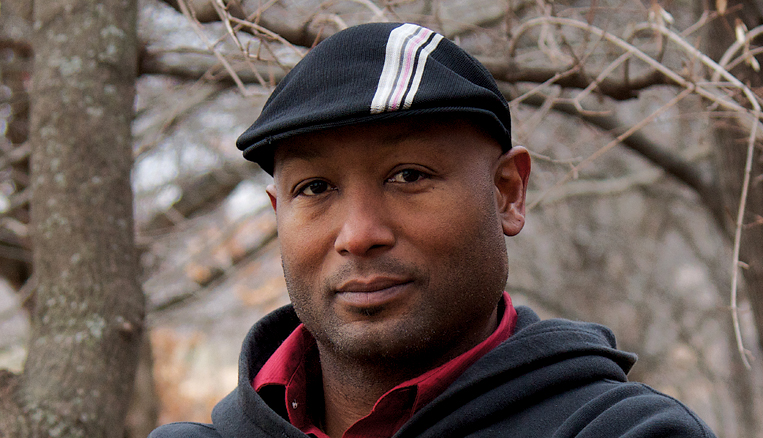
Photo: Paul La Farge. Credit: Carol Shadford

Asian American Poets Encounter the South

Tiana Nobile is a Kundiman Fellow and lives in New Orleans. Her poetry has appeared in the CollagistPhantom, Bone Bouquet, TENDE RLOIN, and others. Her chapbook, The Spirit in the Staircase, a collaboration with visual artist Brigid Conroy, is forthcoming in spring 2017.
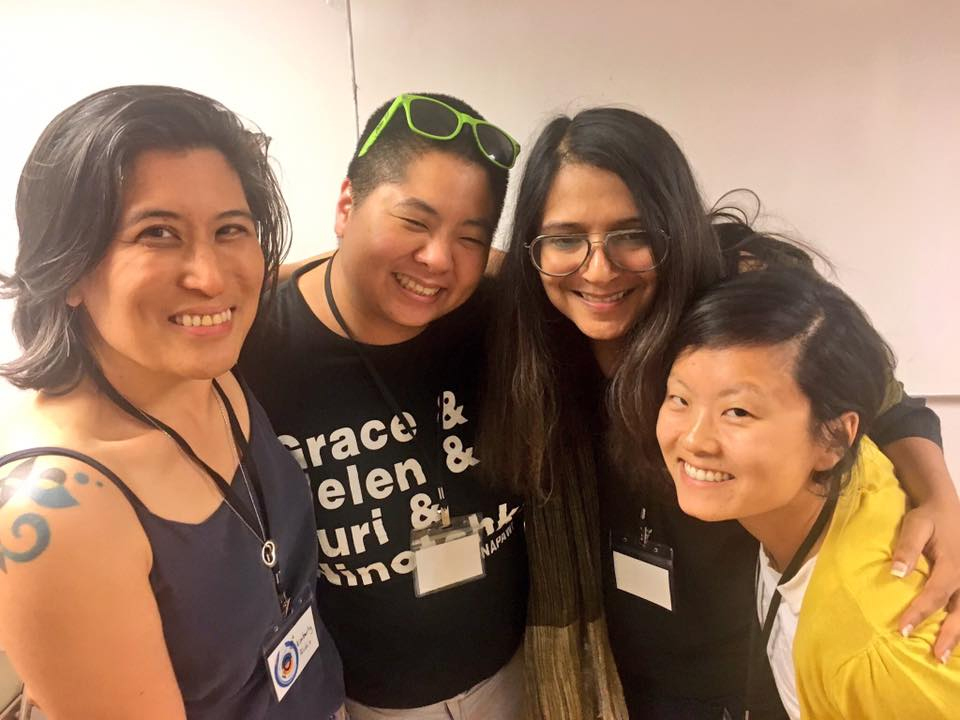
The history and reality of being Asian American in the South are often rendered invisible when it comes to mainstream discourse. Four Kundiman fellows worked to challenge this erasure by uplifting the voices of Asian American poets in the South through the panel, “Self-Articulation and Solidarity: Asian American Poets Encounter the South,” a hybrid poetry reading and discussion at the New Orleans Poetry Festival on April 21.

Within the vast terrain that constitutes the South, we all hail from distinct locations—Ching-In Chen from Houston, Kimberly Alidio from Austin, Vidhu Aggarwal from Orlando, and I’m from New Orleans—and our experiences and histories within these places vary greatly. This panel was not an attempt to seek or define a singular narrative; rather, we discussed the diversity of experience and our personal relationships with the South, whether that be as newcomers, natives, or transplants. While our various participations range, they include actively acknowledging and illuminating the deep, complex histories of Asian American existence in southern communities as teachers and standing in solidarity with the Black Lives Matter movement as activists through Asians 4 Black Lives. During the panel we shared poems and engaged in a critical dialogue in order to call attention to the fact that yes, we are here, we have been here, and we aren’t going anywhere.

Below, the panelists share their thoughts on the experience.

“Our panel was a map across Texas, Louisiana, Florida, and Maryland. It stitched many Asian American Souths: rural and urban, spectacular and invisible. It is intimate and curious. How we commute between communities in a politically diverse South. How we return again and again to crisis encounters in responses to street harassers and scammers profiting from gentrification schemes. How childhoods in the South birth postcolonial futures. How technologies can translate and transmit the migrant condition. Our panel pushed against various narrows and traps. We don’t claim space for permanent, historical settlements atop indigenous land. We refuse to compete with Black communities for civic attention and resources in the South. This is difficult and collaborative work. Thanks to Poets & Writers for making this glimpse of possibility possible.”
—Kimberly Alidio, author of After projects the resound (Black Radish, 2016)

“For Ching-In and I, the New Orleans Poetry Festival was the third iteration of the ‘Self-Articulation’ panel. For me it felt different speaking in New Orleans, where I grew up, learned to ride a bike, worked in street fairs, and where Tiana Nobile has lived for the last ten years. Kimberley Alido read/spoke brilliantly of the Texas landscape. Tiana read from her manuscript The Spirit in the Staircase, ‘l’esprit d’escalier,’ the French term for the perfect comeback, arriving woefully too late, after the fact. We’ve all had our share of jibes, insults on the street, and the impossibility of ready answers. Ching-In asked me about comebacks I might have up my sleeve, and I blanked. A comeback to what? My instinct was to invite folks in the room to hurl insults at me, so I could test my wits in real time! But I couldn’t even do that. I was too slow! The conversation moved on: to the freeze response. Or whether or not our works were a type of response. But would that always put our work/ourselves in a defensive/offensive posture? In argument? We could have talked more, and did over drinks and crawfish at Tiana’s. It was okay to be slow, to take our time, to meet up again and again and figure it out.”
—Vidhu Aggarwal, author of The Trouble With Humpadori (The (Great) Indian Poetry Collective, 2016)

“It’s rare to be seen and allowed space to reflect upon where you live, where you spend time, what you are burning to say and ask. While living in the South, I have felt between spaces, between binaries, between stories. One of the challenges about making sense of our experiences living in the South is that they are so varied and feel singular. Though our experiences living/working in Baltimore; Austin, Houston, and Huntsville in Texas; Orlando, Florida; and New Orleans were varied, to talk, eat, laugh, and poem with other Kundiman South poets at the New Orleans Poetry Festival was to recognize and make sense of each other, to put story to our questions, dialogues, and encounters, to practice generosity with each other and with those we live in community.”
—Ching-In Chen, author of recombinant (Kelsey Street Press, 2017)

Support for Readings & Workshops in New Orleans is provided by an endowment established with generous contributions from the Poets & Writers Board of Directors and others. Additional support comes from the Friends of Poets & Writers.

Photo: Kimberly Alidio, Ching-In Chen, Vidhu Aggarwal, and Tiana Nobile (Credit: Cathy Linh Che).

Drive My Car

As self-driving cars get closer and closer to becoming a reality, the social interaction of driver and passenger may become a thing of the past. Think back to a significant memory you have as the driver or passenger in a motor vehicle. Perhaps it was an adventurous road trip, a taxi ride on a faraway vacation, or in a bus with classmates on your way to a field trip. Write an essay about this event and your role in it. Were you directing the way and in control, or staring dreamily out the window? Was there an argument or a memorable conversation on the journey?

Here Lie the Secrets

What kind of secret should be taken to the grave? How might a secret act as proof of intimacy? For the debut of Sophie Calle’s most recent art installation, the artist spent two afternoons receiving and transcribing visitors’ secrets, and then depositing them into a monumental obelisk installed in Brooklyn’s historic Green-Wood Cemetery. In Calle’s instructive text about the project, she writes of one previously divulged secret, “At the very moment he was depriving me of his love, this man offered me, through his confession, the ultimate proof of our intimacy.” Write a short story in which you imagine the ending to that story. What is the secret that this man confesses to Calle as they are breaking up? Why does he share it with her in their last moments together?

T. Geronimo Johnson Wins New $50,000 Literary Prize

Fiction writer T. Geronimo Johnson has won the Simpson Family Literary Project’s inaugural literary prize. He will receive $50,000 and a brief residency at the Lafayette Library and the University of California in Berkeley. He will also make a number of public appearances and give a public reading in the San Francisco Bay Area. The annual award is given to a midcareer fiction writer to encourage and support forthcoming work.

Johnson, whose 2015 novel, Welcome to Braggsville, was longlisted for the National Book Award, plans to use the $50,000 prize to support his forthcoming novel,which the author says “explores the convergence of Afro-futurism; global AI; the economic imperatives that amplify cultural differences; corporate religion (in all manifestations); and tech inequity. The question behind this novel is the same question that animates my previous work: How do we learn to care about people who are not like us?  I’m thrilled by the opportunity to complete this journey without interruption.”The Simpson Family Literary Prize is cosponsored by the Lafayette Library & Learning Center Foundation in Lafayette, California, and the English Department at the University of California in Berkeley. An anonymous jury selects the winner; there is no application process.

Joe Di Prisco, the Literary Project’s founder and prize chair, established the foundation in 2012 with a mission to foster and build creative writing communities in the Bay Area through collaboration between libraries and university-affiliated creative writing programs. In addition to the literary prize, the Simpson Family Literary Project sponsors community outreach programs, including creative writing classes for high school students and incarcerated youth in diverse communities in California, as well as an annual writer-in-residence program at the Lafayette Library & Learning Center.

Di Prisco says he is excited about the continued growth of the project and selecting Johnson as the winner of its inaugural prize: “The Simpson Family Literary Project is thrilled to share Johnson and his brilliant work with students, readers, writers, teachers, professors, and librarians across generations.”

(Photo: T. Geronimo Johnson; Credit: Sandra Dyas)

Crocodile Ankles

While a crocodile’s ankles might be something you’ve never thought much about, a recent discovery of fossils shows that an early relative of dinosaurs had “crocodylian-like ankle morphology”—or crocodile ankles—an important factor in placing the carnivore within the evolutionary timeline. Write a poem inspired by an unusual phrase or terminology for an animal’s (or human’s) physicality, such as purlicue, perhaps finding humor or playfulness in its sound, sense, and associated imagery.

Pages

Subscribe to RSS - blogs