




Small Press Points
Small Press Points highlights the happenings of the small press players. This issue features Story Line Press, Sarabande Books, Anon. Books, and Rain Taxi.
Jump to navigation Skip to content
Articles from Poet & Writers Magazine include material from the print edition plus exclusive online-only material.
Small Press Points highlights the happenings of the small press players. This issue features Story Line Press, Sarabande Books, Anon. Books, and Rain Taxi.
Page One features a sample of titles we think you'll want to explore. With this installment, we offer excerpts from Vanishing Point by David Markson and Sky Girl by Rosemary Griggs.
Page One features a sample of titles we think you'll want to explore. With this installment, we offer excerpts from The Epicure's Lament by Kate Christensen and Sad Little Breathing Machine by Matthea Harvey.

At some point during her two-year stint atop an ancient 200-foot redwood tree in Humboldt County, California—an effort to to save the old-growth forest—environmental activist and writer Julia Butterfly Hill was approached by HarperSanFrancisco for the rights to publish her memoir, Legacy of Luna. Hill accepted the offer, with one stipulation: Her book had to be printed on 100 percent postconsumer recycled paper manufactured without the use of chlorine bleach.

When it comes to getting poetry into unexpected places, the sky's the limit for Billy Collins. Last fall the former United States poet laureate and author of eight books of poetry partnered with Delta Air Lines to create an audio program of poetry to be offered periodically to passengers on its entire fleet of airplanes.
Literary MagNet chronicles the start-ups and closures, successes and failures, anniversaries and accolades, changes of editorship and special issues—in short, the news and trends—of literary magazines in America. This issue's MagNet features the Kenyon Review, the Iowa Review, the Paris Review, Poetry, Ploughshares, spork, Petroglyph, Isotope, Poetry Daily,Verse Daily, and Literal Latté.
Six months ago Larry Portzline, a professor of writing and literature at Harrisburg Community College in Pennsylvania, started a grassroots movement called Bookstore Tourism—a series of bus trips to urban centers where reader-tourists can patronize independent bookstores. At the end of March, a group of readers from the Harrisburg area will travel approximately 200 miles to the 10th annual Virginia Festival of the Book, where they will participate in festival events (readings, book signings, seminars, and so on) and visit the many independent bookstores that are in Charlottesville, Virginia, including New Dominion Bookshop, the Book Cellar, and Blue Whale Books.
Small Press Points highlights the happenings of the small press players. This issue features Ugly Duckling Presse, Del Sol Press, Scienter Press, and Low Fidelity Press.
In 1998, Dan Bowers, an engineering consultant in Red Lion, Pennsylvania, was on a mission. His son-in-law, Chief Master Sergeant Frederick Honeywell, was serving at an Air Force base in Kuwait that had no recreational facilities and no library—and indeed, no books. When Honeywell's wife, Chris, told her father about the problem, Bowers sent some of his own books, as well as donations from others, overseas. It was the first deployment of what eventually became Operation Paperback. Six years later, the nonprofit organization has sent nearly 150,000 books to American troops in more than 30 locations, including Afghani-stan, Iraq, Bosnia, and Kosovo.

The published correspondence of famous poets often accounts for more real estate on bookstore shelves than their books of poems. For academic scholars who spend their weekends in the special-collections rooms of libraries, the value of these books is obvious. But what are they worth to the general reader, or the practicing poet?
Louise Glück has been appointed the 12th poet laureate of the United States by Librarian of Congress James H. Billington. Glück, whose one-year term began last month, succeeds Billy Collins.
Literary MagNet chronicles the start-ups and closures, successes and failures, anniversaries and accolades, changes of editorship and special issues—in short, the news and trends—of literary magazines in America. This issue's MagNet features American Poetry Review, Land-Grant College Review, 88: A Journal of Contemporary American Poetry, The Prose Poem: An International Journal, Sentence: A Journal of Prose Poetics, Octopus Magazine, Transition, Granta, and Evergreen Review.
British poet and novelist Thomas Hardy, author of Tess of the D’Urbervilles and The Return of the Native, among other literary classics, wanted his personal papers burned after his death. In 1928, a bonfire was dutifully lit but not everything was consigned to the flames. Hardy’s second wife, Florence, saved at least 12 notebooks filled with information and sources on which the author based his later works of fiction. Thomas Hardy’s ‘Facts’ Notebook, edited by William Greenslade and released this month by Ashgate Publishing, is only the most recent to appear.
Page One features a sample of titles we think you'll want to explore. With this installment, we offer excerpts from Jesus Sound Explosion by Mark Curtis Anderson and What Narcissism Means to Me by Tony Hoagland.

This month the world’s first independent publisher of women’s writing, the Feminist Press, launches a steamy—and unlikely—series of pulp fiction titles.

A simple film about the solitary pleasures of reading has turned into a successful campaign to revive a short-lived literary career. Dow Mossman’s only novel, The Stones of Summer, was originally published in 1972 by the now-defunct press Bobbs-Merrill. After being lauded by John Seelye in the New York Times Book Review as “a marvelous achievement” that offered “fulfillment at the first stroke, which is so often the sign of superior talent,” the book went out of print and its author faded into obscurity. Last month it was reissued by Barnes & Noble Books.
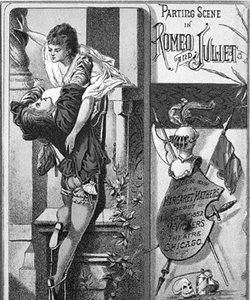
Since Dana Gioia was named chairman of the National Endowment for the Arts in January, the organization has awarded nearly $1 million to poets and translators of poetry and over $2 million to literary arts organizations. But the highest profile project of Gioia’s term so far begins this month, when six theater companies—from New York City; Chicago; Minneapolis; Little Rock, Arkansas; and Portland, Oregon—will begin a yearlong tour of 100 small and midsized cities across the U.S. to perform a selection of plays by William Shakespeare. A seventh theater company will tour 16 U.S. military bases.

Laura Furman, the first female O. Henry series editor in more than forty years, has instituted some changes to the process of selecting stories for her first volume, due out next month from Anchor.

David Foster Wallace’s long-awaited sixth book will arrive in bookstores next month. But it’s not what some might expect from the author of Infinite Jest and A Supposedly Fun Thing I’ll Never Do Again.
Literary MagNet chronicles the start-ups and closures, successes and failures, anniversaries and accolades, changes of editorship and special issues—in short, the news and trends—of literary magazines in America. This issue's MagNet features Poetry, Poems & Plays, the Sow’s Ear Poetry Review, Bloom, the Harvard Advocate, Harvard Review, Meanjin, and Vallum.
Carol Seajay, former publisher of Feminist Bookstore News, a San Francisco–based magazine that covered the feminist, gay, and lesbian book industry until folding in 2000, recently launched Books to Watch Out For, a series of monthly e-mail newsletters featuring reviews of gay and lesbian books.
Page One features a sample of titles we think you'll want to explore. With this installment, we offer excerpts from Bring Me Your Saddest Arizona by Ryan Harty, Indiana, Indiana by Laird Hunt, and Eyeshot by Heather McHugh.

mong organizations hit hardest during the post-9/11 era, in which funding for the arts has been sharply curtailed, literary nonprofits are struggling to simultaneously serve their missions and remain solvent. Despite the economic downturn, two nonprofit organizations—Milkweed Editions, a small press based in Minneapolis, and the St. Mark's Poetry Project in New York City—have maintained financial stability, but more challenges lie ahead: The directors of both organizations, Emilie Buchwald and Ed Friedman, recently retired.
Literary MagNet chronicles the start-ups and closures, successes and failures, anniversaries and accolades, changes of editorship and special issues—in short, the news and trends—of literary magazines in America. This issue's MagNet features the Believer, Partisan Review, Mid-American Review, the Paris Review, One Story, 32 Poems Magazine, and Tin House.
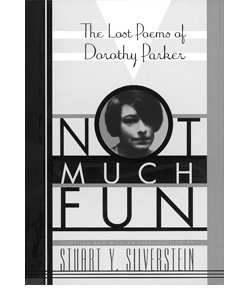
On April 4, United States District Court Judge John F. Keenan ruled in favor of Stuart Y. Silverstein in a plagiarism suit he filed against Penguin Putnam in 2001. Silverstein, who compiled Not Much Fun: The Lost Poems of Dorothy Parker (Scribner, 1996), claimed in his lawsuit that Penguin infringed on his copyright by publishing Dorothy Parker: Complete Poems, which includes a section titled “Poems Uncollected by Parker,” the identical poems published in Not Much Fun.