

Poetry Prize
A prize of $1,000 is given annually for a single poem. Andrew Schelling will judge. Submit up to three poems of no more than three pages each with a $10 entry fee by March 14. Visit the website for complete guidelines.
Jump to navigation Skip to content
A prize of $1,000 is given annually for a single poem. Andrew Schelling will judge. Submit up to three poems of no more than three pages each with a $10 entry fee by March 14. Visit the website for complete guidelines.
Fellowships of up to $5,000 each are given in alternating years to Mississippi poets, fiction writers, and creative nonfiction writers. This year the fellowships will be offered in poetry and fiction. Applicants must be permanent residents of Mississippi. Students enrolled full-time in a degree-granting program are ineligible. Using only the online submission system, submit 5 to 10 pages of poetry or 15 to 20 pages of prose written in the past five years, a résumé, a brief bio, a writer’s statement, and a fellowship impact statement by March 1. There is no entry fee. Visit the website for complete guidelines.
Three prizes of $2,000 each and publication by Sarabande Books are given annually for a poetry collection, a work of fiction, and an essay collection. For the Kathryn A. Morton Prize in Poetry, using only the online submission system, submit a poetry collection of at least 48 pages with a $34 entry fee by February 15. For the Mary McCarthy Prize in Short Fiction, using only the online submission system, submit a collection of stories or novellas or a short novel of 150 to 250 pages with a $34 entry fee by February 15. For the Sarabande Prize in the Essay, using only the online submission system, submit an essay collection of 150 to 250 pages with a $34 entry fee by February 15. Visit the website for complete guidelines.
In a tribute published in the Yale Review to Ellen Bryant Voigt, who passed away in October, executive editor Meghan O’Rourke writes: “Through her, I learned to read like a poet. Not to identify themes, as I’d been trained to do as an undergraduate at Yale, but to attend to effects.” This type of close examination included describing poems by how many medium-length lines and periods were in a poem, and how many lines a sentence takes up. “Her rigor taught me how to read my own work as I’d learned to read others’: closely enough to see what it was resisting,” writes O’Rourke. Revisit a poem you’ve written and consider what the work may want to be, and what it might be resisting. What about its syntax or grammar might lead you to these conclusions? Explore reworking the poem a little or a lot to shape how it arrives at its desired effects, or resists them.
“You have to learn to write when you don’t feel like it.” —Raquel Gutiérrez, author of Southwest Reconstruction
The author of Ocean of Clouds (Knopf, 2025) considers the lineage of his own loping lines and encourages poets to try them.
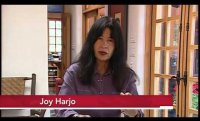
“This table has been a house in the rain, an umbrella in the sun.” In this video that originally aired in 2012, poet Joy Harjo reads her poem “Perhaps the World Ends Here,” which appears in her collection The Woman Who Fell From the Sky (Norton, 1994), for PBS NewsHour.
Write a poem that begins with the image of an animal arriving where it should not be, such as a whale in an office space or a Zebra in a suburban backyard. Allow this surreal scene to take you to unexpected places and metaphors. Is the animal an omen or is it concealing a secret? Focus on the literal and symbolic dimensions of the encounter, drawing out the scene to illuminate overlooked truths, inner stirrings, and the quiet absurdities of the world around you.
The author of Ocean of Clouds (Knopf, 2025) considers the benefits of planning elements of a poem before its composition.