Clam Down

6.11.25

Can a typo inspire a story? In the opening paragraph of Anelise Chen’s memoir, Clam Down: A Metamorphosis (One World, 2025), the narrator recalls a text message from her mother wherein the phrase “calm down” has been transformed, whether through a typo or autocorrect, into “clam down.” This cryptic mistake becomes the premise for a story of metamorphosis and connections, withdrawal and closing up, and family history, as Chen weaves in mollusk science and explores a long-ago period of her father’s retreat from the family. Spend some time observing words and language you see in your daily life from text messages, signage, advertisements, and labels. Select a phrase that has the potential to be interpreted in an open way and leads you into writing a new story, perhaps one that incorporates science, the natural world, and elements of the fantastic.

Joni Murphy

6.11.25
“When you write your letters your goal is twofold: to communicate with your dear friend, and to form a shared portrait of another entity.
read more

Where Does Fiction Come From

Caption: 

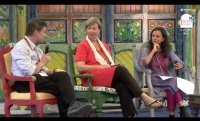
In this Jaipur Literature Festival event moderated by Nadini Nair, novelists David Nicholls, V. V. Ganeshananthan, Geetanjali Shree, Jenny Erpenbeck, and Andrew O’Hagan discuss their respective writing processes, as well as how the novel voice can be used to interrogate the histories established by colonial powers.

Genre: 

When in Rome

6.10.25

The poems in Charity E. Yoro’s debut collection, Ten-cent Flower & Other Territories (First Matter Press, 2023), largely circle around the political history and her personal experience of the Hawaiʻian islands. Her poem “postcard from rome” takes on the feeling of a postcard that arrives unexpectedly in the mail—a surprising and sudden intrusion of an exotic locale. This week, write a poem titled “Postcard From…” and think back to your memories of visiting a new place. Try to reach far from what’s currently at the forefront of your mind, as well as the themes and topics you typically explore in your poetry. Allow this poem to drop in to your current body of writing like a short, evocative glimpse of another time and place—a gentle disruption to your usual flow.

Heid E. Erdrich

Caption: 

In this video, Heid E. Erdrich reads from her collections Verb Animate: Poetry and Prompts From Collaborative Acts (Trio House Press, 2024) and Little Big Bully (Penguin Books, 2020), and answers questions about hope, memories, and revision for this Jensen Lecture Series event hosted by Western Oregon University.

Genre: 

All Talk

“The price of the ride was listening to people talk.” This sentiment is expressed by the young narrator of Joe Westmoreland’s 2001 coming-of-age autofictional book, Tramps Like Us, reissued this week by MCD, to describe his hitchhiking adventures in search of queer belonging and identity. The novel portrays a wide range of characters Joe comes across, befriends, works with, sleeps with, and sometimes loses on the road and in various cities. Compose a memoiristic piece that recounts a cast of characters you’ve met in the past, perhaps only briefly as you traveled from one place to another, who had colorful tales about lives very different from your own. Incorporate snippets of dialogue, trying as best as possible to recall any idiosyncrasies in their speech or vocabulary. Reflect on what you learned from listening and why these stories have stayed with you through the years.

Polly Barton on The Place of Shells

Caption: 

In this McNally Jackson Books event, Polly Barton reads from her English translation of Mai Ishizawa’s debut novel, The Place of Shells (New Directions, 2025), and talks about her experience researching the 2011 Tōhoku earthquake and tsunami in order to capture the historical, emotional center of Ishizawa’s writing in a conversation with Eliza St. James.

Conjoining

In the dystopian world of Hon Lai Chu’s novel Mending Bodies (Two Lines Press, 2025), translated from the Chinese by Jacqueline Leung, a Conjoinment Act has been passed by the government wherein people are encouraged to have their bodies surgically joined to another person, creating couples who purportedly become more fulfilled beings while providing improvements for economic and environmental states. The novel’s structure alternates between sections detailing the narrator’s struggles with her own thinking and decision-making around “conjoining” and sections of her dissertation on the program’s history, including case studies and the origins of bodily “conjoinment.” Taking inspiration from this format, create a dystopian premise in which a society’s government has instituted an optional, controversial policy. Write a short story which intersperses bits of fictionalized research within the in-scene action for a touch of surrealism.

Pages

Subscribe to Poets & Writers RSS