



Neil Gaiman Plays Dress-Up, Cats With Jetpacks, and More
Tags:
Jump to navigation Skip to content
This week write about your experience commuting to work. Whether it's the hour-long drive, daily bus route, or your morning walk, try to think about routines you have developed over the years to make your commute productive or enjoyable. If you work from home, you can write about what it's like not having to commute, and how you turn your home environment into a work environment.
Last night in New York City, George Saunders took home the 2014 Story Prize for his collection Tenth of December. The coveted $20,000 award, now in its tenth year, honors short story collections published in the previous year.
Saunders beat out Andrea Barrett for Archangel (Norton) and Rebecca Lee for Bobcat and Other Stories (Algonquin), who each received $5,000. All three finalists read from and discussed their work with Story Prize director Larry Dark as part of the evening's event.
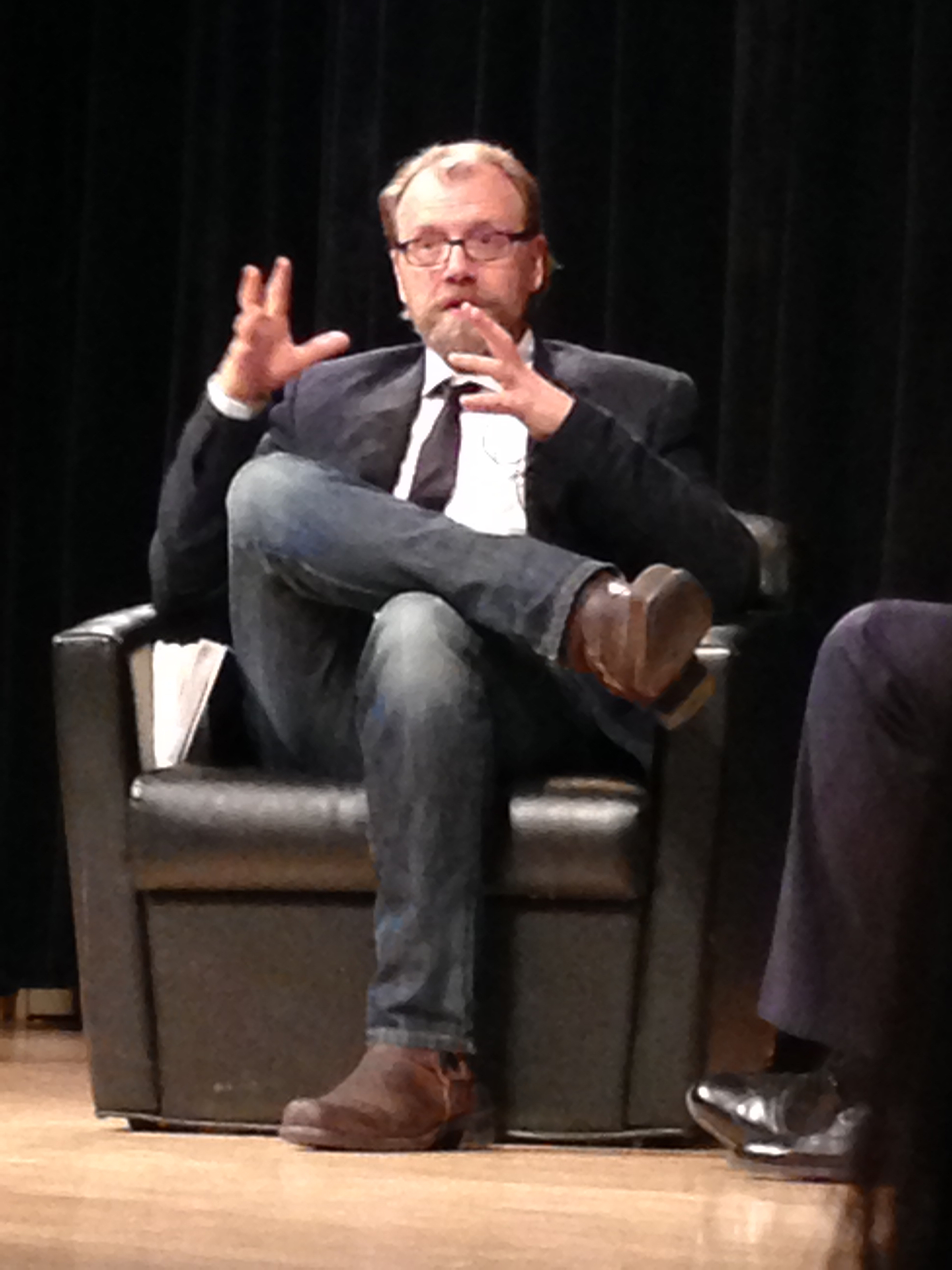
George Saunders discusses his work at the Story Prize ceremony.
Saunders, who lives in Oneonta, New York, is the author of six previous books, including the story collections CivilWarLand in Bad Decline, Pastoralia, and In Persuasion Nation, which was a finalist for the Story Prize in 2007. Tenth of December (Random House), spent ten consecutive weeks on the New York Times hardcover bestseller list, reaching as high as the number two spot. Among numerous other accolades, Saunders received the 2013 PEN/Malamud Award for Excellence in the Short Story and was included in Time's 2013 list of the 100 most influential people in the world.
In his on-stage interview, Saunders discussed his process, the role of sound in his work, and how putting himself inside his characters and “turning to the truth” helps him find what he’s looking for in a character or story. Saunders, who once penned a 700-page novel before scrapping it to turn to stories, praised the short form in his acceptance speech, adding that often the smallest details of the human experience are what ultimately matter most. “We don’t have anything but those small motions of the heart and mind,” he said. “Short stories remind us of that.”
Dark and Story Prize founder Julie Lindsey selected the three finalists from among ninety-six books entered in 2013, from sixty-four different publishers. Three final judges—Stephen Ennis, director of the Harry Ransom Center at the University of Texas at Austin; award-winning author Antonya Nelson; and Rob Spillman, founding editor of Tin House—chose the winner.
“George Saunders offers a vision and version of our world that takes into account the serious menace all around us without denying the absurd pleasures that punctuate life,” the judges said in a statement. “This book is very funny and very sad.”
Claire Vaye Watkins won the 2013 prize. The award is the largest first-prize amount of any annual U.S. book award for fiction.
Last month Ron Charles interviewed poet Carl Phillips, whose most recent collection, Silverchest, was published by FSG in April 2013, as part of the Hill Center Poetry Series, cosponsored by the Library of Congress and the Washington Post.
Seemingly random occurrences can often drive plot forward. Of course, the author curates these random acts—the accidental encounter, the winning lottery ticket. This week, try introducing an element of chance into a story whose plot you've struggled with. It can be as small as a coin toss, or an unexpected event that changes your protagonist’s plans. Be open to wherever it takes you.
Ansel Elkins of Greensboro, North Carolina, has been named the winner of the 2014 Yale Series of Younger Poets prize. Her collection, Blue Yodel, will be published by Yale University Press in April 2014. She will also receive one of five writing fellowships at the James Merrill House in Stonington, Connecticut.

Carl Phillips praised the manuscript, his fourth selection as final judge of the series. “Through her arresting use of persona, in particular, Ansel Elkins reminds us of the pivotal role of compassion in understanding others and—more deeply and often more disturbingly—our various inner selves,” he said. “Razor-edged in their intelligence, southern gothic in their sensibility, these poems enter the strangenesses of others and return us to a world at once charged, changed, brutal, and luminous.”
Elkins is also the recipient of a 2013 National Endowment for the Arts Fellowship in Poetry, the 2012 North American Review James Hearst Poetry Prize, the 2012 Fugue Poetry Prize, and the 2011 “Discovery”/Boston Review Poetry Prize. She received her MFA from the University of North Carolina in Greensboro. Born and raised in Alabama, Elkins writes, “Much of my work explores the South as a complex place of racial violence and isolation, but also familial love.”
Elkins’s book will be the 109th volume in the Younger Poets Series. Given annually since 1919 to a poet under the age of forty for their first collection, the prize is the oldest literary award in the United States. Eryn Green’s Eruv, also chosen by Phillips, received the 2013 prize, and will be published in April. Past winners include John Ashbery, Jack Gilbert, Robert Hass, Adrienne Rich, and Jean Valentine.
Cheryl Strayed visits Wisconsin; Melville House wonders if the author is dead; books to help with midlife crises; and other news.
Most of us have ancestors born in countries we may have never visited. This week, trace your family’s origins to a foreign city or town. Try to imagine the landscape of this place: the terrain, nature, and customs that characterize it. Find a way to connect it to your current landscape, creating a poem that joins these two places.
Eric Obenauf and Eliza-Wood Obenauf talk informally about the origin of Two Dollar Radio, the small press they founded in Columbus, Ohio, in 2005. Or was it 2004?
The Tournament of Books ignores author’s wishes; a fourteen-year-old’s poem goes viral; a new beer-battered bookstore opens in Texas; and other news.
