The Short Short

2.24.21

“Short short stories hold the obvious charge of compressing narrative in a rather extreme way, but what I initially loved about writing the form was the possibility to attend to reverberation,” writes Peter Kispert in a recent installment of Craft Capsules. “I noticed how a detail could echo out more apparent, and controlled, than in the longer works of fiction I had been drafting.” Kispert dives into his experience reading Amy Hempel’s “Going,” a three-page story from her collection Reasons to Live (Knopf, 1985), and how the unconventional narrative blew “the world wide open in the best way.” Write a short short story of up to three pages that compresses a narrative through controlled, powerful details.

A Moment in the Dark

If you are reading this and aren’t from Texas, say some prayers. We are still in recovery mode—our homes are still spaces scarred by ice and busted pipes, waterlogged walls and no food or shelter, all on top of a pandemic. Give us grace.

It isn’t that the winter storm is something we cannot adapt to—it is that this is the latest in a series of natural disasters that Houston has had to endure. The trauma is real. The longing for calm is palpable.

We are boiling water, we are waiting for plumbers to fix the pipes, who in turn have to scavenge to find the materials to fix our houses, and their own. Some of us are still waiting on the lights...IN THE MIDDLE OF A PANDEMIC.

I wrote a poem on the second night of my own family’s personal ordeal. I thought of what could bring down cheer to the heart, not even knowing when this would see the light of day. I wrote this with my phone at 5 percent battery life.

How to Prepare for Winter Storm in TX

The day brings white ice and soon the
Stars see us, wishing on a single thread.
At dusk, we come undone, wait for light
Night brings a child we cannot avoid, we
Are creatures of light, we gather in
Big pockets, we muscle fire forward
And we do howl for peace and flame.
Bright smiles keep us warm even when
Deep rains cause us to freeze. We know
In the gut, what it means to rise up, take
Heart that this won’t bring me down.

I’ll find you, bring you hot hands and song.

If you have a moment, please consider donating to these sources to help the Houston community. Many are overwhelmed with monetary donations, but offer other ways to help. Please also be careful to verify the accounts you send funds to as there have been reports of scams and fake accounts on Venmo and other payment platforms.

Here are a few local organizations to consider supporting:

1. Houseless Organizing Coalition (@HocHtx) is a revolutionary coalition fully operated by BIPOC organizers building dual power within Houston’s houseless community. They are currently distributing supplies and addressing needs for those in our houseless community.

2. West Street Recovery (@weststreetrecovery) is a horizontally organized grassroots nonprofit organization which aims to use efforts toward recovery after Hurricane Harvey to build community power.

3. Houston Food Bank (@HoustonFoodBank ) serves more than 1.1 million people in the eighteen Southeast Texas counties and distributes food and other essentials to those in need through a network of 1,500 community partners.

4. Texas Jail Project (@TxJailProject) is a grassroots advocacy project that listens, informs, and advocates for people trapped in Texas county jails. Amidst the Texas Winter Storm, they have set up a rapid response helpline for folks and their families to report on-the-ground conditions in jail facilities where thousands have no clean drinking water and are experiencing neglect. They are distributing funds to people's commissaries for those who are able to purchase food, water, and hygiene products through their jail’s commissary stores. They are also posting money to phone accounts and covering the cost of all collect calls from jails.

Lupe Mendez is the literary outreach coordinator for Poets & Writers in Houston. Contact him at [email protected] or on Twitter, @houstonpworg.

The Poetic City That Was

Caption: 

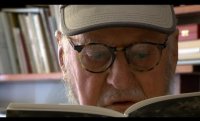
“It was still the last frontier when I arrived in 1951. It was a wide-open city.” In this 2015 video, Lawrence Ferlinghetti recalls his early days in San Francisco and speaks about the changing life of the city. Ferlinghetti died at the age of 101 on February 22, 2021. An interview with the legendary poet and founder of City Lights Booksellers and Publishers is featured in the March/April 2007 issue of Poets & Writers Magazine.

Genre: 

Poem in Prose

2.23.21

In the introduction to The Penguin Book of the Prose Poem: From Baudelaire to Anne Carson (Penguin Classics, 2018), editor Jeremy Noel-Tod asks, “How do you define a prose poem?” Literary critic Michael Rifaterre once characterized the prose poem as a “genre with an oxymoron for a name,” while Noel-Tod simply defines it as “a poem without line breaks.” This week, try writing a prose poem. As Noel-Tod says in the book, “Our habitual expectation when we see a passage of prose is that it will explain, not sing.” How can you make your prose poem sing more than traditional verse might? For inspiration, read exemplary poems from this anthology, such as “Borges and I” by Jorge Luis Borges, “The Colonel” by Carolyn Forché, and “Deer Dancer” by Joy Harjo.

The White Tiger

Caption: 

“When I first saw him, I knew then: This was the master for me.” Aravind Adiga’s Man Booker Prize–winning novel, The White Tiger, has been adapted into a Netflix film directed by Ramin Bahrani. Starring Adarsh Gourav, Priyanka Chopra Jonas, and Rajkummar Rao, the film follows an ambitious driver in India who escapes poverty through deceptive acts.

Genre: 

Milk Blood Heat: Dantiel W. Moniz With Lauren Gross

Caption: 

In this virtual book launch hosted by Books & Books in Florida, Dantiel W. Moniz discusses the inspiration behind her debut short story collection, Milk Blood Heat (Grove Press, 2021), with Lauren Groff, author of Florida (Riverhead Books, 2018). Milk Blood Heat is featured in Page One in the March/April issue of Poets & Writers Magazine.

Genre: 

Scarification

2.18.21

“First, the knees. They meet the gravel, the street, the blunt hips of curbs,” writes Melissa Febos in the prologue of her third book, Girlhood, published by Bloomsbury in March. The numbered essay titled “Scarification” includes detailed anecdotes ranging from childhood injuries with erasers to experiences with addiction. Febos captures “how these memories draw the constellation of your history” and turns the sentiment that “it is better to choose your pain than to let it choose you” into the final words of the essay: “You choose it, and it chooses you.” Write an essay that catalogues a history of your physical injuries and how you have confronted adversity. What similarities connect the various accounts, and what arc is there, if any, to this register?

Motown Mic 2021

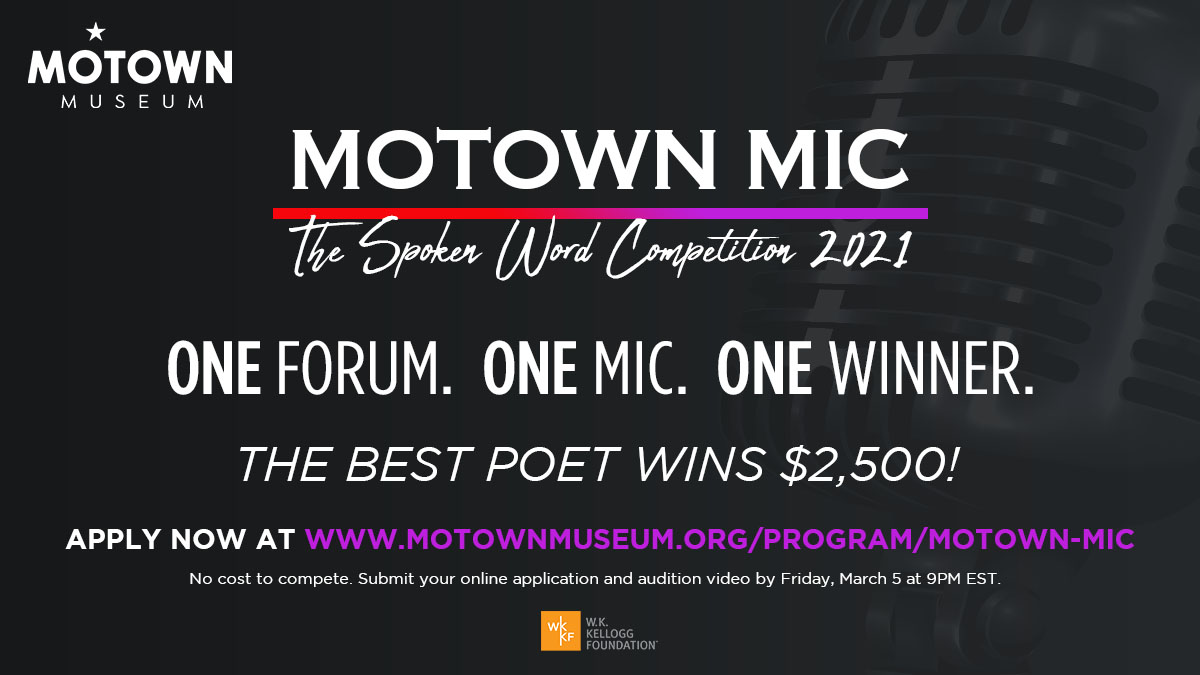
The Motown Mic spoken word competition is an annual event held at the historic Motown Museum in Detroit. The museum preserves the former home of Motown founder Berry Gordy, the offices of Hitsville U.S.A., and the legendary studio where Motown artists recorded some of their greatest hits. Not only did the label record celebrated music, African American poets and orators, including Elaine Brown, Stokey Carmichael, Ossie Davis, Langston Hughes, and Dr. Martin Luther King, Jr., were recorded by the label.

The annual spoken word competition usually involves a series of poetry slams that require participants to write about a specific topic or theme related to Motown. I am excited to see that Motown is able to modify the competition this year to accept auditions recorded on video. Beyond being an amazing opportunity to share poetry, this year’s grand prize includes a two-hour studio session at Hitsville, publication in a literary broadside published by Broadside Lotus Press, and $2,500! 

This year’s original poem theme is focused on the fiftieth anniversary of the release of Marvin Gaye’s award-winning song “What’s Going On”: “At a time when conversations about social justice are taking place with new urgency and passion, and in reflection of the words that Marvin Gaye sang, we want to hear from you. As you compose your submission, keep this, and the legacy of Motown’s contributions to these conversations in mind. Doing so will further influence hearts and minds and contribute to conversations about the moral and civic perspectives shaping our collective future.”

The competition is open to all residents of South East Michigan over sixteen years old. The application deadline is March 5. I hope many of you share your words!

Photo: Motown Mic spoken word competition 2021 poster art.
 
Justin Rogers is the literary outreach coordinator for Poets & Writers in Detroit. Contact him at [email protected] or on Twitter, @Detroitpworg.

Pages

Subscribe to Poets & Writers RSS