Valuing Criticism

5.18.23

In a recent installment of our Ten Questions series, Jennifer Lunden, author of American Breakdown: Our Ailing Nation, My Body’s Revolt, and the Nineteenth-Century Woman Who Brought Me Back to Life (Harper Wave, 2023), mentions a quote by Jean Cocteau she considers the best writing advice: “Listen carefully to first criticisms made of your work. Note just what it is about your work that critics don’t like—then cultivate it. That’s the only part of your work that’s individual and worth keeping.” Write a list of criticisms you have encountered as a writer—including ones you have of yourself. Then, write an essay that looks to the value in those parts of your voice.

Édouard Louis on His Latest Memoir

Caption: 

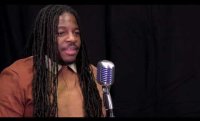
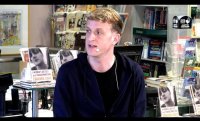
“All the books I’ve written in the past were books that I decided to write suddenly while I was writing something else.” In this London Review Bookshop conversation, French writer Édouard Louis speaks about his writing process and discovering the parts of his mother’s life he did not know for his new memoir, A Woman’s Battles and Transformations (Farrar, Straus and Giroux, 2022), with translator and novelist Tash Aw.

It’s a Myth

5.17.23

In a scene from Mary Gaitskill’s novel Veronica, the protagonist reflects on an innocent moment from her childhood: “When I was a young child, my mother told me that love is what makes the flowers grow. I pictured love inside the flowers, opening their petals and guiding their roots down to suck the earth.” This week write a story based on a myth told to you as a child, whether it be storks delivering babies, the tooth fairy trading money for teeth, or that chewing gum would stay in your stomach for seven years if you swallowed it. Were there good intentions behind these stories or did they cause more harm than good?

Nana Kwame Adjei-Brenyah on Writing Chain-Gang All-Stars

Caption: 

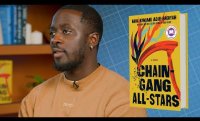
“Part of my purpose as a writer is to help make compassion the standard.” In this Penguin Random House video, Nana Kwame Adjei-Brenyah talks about his research process, speculative fiction, and writing his debut novel, Chain-Gang All-Stars (Pantheon, 2023).

Genre: 

Small Towns

5.16.23

“This where all the roadside memorials are, / pink wreaths and dirty teddy bears. // This where a man walked when he wanted to fly,” writes Tyree Daye in his poem “Ode to Small Towns,” which appears in his collection Cardinal (Copper Canyon Press, 2020). Daye uses the repetition of “this where” to fold in various threads of distinct stories, making it feel as if the poem was written while driving through a series of towns and telling the tales as they surfaced. Inspired by Daye’s poem, write an ode to the small towns you’ve encountered while on the road. What kinds of stories do you picture when you pass through?

Sarah Moss

Caption: 

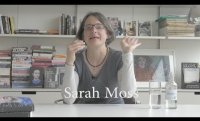
“I don’t really think you can teach people to write, you can just teach them to read. Read everything you can about your setting or your characters or whatever it is you don’t know.” In this Granta video, Sarah Moss, author of the novels Ghost Wall (Farrar, Straus and Giroux, 2019) and Summerwater (Farrar, Straus and Giroux, 2021), offers advice on first drafts, research, and the importance of reading to a writer.

Genre: 

Han Kang on the Horror of Humanity

Caption: 

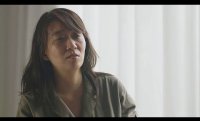
In this 2019 Louisiana Channel interview, Man Booker–winning author Han Kang speaks about the origins of her writing from her love of books to her questions about humanity. “When we are confronted by the horror of humanity, we have to question ourselves,” says Kang. Her new novel, Greek Lessons (Hogarth, 2023), translated from the Korean by Deborah Smith and Emily Yae Won, is featured in Page One in the May/June issue of Poets & Writers Magazine.

Failure as Kin

5.11.23

In a recent installment of our Craft Capsules series, Christine Imperial, author of Mistaken for an Empire: A Memoir in Tongues (Mad Creek Books, 2023), writes about the freedom in hybrid forms of the essay and how becoming comfortable with failure helped the process of writing her book. “The essay should be an experiment—without a guarantee of success, like the hypothesis before an experiment,” she writes. “When one writes with failure as kin, one writes without the expectation of understanding, ceding to the persistence of the opaque.” Write an essay about a time when failure led to a better understanding of something in your life. What lessons did you learn through this process?

Unboxing Shakespeare’s First Folio

Caption: 

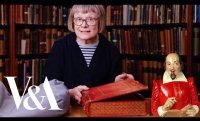
Travel back four hundred years for this Victoria and Albert Museum video as Elizabeth James, senior librarian at the National Art Library in London, presents the secrets behind the First Folio of Shakespeare, which was published in 1623 and includes his iconic plays Twelfth Night, Macbeth, and The Tempest.

Pages

Subscribe to Poets & Writers RSS