

Genre: Fiction

Bard Fiction Prize

Bard College
Entry Fee: 
$0
Deadline: 
June 1, 2026
A prize of $30,000 and a one-semester appointment as writer-in-residence at Bard College is given annually to a fiction writer under the age of 40. The winner must give at least one public lecture and meet informally with students but is not expected to teach traditional courses. Submit three copies of a published book of fiction, a cover letter, and a curriculum vitae by June 1. There is no entry fee. Visit the website for complete guidelines.
Literary Awards

New Letters
Entry Fee: 
$24
Deadline: 
May 18, 2026
Three prizes of $2,000 each and publication in New Letters are given annually for a poem, a short story, and an essay. Using only the online submission system, submit up to six poems totaling no more than 30 pages or a story or an essay of up to 8,000 words with a $24 entry fee, which includes a digital subscription to New Letters, by May 18. All entries are considered for publication. Visit the website for complete guidelines.

Prizes in Poetry and Prose

Bellevue Literary Review
Entry Fee: 
$20
Deadline: 
July 1, 2026
Three prizes of $1,000 each and publication in Bellevue Literary Review are given annually for a poem, a short story, and an essay about health, healing, illness, the body, or the mind. Natalie Diaz will judge in poetry, Daniel Mason will judge in fiction, and Meghan O’Rourke will judge in creative nonfiction. Using only the online submission system, submit up to three poems totaling no more than five pages or up to 5,000 words of prose with a $20 entry fee by July 1. All entries are considered for publication. Visit the website for complete guidelines.

Kellman Prize for Immigrant Literature

Restless Books
Entry Fee: 
$20
Deadline: 
May 31, 2026
A prize of $10,000 and publication by Restless Books is given annually for a debut book of fiction or nonfiction by a first-generation immigrant. The winner will also receive a writing residency at Millay Arts in Austerlitz, New York. Writers who have not published a book of fiction or nonfiction in English are eligible. Using only the online submission system, submit a prose manuscript of at least 45,000 words, a curriculum vitae, and a one-page cover letter with a $20 entry fee by May 31. Visit the website for complete guidelines.

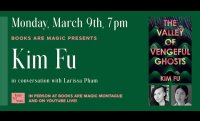
Kim Fu: The Valley of Vengeful Ghosts

Caption: 

In this Books Are Magic event, Kim Fu reads from her latest novel, The Valley of Vengeful Ghosts (Tin House, 2026), and talks about how word choices and details shape the loneliness of her worlds in a conversation with Larissa Pham. “You can describe anything in an infinite number of ways,” says Fu.

Genre: 

Critical Fabulation

In much of her work, scholar and author of the award-winning book Wayward Lives, Beautiful Experiments: Intimate Histories of Riotous Black Girls, Troublesome Women, and Queer Radicals (Norton, 2019), Saidiya Hartman writes about the silences, gaps, and omissions present in conventional institutional archives that leave out the voices and lives of marginalized people. In her 2008 essay “Venus in Two Acts,” published in Small Axe: A Caribbean Journal of Criticism, she coined the term “critical fabulation” to describe a research method that combines archival research, critical theory, and storytelling to redresses and reimagine these historical biases. Write a short story that echoes this idea, beginning the process by considering what old textbooks have gotten wrong. What history would you like to retell? How can your story reimagine not only what happened long ago but also imagine a different present?

Aurora Writers Workshop

The 2026 Aurora Writers Workshop will be held from June 5 to June 7 at several locations throughout downtown Aurora, Illinois. The workshop will feature small-group craft workshops, a keynote address, a group dinner with a faculty reading, an open mic reading, and generative writing sessions for poets and fiction writers. The faculty includes poet Faisal Mohyuddin and fiction writer Meg Cass. Poet and fiction writer M. Rae Henry will give the keynote address. The cost of the conference, which includes one dinner and a continental breakfast on Sunday, is $200.

Type: 
CONFERENCE
Ignore Event Date Field?: 
no
Event Date: 
June 5, 2026
Rolling Admissions: 
yes
Application Deadline: 
May 9, 2026
Financial Aid?: 
no
Financial Aid Application Deadline: 
May 9, 2026
Free Admission: 
no
Contact Information: 

Aurora Writers Workshop, 1030 Northfield Drive, Aurora, IL 60505. Kristin LaTour, President.

Kristin LaTour
President
Contact City: 
Aurora
Contact State: 
IL
Country: 
US

Vauhini Vara and Karan Mahajan on A.I.-Generated Fiction

Caption: 

In this episode of Literary Hub’s Fiction/Non/Fiction podcast cohosted by V. V. Ganeshananthan and Whitney Terrell, Vauhini Vara talks about her New Yorker essay on A.I.-generated fiction and about how technology might change the future of literature with Karan Mahajan, author most recently of The Complex (Viking, 2026).

Genre: 

Soaping Up

Amnesia, evil twins, baby swaps, love triangles, and fake deaths are common tropes that have been used in American soap operas for decades. According to Jo Walker’s Guardian review of the 2019 South Korean television series Crash Landing on You, which received critical acclaim and gained worldwide popularity after streaming on Netflix, Korean melodrama plot conventions include “forgotten chance meetings, dramatic piggyback rides, and at least one scene per show where the heroine gets totally juiced on beer.” Write a short story that borrows one of these K-drama tropes or a newly discovered one. Give yourself permission to meld “soapy” characteristics with perhaps more nuanced or subtle literary elements. How can the integration of melodrama imbue your story with humor or emotional dynamism?

Pages

Subscribe to Fiction