Toward the Sensuous Form: Origins and Possible Trajectories of the Essay

The author of Voice of the Fish: A Lyric Essay (Graywolf Press, 2022) reflects on the ancient origins of the essay form.
Tags:
Jump to navigation Skip to content
The author of Voice of the Fish: A Lyric Essay (Graywolf Press, 2022) reflects on the ancient origins of the essay form.
It’s that time of year to send and receive holiday cards, some of which may include a family newsletter with highlights of the past year from friends and family. According to a survey from the Emily Post Institute, a family business promoting etiquette since 1922, 47 percent of respondents don’t like to receive holiday newsletters. The institute’s website suggests this might be because the letters are more of a brag sheet rather than a genuine desire to communicate. Try your hand at composing a holiday newsletter that recounts notable events and milestones from throughout the past year. Take this exercise as an opportunity to reflect on favorite memories and changes, both big and small. Perhaps you’ll decide to subvert conventional expectations and strike a subversively satirical or darkly apocalyptic tone. Have fun with it!
The 2026 Neraki International Writers Workshops will be held from June 5 to June 14 at a seaside private home and seminar space in Katigiorgis, Greece. The workshop features craft classes, generative writing sessions, small-group workshops, individual meetings with mentors, unstructured time for writing, and various wellness activities for poets, fiction writers, and creative nonfiction writers. The faculty includes poet and fiction writer Paula Closson Buck and fiction and creative nonfiction writer Jim Buck.
Neraki International Writers Workshops, c/o Paula Closson Buck, 145 Jean Boulevard, Lewisburg, PA 17837. (570) 412-2366. Paula Closson Buck, Cofounder.
Writeaways offered a weeklong retreat from April 10 to April 17 to poets, fiction writers, and nonfiction writers (including creative nonfiction writers) at the 17th century Villa Cinci and Villa Casanova located in the Chianti region of Tuscany, Italy. Residents were provided with time and space to write, writing workshops, private writing consultations, and a cooking class. The faculty includee poet and fiction writer Mimi Herman and fiction and nonfiction writer John Yewell.
Writeaways, Writeaway in Italy, P.O. Box 62012, Durham, NC 27715. Mimi Herman and John Yewell, Codirectors.
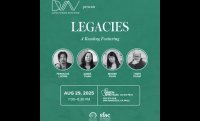
In this Green Apple Books event, the Diasporic Vietnamese Artists Network (DVAN) presents a night of readings featuring writers François Luong, Aimee Phan, Minnie Phan, and Thien Pham, sponsored by the San Francisco Public Library and San Francisco Arts Commission.
For the “Seriously Celebrating the New Yorker’s 100th Anniversary: Fiction” event hosted by the House of SpeakEasy at Joe’s Pub in New York, Yiyun Li weaves together stories about connecting with hairdressers in salons over the years and how real-life stories can sometimes transform into different stories through fiction writing. “People tell us stories and our stories live in their memory. And hair grows, life goes on,” says Li.
A prize of $5,000 is given annually for a work-in-progress by a debut biographer. The winner also receives a review of their manuscript proposal by an agent, publicity through the Biographers International Organization (BIO) website and the Biographer’s Craft newsletter, registration to the annual BIO Conference in May, and a one-year BIO membership. Writers who have not previously published or who are not under contract to write a book of biography, history, or other work of narrative nonfiction are eligible. Using only the online submission system, submit a writing sample, a manuscript proposal, and a résumé in one document totaling no more than 20 pages with a $25 entry fee by March 1. Visit the website for the required entry form and complete guidelines.
Nine fellowships of $1,500 each and participation in a virtual five-month mentorship program, which includes one-on-one mentorship with an established writer; introductions to editors, agents, and publishers; a professional headshot; and a one-year PEN America membership, are given annually to emerging poets, fiction writers, and creative nonfiction writers “from communities that are traditionally underrepresented in the publishing world.” Fellows also participate in workshops on editing, marketing, and building a professional platform. Writers who have not yet published a book and who do not hold an advanced degree in creative writing are eligible. Using only the online submission system, submit a writing sample of up to 10 pages of poetry or 15 pages of prose, a series of personal statements, a curriculum vitae, and contact information for at least one reference with a $25 entry fee by January 31. Visit the website for complete guidelines.
A prize of $5,000 and publication in Chautauqua is given annually for a single work of fiction or nonfiction by an emerging writer displaying “daring formal and aesthetic innovations that upset and reorder readers’ imaginations.” The winner will also receive a $2,000 travel and lodging stipend to give a lecture at the Chautauqua Institution in the summer. Writers who have not published a book of over 15,000 words in any prose genre are eligible. Submissions may consist of unpublished work or work published no earlier than April 2025. Submit a manuscript of up to 15,000 words totaling no more than 100 pages with a $25 entry fee by January 31. Visit the website for complete guidelines.
Two prizes of $10,000 each are given annually for a book of fiction and a book of nonfiction (including creative nonfiction) published in the previous year that “foster peace, social justice, and global understanding.” A runner-up for each prize receives $5,000. Publishers may submit any number of books published in 2025 with a $100 entry fee per title by March 4. Books first printed in or translated into English are accepted. Visit the website for the required entry form and complete guidelines.