John Ashbery Has Died, Literary Agents in D.C., and More
Poetry Foundation announces 2017 fellowship recipients; novelist Susan Vreeland has died; Christopher Soto on political poetry versus protest poetry; and other news.
Jump to navigation Skip to content
Poetry Foundation announces 2017 fellowship recipients; novelist Susan Vreeland has died; Christopher Soto on political poetry versus protest poetry; and other news.
Danny Strong’s directorial debut, Rebel in the Rye, is a biopic portraying J. D. Salinger’s earlier years, focusing on his service during World War II and the 1951 publication of The Catcher in the Rye. The film is adapted from Kenneth Slawenski’s biography J. D. Salinger: A Life (Random House, 2011), and stars Zoey Deutch, Nicholas Hoult, and Kevin Spacey.
In a New York Times review of three recently reissued books by English-born artist and author Leonora Carrington, Parul Sehgal describes Carrington’s habit of writing in rudimentary Spanish or French, an example of exophony, the practice of writing in a language that is not the writer’s native tongue. Sehgal also recounts Samuel Beckett, who after adopting French, stated in a letter: “More and more my own language appears to me like a veil that must be torn apart in order to get at the things (or the Nothingness) behind it.” Write a short essay about a particularly resonant memory. Then try rewriting the same memory either in another language, even if you only have a basic knowledge of it, or in a style of English that has been “torn apart” and defamiliarized. Do you find this practice freeing or limiting? Which elements of the memory and your storytelling are drastically altered, and what remains consistent throughout both versions?
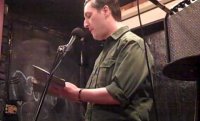
Mike Scalise reads from his debut memoir, The Brand New Catastrophe (Sarabande Books, 2017), at the Sunday Salon series in New York City. Scalise is featured in “The Unknown Yet Inevitable: Debut Literary Nonfiction of 2017” in the September/October issue of Poets & Writers Magazine.
Eyvette Jones Johnson and her husband Craig Johnson are founders of Urban Possibilities, an empowerment program that uses writing and performance to help inner-city job seekers thrive in the marketplace and in life. Craig is a photographer who chronicles their journey and Eyvette serves as executive director. For fifteen years, she was a TV producer creating shows for networks that include CBS, NBC, ABC, and PBS. Today, she uses skills honed in entertainment to help adults find their voices, tell their stories, and bring diverse audiences together to celebrate their talent. 80 percent of Urban Possibilities students are or have been homeless.
 Each time an inner-city job seeker walks through our doors, we see unparalleled treasure. To make sure audiences and employers see it too, we know our job is to deliver light into deep dark places. The voices and stories of our students are buried under life’s toughest circumstances: homelessness, joblessness, abuse, addiction, and military trauma, among others. Our students are adults, often marginalized, fighting to survive and searching for work in the homeless capital of America: Los Angeles.
Supported by Poets & Writers from the day we began, our twelve-week Writing Empowerment program at Chrysalis job center is a fueling station that turns pain into power for those making their way back from the abyss. Writing and sharing their truths help ignite their comeback. Weekly classes, most recently led by P&W–supported teaching artist Jesse Bliss, help urban job seekers deal with trauma, rediscover their strength, and tell their stories poetically and with power—all skills needed for a successful job search.
Each class culminates in a public performance by students of their original work. Teaching artists from our partners at the Geffen Playhouse coach students to perform their pieces. In each show, we watch our students take the stage and take flight, including students like Norma and Keith.
 In our classes, it is common to have students who have been rendered mute by the brutal blows they’ve faced, and Norma was no exception. A middle class woman hurled into silence and homelessness by domestic violence, she’d lost her will months before we met. Norma said, “I was preparing to take my life but this class opened my heart to see beyond my darkness and despair and showed me the greatness that was always there. Now I use my voice in the service of others like me. I use my talent to create change.”
Keith was silent in another way. A soldier in the British Army for over twenty years, he lived from a young age with the ravages of war and in the daily human wreckage of combat zones. He survived in a band of brothers, but watched many of them fall. His closest friend died in his arms in the heat of battle. As a soldier and a Brit, he was taught to keep it all in, buttoned up tight. “Expressing your feelings was something you just didn’t do. But I learned by sharing my story the burdens I carried magically started to lessen and this incredible feeling of empowerment took over. Now in expressing I have the ability to receive and give back,” said Keith.
Norma and Keith were featured artists at Poets & Writers’ Connecting Cultures Reading this summer. As my husband Craig and I watched them poised on the stage, they affirmed beliefs that have become our true north: that there is a sea of untapped potential in inner-city communities just waiting to be set free; our history, no matter how devastating, does not have to dictate our destiny; and the greatest treasures are often buried where many least expect to find them, like the exquisite gold in plain sight walking the streets of Los Angeles’s Skid Row.
Support for Readings & Workshops in California is provided by the California Arts Council, a state agency, and the National Endowment for the Arts, a federal agency. Additional support comes from the Friends of Poets & Writers.
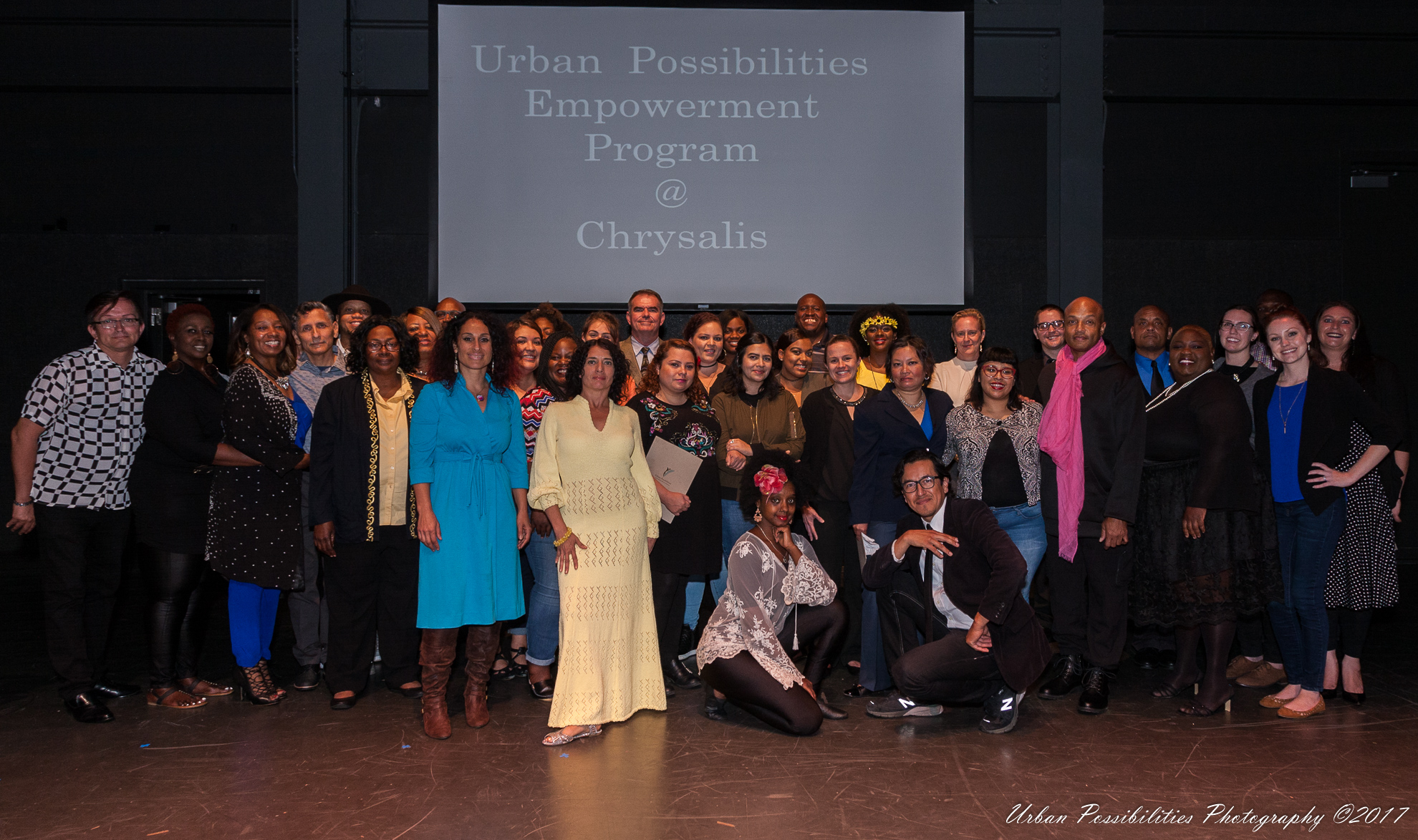
Photos: (top) Eyvette Jones Johnson (Credit: Craig Johnson Photography). (middle) Eyvette Jones Johnson with Norma L. Eaton and Keith Brown (Credit: Craig Johnson Photography). (bottom) Urban Possibilities workshop reading group shot with Chrysalis staff (Credit: Craig Johnson Photography).Prose writers, end your summer strong and submit to the following contests in fiction and nonfiction by Thursday, August 31. Each contest offers an award of at least $1,000 and publication.
Gemini Magazine Flash Fiction Contest: A prize of $1,000 and publication in Gemini Magazine is given annually for a short short story. Entry fee: $5
Glimmer Train Press Fiction Open: A prize of $3,000, publication in Glimmer Train Stories, and 20 copies of the prize issue is given twice yearly for a short story. A second-place prize of $1,000 is also given. Entry fee: $21
Glimmer Train Press Very Short Fiction Award: A prize of $2,000, publication in Glimmer Train Stories, and 20 copies of the prize issue is given twice yearly for a short short story. Entry fee: $16
Gulf Coast Barthelme Prize for Short Prose: A prize of $1,000 and publication in Gulf Coast is given annually for a piece of short prose. Roxane Gay will judge. Entry fee: $18
Gulf Coast Prize in Translation: A prize of $1,000 and publication in Gulf Coast is given for a prose excerpt translated from any language into English. John Keene will judge Entry fee: $18
New Guard Machigonne Fiction Contest: A prize of $1,500 each and publication in the New Guard is given annually for a short story. Chris Abani will judge. Entry fee: $20
Red Hen Press Quill Prose Award: A prize of $1,000 and publication by Red Hen Press is given annually for a short story collection, a novel, or an essay collection by a queer writer. Ryka Aoki will judge. Entry fee: $5
Snake Nation Press Serena McDonald Kennedy Award: A prize of $1,000 and publication by Snake Nation Press is given annually for a short story collection or a novella. Entry fee: $25
Sustainable Arts Foundation Writing Awards: Awards of $5,000 each are given annually to fiction writers and creative nonfiction writers with children. Writers with at least one child under the age of 18 are eligible. Entry fee: $15
Visit the contest websites for complete guidelines and submission details. Check out our Grants & Awards database and Submission Calendar for more upcoming contests in poetry, fiction, and nonfiction.
“First you live through the experience. Then you find out what it meant. Then you write.” Joyce Maynard’s essay “Patience and Memoir: The Time It Takes to Tell Your Story” in the September/October issue of Poets & Writers Magazine emphasizes the importance of the passage of time and reflection as a vital part of the process of memoir writing. Write a memoiristic essay about an event or situation from your distant past. Was this a subtle experience that became more significant with time or an experience that instantly changed your life? What had to happen before you could gain enough distance for insights to be revealed? How might the meaning of this experience potentially continue to evolve in the future?
The Village Voice to shutter print weekly and go fully online; Cambridge University Press faces backlash for removing articles at Chinese government’s request; when the Harlem Renaissance went to communist Moscow; and other news.
Morgan Parker on resisting labels and embracing one’s fallibility; Thomas E. Ricks on rewriting his book after his editor hated it; the shifting focus of the New York Times book coverage; and other news.
Nicole Krauss on portraying uncertainty in fiction; science fiction writer Brian Aldiss has died; book recommendations for the existentialist; and other news.