




California Contest Winners Celebrate First Publications at the Last Bookstore
The California Writers Exchange contest introduces emerging writers from California to the New York literary community and provides them a network for professional advancement. Every third year, writers in California are invited to submit manuscripts. On May 25, 2013, winners of the 2004, 2007, 2010, and 2013 contests gave a celebratory reading at the Last Bookstore in Los Angeles. Cheryl Klein, director of P&W’s California office, blogs about the event.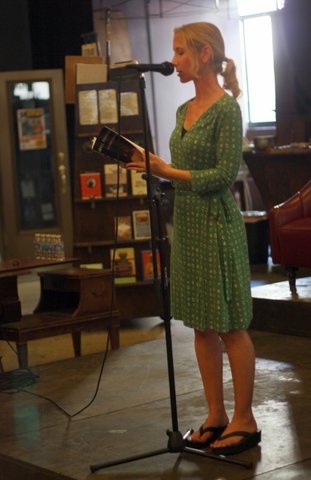 It was poet Allison Benis White who coined the catchphrase of the day: Her trip to New York in 2004, she said, was “like Disneyland for writers.” She described a week of meals at fabulous restaurants with the literary equivalents of Mickey and Donald. She remembered being nervous and joyous. And she remembered Richard Howard, then poetry editor of the Paris Review, bringing her back down to earth again.
“I was feeling anxious because I’d heard he was very critical. But then he said to [fiction winner] Dylan Landis and me, ‘I loved your work.’ That put my mind at ease. But then he turned to Dylan and said, ‘And I especially loved yours.’” White laughed. “So I couldn’t get too carried away.”
White’s second collection, Small Porcelain Head, recently won the Four Way Books Levis Prize in Poetry. Her first, which included the poems in her California Writers Exchange manuscript, was published as Self-Portrait With Crayon by Cleveland State University Poetry Center in 2009.
Although only one of the eight contest winners (Craig Santos Perez, 2010) had a book out when he won the contest, now the first six have a book published or forthcoming, cementing the contest’s reputation as a career stepping stone—or at least a forecaster of success—for emerging writers.
The Last Bookstore, an old bank remodeled as a cavernous literary wonderland, was an appropriate site for writers to talk about their Disneyland experiences. Sculptures made out of old books swooped from the walls and mezzanine. Browsers weaved in and out of book-bricked archways on the second floor in search of $1 bargains. And on a stage amid the stacks on the ground floor, four additional contest winners echoed White’s testimony and read from their latest work.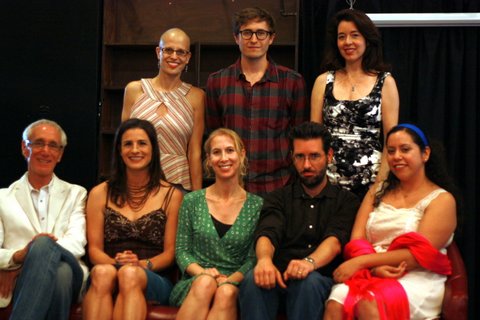 Larry Colker, poetry winner from 2007, showed off the Matrix-like cover of his book Amnesia and Wings (Tebot Bach). 2010 winner Sean Bernard read an offbeat zombie story, in which the creatures don’t groan “braaaains” so much as matter-of-factly state it: “brains.” Laura Joyce Davis, the 2013 fiction winner, read from her novel about sex trafficking in the Philippines. Her co-winner, poet Xochitl-Julisa Bermejo, read from a series of poems set on the Arizona-Mexico border, including one—from the point of view of a border agent—that she confessed she’d been afraid to read aloud until now.
But none of the writers who took the stage that day got there by being timid. Bermejo’s poem was gripping, sobering, and threaded with moments of unlikely connection. After the reading, writers and audience members mingled over wine, cheese, and strawberries. Not surprising, several audience members who had novels and poetry collections in the works wanted to know when the contest would be offered again.
Photos: Top: Allison Benis White. Bottom: back row, from left: P&W staff members Cheryl Klein, Andrew Wessels, and Jamie FitzGerald; front row: Larry Colker, Laura Joyce Davis, Allison Benis White, Sean Bernard, Xochtil-Julisa Bermejo. Credit: Alberto Vega.
The California Writers Exchange contest is made possible by a generous grant from the James Irvine Foundation.
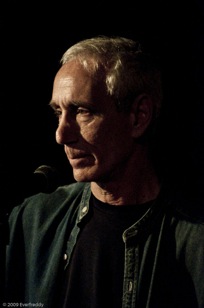 I am happy to have this opportunity, as the June Readings/Workshops Writer in Residence, to give something back to Poets & Writers. I have been the beneficiary of much largesse from P&W,
  I had an idea to have a free community-based poetry and arts festival in Coney Island, a neighborhood on the edge of a city. The festival would incorporate site-specific poetry, free workshops, and readings in a spectacular location. I wanted to create a space where people who had written about Coney Island could come and read and share their words about the place. Coney Island is a neighborhood with a vivid art and literary history, and for me it holds significant family history. My mother’s family lived in Coney Island, on 29th between Mermaid and Surf, for almost twenty years, from the 1920s to the 1950s. Ever since hearing my grandmother Betty first say the words, “Half Moon Hotel,” "Abe Reles," and "meshugana," Coney Island held a poetic resonance for me. I wanted to spend as much time as possible in the place where this Half Moon Hotel once towered with views of the Atlantic and a 150-foot ferris wheel could be landmarked.
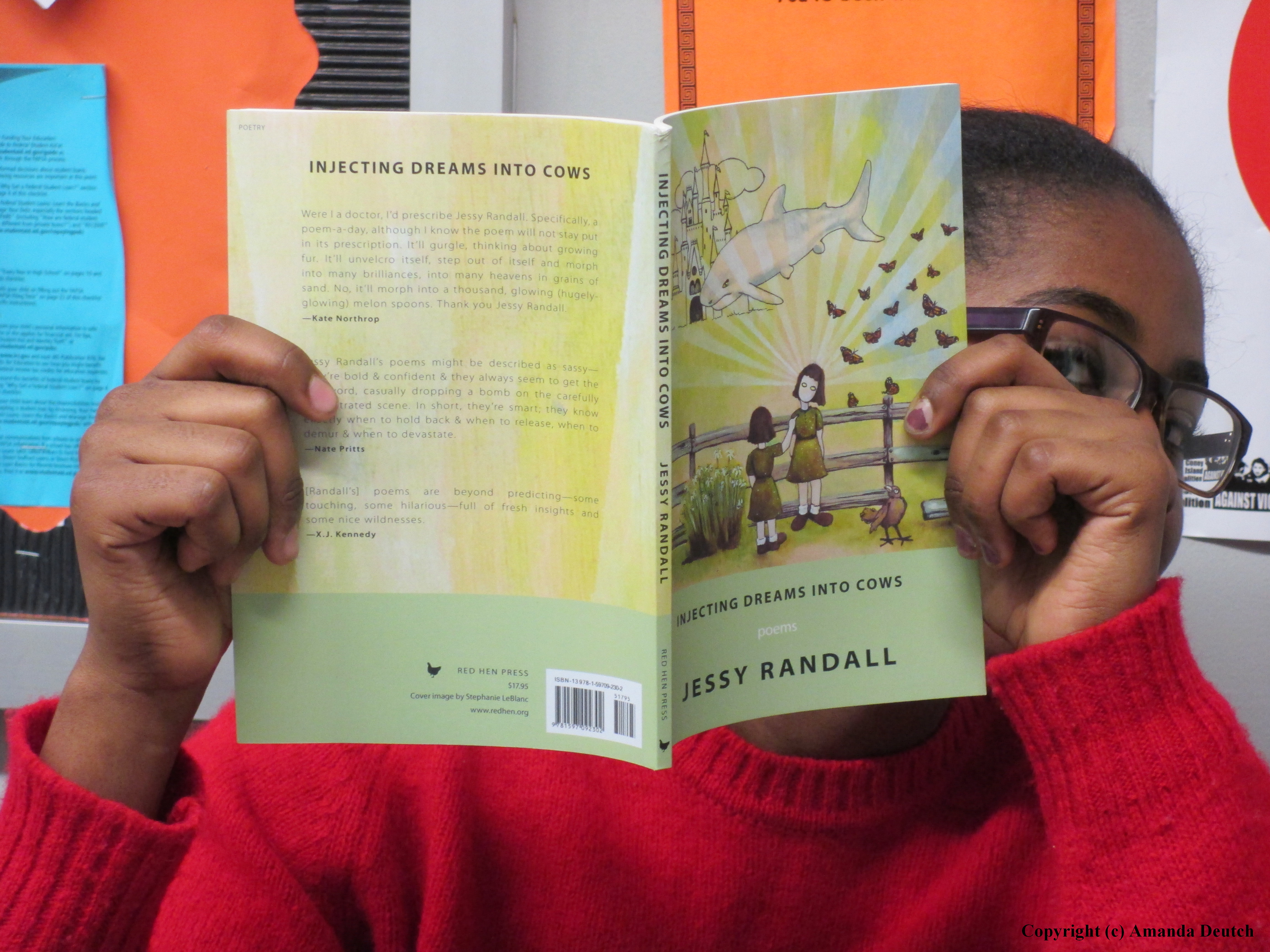 13 I put out a call for poetry books to create a lending library for the YWCA after-school teen empowerment program where
  eeks ago and said, “Miguel Pinero, he’s the realest.” I said, “Yeah, his poetry changed the course of my life. Before that all I ever saw was poetry about daisies, not that I don’t like daisies. We don’t have any books of his, yet, but why don’t you read Sheila Maldonado? She’s a local poet, born around here.” He checked her book out of our new burgeoning library (and made my day). There are so many interactions like this. Maya is a thirteen-year-old student at the writing workshop. She soaks up information and is very talented. One day she came in asking me about a poem she’d seen that looked like an eye. We had a conversation about the French poet Guillaume Apollinaire and for the next week’s class I brought in one of his books. She poured over the pages and held it up saying, “This one is my favorite.” I instantly got chills and realized, here I was in a classroom in Brooklyn, in Coney Island, discussing surrealist French poetry with a thirteen-year-old girl.
 For a relatively small city, Seattle has a thriving literary community. What do you attribute this to?
 Celebrities flash everywhere: billboards, newspapers, computer screens, televisions. We live in a KarGaGaianBieber glowing orb of a virtual society. They suggest what we buy, how we dress, how we live, and what we consider beautiful. Unfortunately, Warhol’s prediction of fifteen minutes of celebrity fame has drawn out to become several hours of fame and in some cases, even years of it. Like it or not, we know celebrity's faces, their favorite coffee drinks, and the names of their pet monkeys.
 From street signs to carnival talkers, from the Chief hawking fresh clams with a call of, “Hey! Get it! Get it!” to the influx of monarch butterflies in late August, there is poetry in the everyday language that surrounds us. I want people to stop and notice poetry in daily motions. That’s part of my job as a poet.
  The
The  I have spent much of the last week with Sabrina Chap. I organized two events while she was in Seattle, and I enjoyed the conversations in between as much as the workshop and lecture. Sabrina is very open and encouraging when it comes to difficult subjects. She makes it suddenly okay to talk about topics such as grief and self-destruction that our society says are shameful. Her book
  Why poetry? I’m asked frequently, which brings me to ask myself the same question. I imagine the typical inquisitor thinks poetry as gilded, arcane, highfalutin'. As it is, it has taken me years to be comfortable saying that I’m a poet. To this day there’s still a tiny level of discomfort, uttering the—what? title, character, state of being? What does it mean to be a poet? Poetry is not a career nor is it employment that pay the bills. It's not a marker of identity like gender or nationality. What is it that you do? Americans love to ask. I write poems. But not all the time. Not the same amount of hours as my day job, and my other jobs.