Genre: Poetry

Lost Map

5.26.26

Write a poem that begins with directions you cannot give, whether it’s returning to a childhood home that no longer exists, finding someone you’ve lost, or reaching a place that has only ever appeared to you in dreams. Let the poem move between the literal and the imagined, charting not only streets and landscapes, but also memories, misdirections, and silences. What landmarks have shifted? What details remain sharp? Allow the act of mapping to reveal both presence and absence, and bring the reader in on what it feels like to be in the place you want to bring them.

Loitering

5.19.26

Poet and novelist Stacy Skolnik pieced together a series of Facebook posts from her old high school friend Robert Frost into a collaborative hybrid poetry collection, which is forthcoming from Book Works in June. In one of the collection's poems, the speaker expounds a moment of frustration after reading the signage outside a shopping area: “Can you believe this notice / in the middle of a seating and dining porch / it’s literally made for loitering // We have this seating area but NO ONE CAN USE IT!!!” Taking inspiration from themes that this poem touches upon—class, productivity, propriety—compose a poem of your own that meditates on what it means to loiter, which Merriam-Webster defines as “to remain in an area for no obvious reason.” What judgments do you make when you notice someone who appears to be loitering?

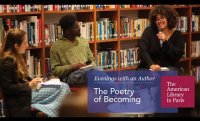
The Poetry of Becoming: Sasha Debevec-McKenney and Oluwaseun Olayiwola

Caption: 

In this event at the American Library in Paris, Sasha Debevec-McKenney, author of Joy Is My Middle Name (Norton, 2025), and Oluwaseun Olayiwola, author of Strange Beach (Soft Skull Press, 2025), speak about their debut collections, published by Fitzcarraldo Editions in the U.K., in a conversation with writer and researcher Emma Gomis. Debevec-McKenney is the winner of the 2026 Swansea University Dylan Thomas Prize.

Genre: 

A Good Rhyme

5.12.26

Fady Joudah, winner of the 2024 Jackson Poetry Prize, writes that he thought about how animals process trauma without speaking and how “intifada deserves a good rhyme” when composing his poem “Pink Panther,” recently published in the Academy of American Poets’ Poem-a-Day series. The poem concludes with the stanza: “See cicada or when home is a howling / intifada. Your heart, utterly flexible, / a wind like water, / the stubborn wind.” This week, begin by creating a short list of words or phrases that you find yourself circling around in your work, perhaps indicative of themes at the forefront of your thoughts. Then, select one term that is particularly difficult to rhyme. Challenge yourself to think of rhyming words and ways to connect the terms, even if far-fetched. Build your poem around this innovative and unexpected rhyme pairing.

Marianne Boruch on Her Process

Caption: 

In this 2017 interview at Claremont Graduate University, Marianne Boruch talks about her 2011 collection, The Book of Hours, for which she won the Kingsley Tufts Poetry Award, and how poetry remains a “mysterious form” and creates a space where “it’s a pleasure to be elsewhere.” Boruch is the recipient of the 2026 Jackson Poetry Prize.

Genre: 

Beyond Baroque Book Launch: Alan Chazaro

Caption: 

In this Beyond Baroque event, poets David Quiroz and Joseph Rios join Alan Chazaro for a reading to celebrate the launch of his second collection, These Spaceships Weren’t Built for Us (Tia Chucha Press, 2026). For more from Chazaro, read the latest installment of Literary MagNet in the May/June 2026 issue of Poets & Writers Magazine.

Genre: 

Caregiving, Caretaking

What sort of emotional labor does one experience when caring for a parent or a child, a friend or lover, or someone who’s ill? This week compose a poem that details the gestures and actions, the commitments and complications involved in taking care of someone else. In Angela Jackson’s poem “Caregiving,” published in the April 2023 issue of Poetry magazine, the speaker recalls a time before the responsibility of caretaking when she would “rumble-race” and “haul-dash” to the gym to exercise twice weekly, and contrasts that dynamism with the slowed-down, zoomed-in attention spent on the person she is looking after who is “sitting on the gray stoop / like a lost little girl.” In your own poem, think about the resulting sacrifices and rewards of caretaking, and consider how to express that through sound and rhythm.

Emilie Lygren and Deema K. Shehabi

Caption: 

In this Green Apple Books event, Emilie Lygren, author of Once I Was a Stone (Wayfarer Books, 2025), and Deema K. Shehabi, author of Water to Water: Gaza Renga (Interlink Books, 2025), read a selection of their poems and discuss their experiences with writing communities and creating time and space for their writing.

Genre: 

Pages

Subscribe to Poetry