This week’s installment of Ten Questions features Beth Piatote, whose debut poetry collection, distant water, is out today from Milkweed Editions. “It’s hard to translate / causative + heart + pour out,” the poet writes in a collection that flows between the Nez Perce language and English, eddying around different modes of understanding. Piatote’s poetry explores and celebrates the embodied quality of Nez Perce verbs, which “not only describe but perform motion” and interlink living beings and landscapes. In “Words at Dawn Break,” Piatote explains that a crow’s utterance (“’á·’a híce ’á·’a híce ’á·’a”) might be represented as crow speak crow speak crow. The word for crow “sounds like breathing,” the poet observes: “when I say ’á·’a // I am speaking my language / and crow’s.” Jake Skeets wrote, “Beth Piatote writes with the Nez Perce language, its sounds, images, and breath, to create a vivid document of reclamation and futurity.” And Natalie Diaz praised Piatote for sharing “this old, patient, still-powerful language capable of summoning the ocean’s greatness to wash away our human griefs, to bear the burdens and errors of our human bodies and minds.” Beth Piatote is the author of the scholarly monograph Domestic Subjects: Gender, Citizenship, and the Law in Native American Literature (Yale University Press, 2013) and the short fiction collection The Beadworkers (Counterpoint Press, 2019), longlisted for the Aspen Words Literary Prize and the PEN/Robert W. Bingham Prize. Piatote is an associate professor of English and Comparative Literature at the University of California in Berkeley. She is Nez Perce and an enrolled member of the Confederated Tribes of the Colville Reservation.
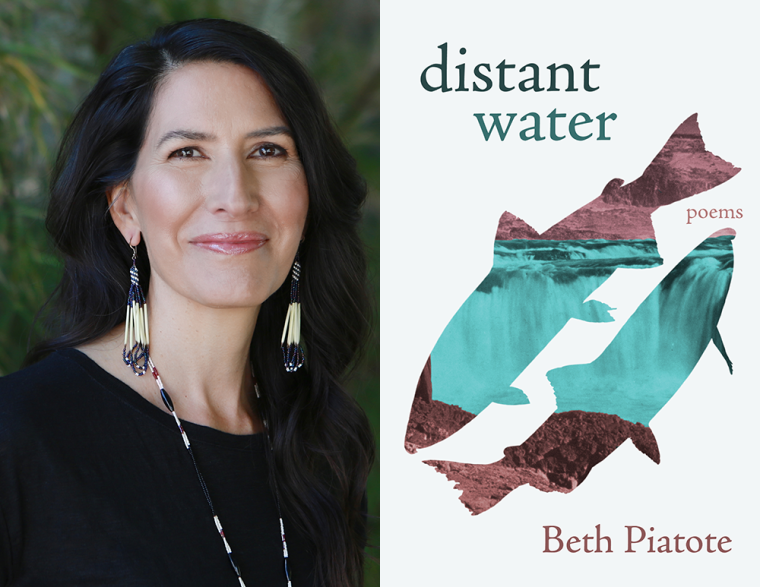
Beth Piatote, author of distant water. (Credit: Kirsten Lara Getchell)
1. How long did it take you to write and assemble the poems in distant water?
I started in January 2020 and it’s coming out now, so six years.
2. What was the most challenging thing about writing the poems in the collection?
I had no formal training in poetry. But I knew that this project required poetry, so I studied forms on my own and I worked in writing groups. I also received advice and guidance from generous, well-established poets. I apprenticed myself to poems. I read some great books about writing poetry, including the wonderful Finger Exercises for Poets (Norton, 2024) by Dorianne Laux, and took a few workshops. Due to my lack of formal training, I had to work through some insecurities and limitations; but also I experienced great freedom to experiment. This lack helped me to be true to my Nez Perce language, to allow the grammar, sounds, and concepts of the language give primary shape to the poems. I learned from Cecily Nicholson to say, “I am practicing,” and that gave me appreciation for my pile of false starts and still-emerging work.
3. Where, when, and how often do you write?
I write whenever I can, wherever I can, however I can. I always write by hand in the morning, even if it’s brief. My day job requires a lot of writing in different genres. When I’m working on a specific project, I have a designated notebook where I log my ideas, sources, and daily word count by hand. But even when I’m not putting words on the page, I’m moving through the world as a writer.
4. What are you reading right now?
For pleasure, You Dreamed of Empires (Riverhead Books, 2024) by Álvaro Enrigue. I just finished The Wife of Willesden (Penguin Books, 2023) by Zadie Smith, which I loved. It’s the end of the semester here, so a lot of my reading is student work—theses and dissertations—which is gratifying and interesting. I’m working on a new book for Norton, a collection of essays, so I’m reading a lot of nineteenth- and twentieth-century Native American history, which can be difficult but also so generative. I’m also re-reading the impeccable storytelling in Highway Thirteen (Farrar, Straus and Giroux, 2024) by Fiona McFarlane in preparation for a summer writing workshop I’ll be teaching at Fishtrap in Oregon in June.
5. Which poet, in your opinion, deserves wider recognition?
What is recognition? Every poem has work to do in the world, and recognition is the moment that the soul meets the poem it needs at that time. For me, the answer to this question is that everyone needs to read more of everyone else.
6. What is the biggest impediment to your writing life?
Time.
7. What is the earliest memory that you associate with the poems in the collection?
The poem “some days, thinking of horses” channels a personal and ancestral love of horses toward another topic. An absolutely unfettered love of horses is the first thing I truly knew about myself, from a very early age, and my older Nez Perce relatives have assured me that this love is in our blood, an inheritance.
8. What was your strategy for organizing the poems in this collection?
On a blank sheet of paper I drew of rough map of the Columbia River and its major tributaries going out to the sea. Then I placed each poem along these waters, in the specific places from which the poems emerged or belong.
9. Outside of writing, what other forms of work were essential to the creation of distant water?
The most fundamental work for me has been the language work I have been doing in my heritage language of Nez Perce over many years to understand its grammar, sounds, stories, and life force. The language is a living being among other living beings who are born of and thrive in our homelands, so this is a dynamic relationship. In order to write, I need to spend a lot of time outside—walking, running, working with horses. A big sky is useful. I also need to do creative, flow-state things like beadwork and sewing. I need to spend time with friends and family and pets. I am fortunate to work at a university where there is a vibrant intellectual culture and the fulfilling labor of analyzing literary works is a central requirement of my job. The Bay Area offers a phenomenal art scene, and visual art, music, and performance arts all feed my imagination and my perception of how to channel ideas and aesthetics through various forms. Finally, I do a lot of work at night, through dreams.
10. What’s the best piece of writing advice you’ve ever heard?
The work of being a writer isn’t only the writing we produce; it requires and invites us to organize an entire life around writing and living as a writer.