This week’s installment of Ten Questions features Emma Copley Eisenberg, whose fiction collection, Fat Swim, is out today from Hogarth. In ten interlinked stories, Eisenberg follows a cast of characters that includes an eight-year-old girl mesmerized by a group of fat women swimming at the public pool, a woman bought out from the beauty company she cofounded due to her weight, and a trans man procuring Grindr dates for the elderly gay author he adores. Elsewhere, a mother ponders her daughter’s romantic life, exclaiming, “Two girlfriends! What does a person do with so much love?” Carmen Maria Machado praised Fat Swim as “a lush, radical meditation on the body’s pleasure and potential.” Publishers Weekly described the book as a “glittering story collection” in which Eisenberg’s protagonists “grapple the messiness of desire and their relationship to their bodies as queer and fat people.” Emma Copley Eisenberg is the author of the novel Housemates (Hogarth, 2025), nominated for a Lambda Literary Award and the VCU Cabell First Novelist Prize, as well as the nonfiction book The Third Rainbow Girl (Hachette, 2020), a New York Times Notable Book and Editor’s Choice and a finalist for an Edgar Award and an Anthony Award. She lives in Philadelphia.
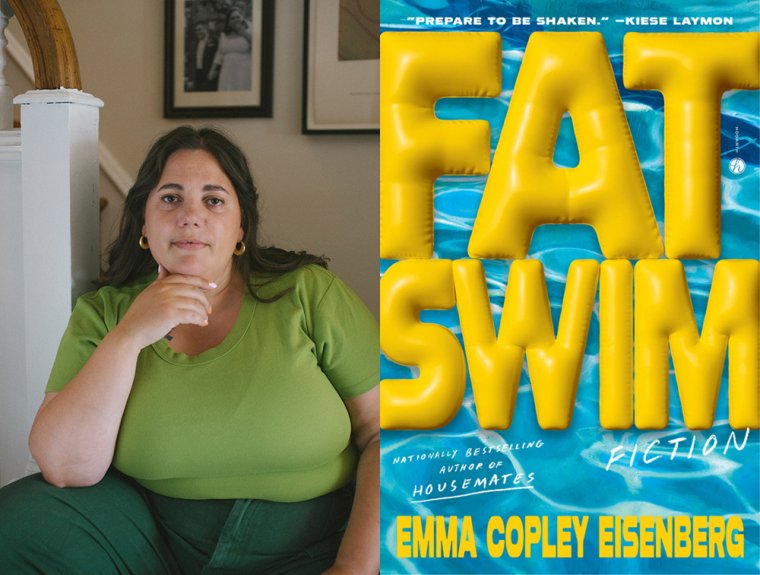
Emma Copley Eisenberg, author of Fat Swim. (Credit: Kenzy Crash)
1. How long did it take you to write Fat Swim?
Twelve years. It contains my oldest published fiction and my newest, strangest words, including a novella that was finished moments before my team lovingly demanded the final version. But I was working on it at the same time as other projects.
2. What was the most challenging thing about writing the book?
I had to become a different person in order to write the version of this book that readers will hold in their hands, and for a long time I wasn’t that person yet. When I first started writing this book, the only ways I knew to access basic bodily sensations were eating and sex. There is a famous (in my household) story of an ergonomic desk chair I bought and then assembled wrong. It was tilted all the way forward so that I hunched over my desk. “Is that comfortable?” my partner asked at some point, and I was like “I don’t know, it’s ergonomic!” That’s how little communication was happening between me and my body for a long time. In sum: It was hard to be writing a book about questions and experiences I was so dumb about. I suppose this is understandable because the world in general and the literary world specifically are also so dumb and confused about the body.
3. Where, when, and how often do you write?
When I’m drafting, I wake up before the anxiety kicks in and write in my office that faces an alley through which I can see the Philly skyline for a few hours every weekday (I don’t write on the weekends). When I’m revising it’s longer—I can do eight hours a day if I’m lucky, and I like to go somewhere else—a friend’s house where I can house sit, a residency, somewhere near the ocean. When I’m teaching or doing other work, I’m just taking notes or sending myself e-mails, storing things up like Frederick for winter.
4. What are you reading right now?
Highway billboards and poetry.
5. What is the biggest impediment to your writing life?
Instagram.
6. What is the earliest memory that you associate with the book?
A stretch of South Philly I walked all the time in the years 2011 and 2012 made it into the story “Ray’s Happy Birthday Bar,” which is about a young woman bartender contending with giving up a kid for adoption. Every time I walk that stretch I live inside the funny and very sad mind of that character.
7. What is one thing that your agent or editor told you during the process of publishing this book that stuck with you?
The novella, “Camp Sensation,” is not quite realism, and that is not comfortable terrain for me. An early version of the collection did not include it because my team—and I agreed at the time—felt the story, with its surrealist elements, was not working. But then my wonderful editor, Helen, who came onto the project later, read it and said—no, it needs to be in the book because there is something about the body that realism can’t quite express. Instead of cutting the story, she encouraged me to make it even weirder and less tethered to the Real. It also expanded physically and became a much larger story. This reminds me of something else an MFA professor said to be once: “Sometimes when people tell you there should be less of a thing in your story, you actually need more of it.”
8. If you could go back in time and talk to the earlier you, before you started Fat Swim, what would you say?
It will be very hard to get a short story collection with the word “fat” in the title published. But you will do it. And it will be the most artistically satisfying experience of your life so far.
9. Outside of writing, what other forms of work were essential to the creation of Fat Swim?
Teaching and reading other people’s novels made writing it financially possible. Collaging and crafting kept my hands busy and my mind oiled. Ceramics kept me off my phone. Doing organizing work—literary, and for food access in Philly—found me the people that mattered.
10. What’s the best piece of writing advice you’ve ever heard?
Write at sunrise or sunset because your daytime and nighttime brains are online at the same time. Plus these are, for a reason, when a lot of people pray.