This week’s installment of Ten Questions features Rachel Khong, whose story collection, My Dear You, is out today from Knopf. The book opens on a dead woman, recently eaten by a crocodile, choosing her new face in heaven: “All I had to do was drop the features into a shopping-cart-type basket, as though I were online shopping, and it would show up more or less instantaneously on my face.” Elsewhere, a group of Asian women discover that the same white man has been taking them on identical dates, a woman working at a sex doll factory struggles to make a sale, and Americans bicker over species politics after God announces that all people, as punishment for their arrogance, will soon be transformed into nonhuman animals of their choosing. In a starred review, Kirkus Reviews wrote that the ten stories of My Dear You “explore premises surreal, profound, prophetic, playful, and provocative,” while Bryan Washington called the collection “a garden of bravura, incandescent and explosive and compassionate all at once.” Rachel Khong is the author of the novels Goodbye, Vitamin (Henry Holt, 2017), winner of the California Book Award for First Fiction, and Real Americans (Knopf, 2024), a New York Times best-seller. She lives in Los Angeles.
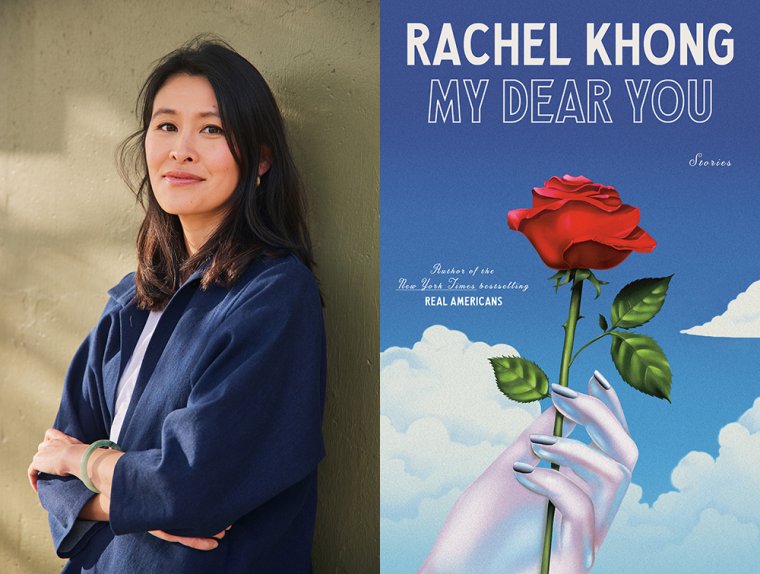
Rachel Khong, author of My Dear You. (Credit: Andria Lo)
1. How long did it take you to write My Dear You?
The first story, “My Dear You,” was written in 2016, and the last, “Colors from Elsewhere,” was written in 2025. So nine years, officially, though I was mostly working on novels during that time. These stories were written alongside Goodbye, Vitamin, Real Americans, and my third novel (which I cannot speak of yet!).
2. What was the most challenging thing about writing the book?
I wrote each story to stand alone, so when I assembled the ten stories into the collection, reading them one after another filled me with a fair amount of self-loathing—made made me sick to my stomach, tired of myself. At the same time, writing is how I’ve learned to have more compassion—to experience the loathing alongside pride and satisfaction.
3. Where, when, and how often do you write?
When I lived in San Francisco, I wrote at my dining table. In 2023, I moved to Los Angeles, and now I work from my office, which was perhaps intended to be a kitchen nook. It was my dream to have a door, and now I do, complete with a little “Do not disturb” sign my husband fashioned for me from a piece of fencing. Mornings are when I’m best at writing. I’m still a little dreamy from sleep and my conscious mind is quieter. I strive to write very weekday, at least a little bit, though the way I write changes through the years; I try to stay open to those changes.
4. What are you reading right now?
I just finished Cursed Bunny (Algonquin Books, 2022) by Bora Chung, which I loved. I read a short story a day so I usually have a short story collection in process. I’m also reading Daybook (Scribner, 2013) by Anne Truitt, which is incredible, with so many beautiful and wise insights into the art-making process.
5. What is the biggest impediment to your writing life?
For several years now, I’ve been struggling with infertility. Through 2025 I went through IVF, which involved many early morning appointments, hormonal fluctuations, periods of waiting and loss. The morning appointments have been a great impediment to my writing life, because mornings are when I work best; grieving, too, gets in the way. At the same time, my work is made from my life. I agree with Mary Oliver: “It is better for the heart to break, than not to break.”
6. What is the earliest memory that you associate with the book?
My agent, Marya, is the first person I send all my work to. Marya came to my thirtieth birthday gathering at a karaoke bar; now we’re both in our forties. She saw me through the writing of all these stories. I remember e-mailing her after I had written “My Dear You,” very tentatively, to say, “I wrote this weird story.” I was a little scared about what she would say. She wrote back right away to say “DUH!!! Send away; so excited!!” I also remember sharing the story, “My Dear You,” with my writing group. Someone in the group wondered if the racist dog should be cut. I remember the feeling of believing—so clearly—that the dog needed to remain. And I think that was essential to my process of creating this collection, insisting on the rightness of my own artistic perspective, even if someone else might consider them “too much.”
7. What is one thing that your agent or editor told you during the process of publishing this book that stuck with you?
I am so lucky to work with John Freeman, my editor. He is the best cheerleader and writer of emails; he understands the ups and downs of being a writer because he is a wonderful writer himself. Last year, John sent me an out-of-the-blue e-mail that included this sentence: “I hope every now and then that feeling about your work hits you too and you get a break from everything else to feel the sun of its excellence on your back.” Whenever I’m feeling discouraged, I try to remember his kindness.
8. If you could go back in time and talk to the earlier you, before you started My Dear You, what would you say?
I would say there is so much you are going to live through—so much you’ll learn, and so many ways your writing will change. I’m saying that to myself now.
9. Outside of writing, what other forms of work were essential to the creation of My Dear You?
The works of Ruth Asawa and Pieter Bruegel the Elder, the Phantom Thread soundtrack, the television show Monk, Denis Johnson’s poems, 10,000 Steps a Day in LA (Santa Monica Press, 2020) by Paul Haddad, tarot.
10. What’s the best piece of writing advice you’ve ever heard?
Write the fun parts.