This week’s installment of Ten Questions features Tara Menon, whose debut novel, Under Water, is out today from Riverhead Books. In 2012, Marissa is living in New York City, writing copy for a vacuous travel magazine and watching New Yorkers prepare—or fail to prepare—for the arrival of Hurricane Sandy. Her thoughts continuously return to the days leading up to another weather event: the Indian Ocean tsunami that would devastate Thailand in 2004. For Marissa, the daughter of marine biologists, an island off the coast of Phuket is still home, and the significant relationship in her life remains her remembered childhood friendship with Arielle: The two girls spent every day they could in the ocean, diving among the corals and swimming alongside the female manta rays they named for athletes and literary heroines. Years later, when Marissa hears a college student suggest that the grief of Tennyson’s In Memoriam must have been inspired by romantic love, Marissa pities the girl: “You’ve never had a real friend.” In a starred review Kirkus Reviews wrote, “This debut novel tenderly and yet unflinchingly mines Marissa’s grief as it meditates on friendship, loss, and the shimmering beauty of memory.” Namwali Serpell called Under Water “immersive and stirring, pellucid and mysterious, shot through with light and with shades.” Tara Menon’s writing has appeared in the New York Times, the Nation and the Paris Review. She lives in Cambridge, Massachusetts, where she is an assistant professor of English at Harvard University.
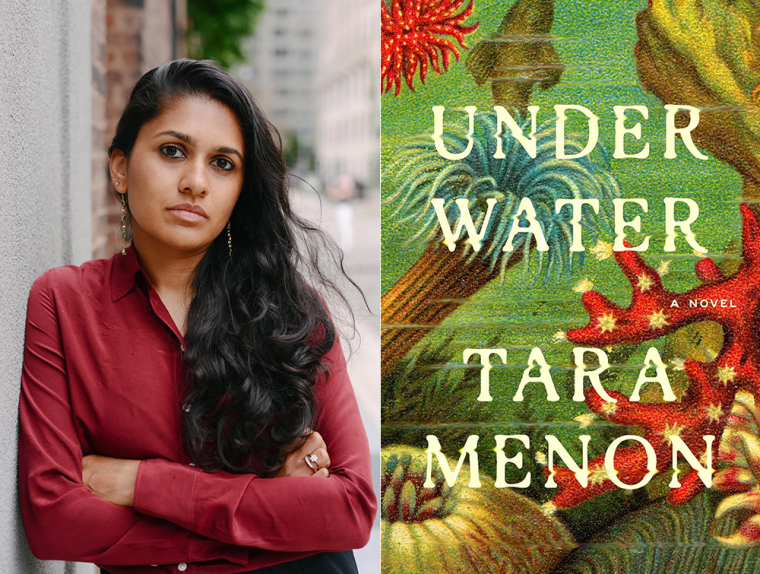
Tara Menon, author of Under Water. (Credit: Lauren Crothers)
1. How long did it take you to write Under Water?
About eight years—I started writing in 2016 and sent the final draft to my agent at the end of the summer of 2024. I didn’t work on it every day (or even close to every day) but I lived with the book for a long time.
2. What was the most challenging thing about writing the book?
I did a lot of research of various kinds to write this book. Some of it was really pleasant and pleasurable—reading about butterfly species in Central Park, or learning about the social habits of manta rays—but watching video after video of the 2004 tsunami was harrowing. In 2020, when mass death was dominating the news every the day, I had to take a break from writing the scenes about the tsunami and its aftermath.
3. Where, when, and how often do you write?
I write when I can and when I must. Sometimes I go several weeks without writing at all, and sometimes I write for six to seven hours a day every day for a month. I wish I was the kind of person who could say: I write for three hours starting at 9 AM every week day but this has, sadly, never been my way. I constantly aspire to this kind of rhythm and routine but I fear I will never find it.
4. What are you reading right now?
I tend to have several books on the go at once. I’m teaching Othello so I’m rereading that (my favorite Shakespeare play, even though I think King Lear is the best one), and I’m doing an event with the Colombo-raised Tamil novelist Anuk Arudpragasam so I’m also rereading his extraordinary debut novel The Story of a Brief Marriage, which was published by Flatiron Books in 2016. And I’ve just started Rosa Mistika (Yale University Press, 2025), written in Swahili by the Tanzanian writer Euphrase Kezilahabi, and translated into English by Jay Boss Rubin.
5. Which author, in your opinion, deserves wider recognition?
So many answers to this! I’ll restrict myself to two. First, the Indian novelist Vivek Shanbag, who writes in Kannada. Two of his novels, Ghachar Ghochar (Faber & Faber, 2018) and Sakina’s Kiss (McNalley Editions, 2025), have been beautifully translated by Srinath Perur. Ghachar Ghochar, a novella about one family in Bangalore’s change in fortunes, is staggeringly good. Second, Ananda Devi, the francophone Mauritian writer. Eve Out of Her Ruins (Les Fugitives, 2021), translated by Jeffrey Zuckerman, is a violent, devastating tale of lust, desire, and broken dreams told in mesmerizing prose. And to clarify my answer: I think these two deserve more recognition among readers in English. They have each received plenty of recognition among other readers.
6. What, if anything, will you miss most about working on the book?
I’ll miss a lot about it. But what I will miss most is being able to leave where I was writing (New York, Providence, Cambridge, London, Zurich, Singapore) and escape to the beaches and forests of Thailand. I got to spend a lot of imaginative time underwater—I always felt I could retreat (if only in my head) to the coral reefs of the Andaman sea.
7. What is one thing that your agent or editor told you during the process of publishing this book that stuck with you?
I am extraordinarily lucky to have the agent I do: Seb Godwin of DGA London. Both Seb and David Godwin told me: You only get one chance to be a debut novelist, so take your time. They never rushed me; they never made me feel I had to finish according to any timeline other than my own. It’s difficult to say how grateful I am for their wisdom and patience. For so many reasons, I am so glad I took so long.
8. If you could go back in time and talk to the earlier you, before you started Under Water, what would you say?
The actual process of writing—of thinking, imagining, living in the fictional world, making sentences, revising those sentences, and revising again—will give you more pleasure and intellectual satisfaction than anything else. Don’t rush the writing, and enjoy it for itself.
9. Outside of writing, what other forms of work were essential to the creation of Under Water?
I wrote Under Water while I was a PhD student, then a postdoctoral fellow, then an assistant professor. Often it felt like doing my actual job—writing a dissertation, teaching, writing an academic book and research papers—got in the way of writing my novel. But really, all of that work was invaluable. The novel is heavily influenced by the books I read and write about as an academic.
10. What’s the best piece of writing advice you’ve ever heard?
In Bird by Bird, Ann Lamott writes, “I just try to warn people who hope to get published that publication is not all that it is cracked up to be. But writing is. Writing has so much to give, so much to teach, so many surprises. That thing you had to force yourself to do—the actual act of writing—turns out to be the best part. It’s like discovering that while you thought you needed the tea ceremony for the caffeine, what you really needed was the tea ceremony. The act of writing turns out to be its own reward.” It’s really so true. I also think often about two things Barbara Kingsolver said. One: “To begin, give yourself permission to write a bad book.” And two: “Study something other than writing.”