This week’s installment of Ten Questions features Tom Junod, whose memoir, In the Days of My Youth I Was Told What It Means to Be a Man, is out today from Doubleday. Big Lou Junod, the author’s father, left only one instruction for his funeral: “Just give me a closed casket draped with an American flag and a picture of me in my prime.” In his prime, Lou was Charles Atlas on the beach in a tiny black bikini bottom and a heartthrob in nightclubs: a figure who mesmerizes and intimidates the people around him, including his young son, who looks to define himself against a man he later sees as a “first-class philanderer.” Kirkus Reviews described In the Days of My Youth I Was Told What It Means to Be a Man as “written with both panache and feeling,” while Susan Orlean praised the memoir for its “beautifully rendered portrait of family, masculinity, and what it means to find your own way in the world.” Tom Junod is a senior writer for ESPN, where his work has won an Emmy and the Dan Jenkins Medal for Excellence in Sportswriting. He is a two-time winner of the National Magazine Award for Feature Writing and a winner of the James Beard Award for essay writing. He was previously a staff writer for GQ and Esquire; an article he wrote for the latter inspired the 2019 film A Beautiful Day in the Neighborhood. Junod lives in Atlanta.
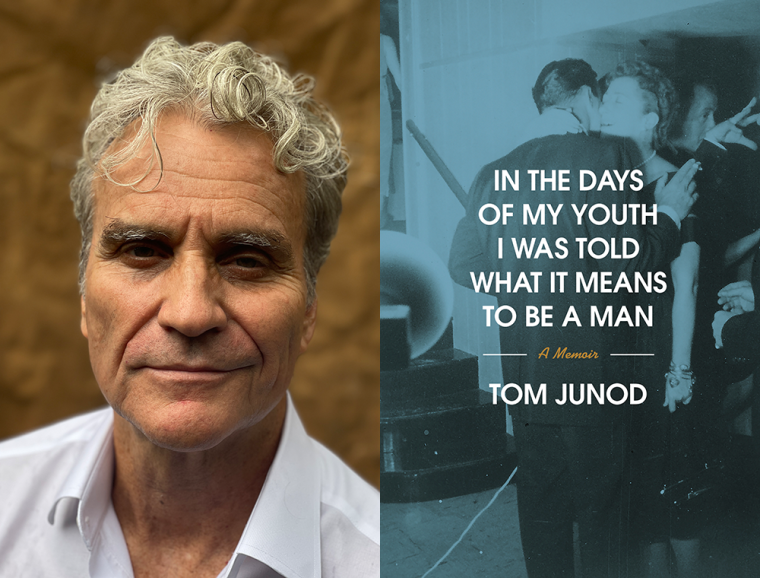
Tom Junod, author of In the Days of My Youth I Was Told What It Means to Be a Man. (Credit: Lee Crum)
1. How long did it take you to write In the Days of My Youth I Was Told What It Means to Be a Man?
Nine years, by the calendar. But it didn’t really begin with writing. It began with a decision to write, which I made in the later summer of 2015. And that decision began with.... I had written about my father, Lou Junod, before—once for GQ, once for Esquire, once for ESPN. But none of those stories told the truths I knew about him, and had known about him, from a very young age. I had sworn that I would tell those truths one day, long before I knew I could write, was a writer, started writing. And so, one day, I decided to live up to that vow. There was a moment. My father had died in 2006, and I thought I knew everything about him. But one day that summer, in August 2015, I was asked a question about him I couldn’t answer. And so it began.
2. What was the most challenging thing about writing the book?
I was going to say that the most challenging thing about writing the book was giving myself permission—and I suppose that that’s the most challenging thing for any writer setting out to tell family secrets. But there’s something about that phrase that implies it’s like writing yourself a big blank check: You sign your name and off you go. The greater challenge was to keep giving myself permission day after day. Permission not just to tell the truth but to find it; not just to find the truth but to dramatize it; not just to speak the truth to find a voice for it; not just to start the book but to finish it.
You see, when I started the book in 2015, I also started a search, a quest, an investigation, a dive into my family’s and my father’s past, figuring that would give the book its bones. I wound up understanding that the search, not just the writing, was what I had been putting off all along, because I was afraid that it would change both my life and the lives of those I was looking for. There was no search without the book; there was no book without the search, and I had no choice but to complete one in order to complete the other. And I did. I took the risk of searching and then I took the risk of finding. Talk about permission! And I finished a draft of the book on August 12, 2024.
3. Where, when, and how often do you write?
Well, I’ve kept a journal since I was twenty years old, with very few interruptions. It’s the first thing that allowed me to engage the world by writing about it, and to that end it’s never let me down. It’s also demystified writing for me—the simple act of trying to squeeze something out every day, no matter what has happened to you or, just as frequently, not happened. As for where: I’m writing this sitting on the couch in my living room, the head of my pit bull Jacques pressed up against my hip. I also sometimes write at coffee shops, in the public library, in the car in the middle of a church parking lot. It’s not just keeping a journal that demystifies writing; journalism does a pretty good job of that too, so the best answer of where I write is the simplest: wherever I can find a seat.
I’ve never had a preferred place for writing. I will admit, though, that a few years ago, we did a simple renovation of the ratty old shed that sits in the backyard of our house on Long Island. It became my favorite place to write and it is where I went to finish In The Days of My Youth I Was Told What It Means To Be a Man in the first cold months of 2024. It had taken me six years of writing to write the first two thirds of the book. The last third took about six months. I will be indebted to that little shed for as long as I live.
4. What are you reading right now?
I like to read in the morning and listen to books in the afternoon, when I’m driving around or walking the dog. So the book I finished this morning was George Saunders’s Lincoln in the Bardo. The book I’m listening to in the afternoon is Catherine Nixey’s Heretic, her rather heretical book on all the Sons of God who competed with the Son of God. I’m also reading Clive James’s book of biographical essays called Cultural Amnesia—an unexpected delight— and A. N. Wilson’s Jesus: A Life.
5. Which author, in your opinion, deserves wider recognition?
Sharon Olds. She has shared her own and her family’s secrets in long lines that are as distinctive and supple as any in American poetry and she goes about it unflinchingly, with a fantastic narrative kick. I’ll always be grateful to her—the permission she gives herself in just about every poem gave me permission in turn. I read her poem “I Go Back to May 1937” whenever I lost heart, and I lost heart a lot. I’m surprised each year she is not mentioned as a contender for the Nobel Prize.
6. What is the biggest impediment to your writing life?
My organizational skills. They’re lacking. When I work in coffee shops, people actually remark on the chaos of my desktop, wondering how I can get any work done.
7. What is one thing that your agent or editor told you during the process of publishing this book that stuck with you?
My editor, Bill Thomas, was very consistent and very insistent about one thing: Don’t explain. He didn’t always use that simple phrase; sometimes he told me, “Don’t process on the page,” but I think they both meant “stop telling the reader what to think.” It took me a while to get the hang of this, because I came to the book from a long career as a magazine writer, where in the second section of each story I delivered “the nut graf” that did exactly what Bill was telling me to avoid. I was good at nut grafs. I prided myself on nut grafs, and said so. But Bill said that books were different, and so they are. I wound up writing a book that is not explanatory and not analytical, but rather experiential—that just puts my Dad on the page and lets the reader experience him. As a result, people have all different ideas about the book, different choices of different scenes that contain, they believe, the meaning of the book. I’m always surprised when I hear people talking about my own book, and that sense of surprise is wonderful.
8. If you could go back in time and talk to the earlier you, before you started In the Days of My Youth I Was Told What It Means to Be a Man, what would you say?
Since the book goes so deeply into the days of my youth, I wouldn’t bother talking to the version of myself who knew he could write. I would go back to the one who didn’t, who had no idea either how to deal with his father or what to do next. I would tell him, You got this, kid. Because, Lord knows, he needed to hear it.
9. Outside of writing, what other forms of work were essential to the creation of In the Days of My Youth I Was Told What It Means to Be a Man?
The work of being a Dad, being a husband, being a brother, being an uncle, being a friend, and spending time with my dogs. I say this not as an obligatory piece of uplift; what enabled me to research, write, and finish the book was my realization that I loved everyone in it, including my Dad, for all the errors of his ways. And once I allowed myself to understand that what I was writing wasn’t limited to the page—that it wasn’t just about everyone, but everything—I allowed myself to write about really hard things, lovingly. I’m proud of a lot of things about In the Days of My Youth I Was Told What It Means to Be a Man. But what makes me most proud is hearing people call it a book about love.
10. What’s the best piece of writing advice you’ve ever heard?
When I was first starting to write in Atlanta, I was an editorial assistant at a publisher of trade magazines. There wasn’t much writing to be done there. But there was a magazine that covered Atlanta’s business community, and the editor prided himself on being a man who knew what good writing was. Total blowhard. But one day I wheedled an assignment from him, and after I handed in a draft, he asked me to come and see him over the weekend. He must have seen something in me, so I went to the office on a Saturday morning. He asked me to read the second paragraph of my story, which was about 800 words. I did. Then he said, “Do you know what you need to do in the beginning of every story, no matter how long or how short?”
“No.”
“You have to find a way to assure the reader that one day, the damn thing is going to end.”