This week’s installment of Ten Questions features Tayari Jones, whose novel Kin is out today from Knopf. Born in 1941 in Honeysuckle, Louisiana, Vernice and Annie are first cradle friends, then best friends: one quiet, one vivacious. Both have lost their mothers early on, a trauma that informs the pathways of their adult lives. “When you don’t have your mother,” reflects Annie, “you don’t really know who you are.” In a starred review, Kirkus Reviews wrote that “the author interrogates social injustice through the lens of personal relationships while exploring the ways in which it shapes those relationships, and she does this in language that is intimate, conversational, and musical all at once.” Publishers Weekly, in another starred review, declared the book a “tour de force.” Tayari Jones is the author of four previous novels, including An American Marriage (Algonquin Books, 2018), which won the Women’s Prize for Fiction, the Aspen Words Literary Prize, and an NAACP Image Award. The novel was also an Oprah’s Book Club selection and appeared on Barack Obama’s summer reading list and end-of-year roundup. Jones’s work has been recognized with a Guggenheim Fellowship, the Hurston/Wright Legacy Award, and other honors. She is a contributing editor of Poets & Writers Magazine. She lives in Atlanta, where she is a Charles Howard Candler Professor of English and Creative Writing at Emory University.
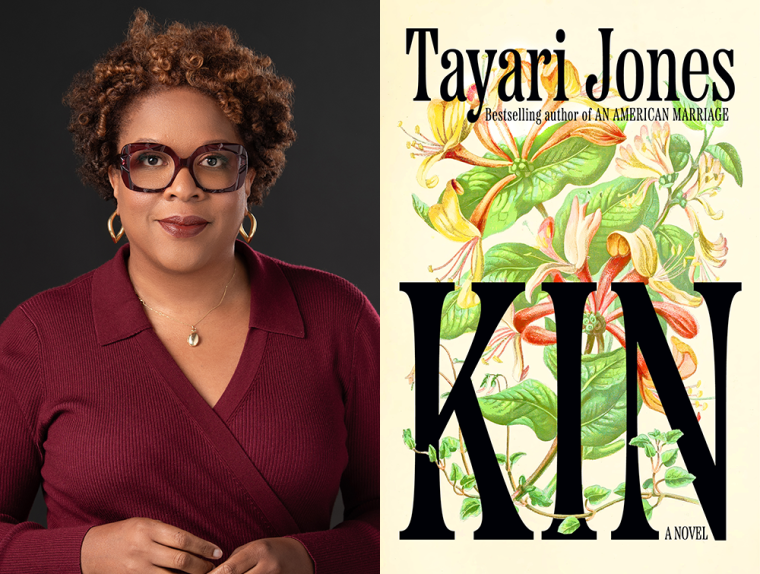
Tayari Jones, author of Kin. (Credit: Julie Jarborough)
1. How long did it take you to write Kin?
Well, it depends on when you start counting. I starting trying to write a new book seven years ago, but I took many a wrong turn. I can’t decide if I was just barking up the wrong tree, or if this was crucial pre-writing. But my main characters, Annie and Vernice came to me three years ago.
2. What was the most challenging thing about writing the book?
I had to accept that the book I planned to write wasn’t the book I ended up writing. I had always sworn I would never write a historical novel, and the next thing I knew—the writer’s block melted and I was somehow writing about the 1950s. I had to let go of the illusion of control.
3. Where, when, and how often do you write?
I prefer to write in the mornings, in my cozy office. But when this deadline was closing in on me, I moved out of the office and downstairs to the “situation room.” I was up at 5AM every morning, and chained to the espresso machine.
4. What are you reading right now?
I am reading The Correspondent (Crown, 2025) by Virginia Evans like everybody else!
5. Which author, in your opinion, deserves wider recognition?
I’d like to see more people reading Dolen Perkins-Valdez. Writing a historical novel gave me a whole new technical appreciation for her superb novels.
6. What is the biggest impediment to your writing life?
It’s hard to be a writer and an “author” at the same time. The author is the person who goes on tour. She is well-dressed and answers questions with authority. The writer is a dreamy person who spends a lot of time in her pajamas, puzzling over hard questions.
7. What is one thing that your agent or editor told you during the process of publishing this book that stuck with you?
When I turned in the first draft, my editor told me I had killed the wrong character. She said, “When this character dies, it’s unfortunate, but after 300 pages, the reader wants to be devastated.” I realized that I was actually shielding myself from the vicarious heartbreak that comes for losing a character you love.
8. If you could go back in time and talk to the earlier you, before you started Kin, what would you say?
I would remind myself that my writing is my pleasure, my calling, and to forget about my career. I think that losing the joy of process causes writer’s block. I wrote my first novel as a free artist—I didn’t even know what an agent did! I only wanted to tell my story to anyone that might care. I am always trying to get back to that place.
9. Outside of writing, what other forms of work were essential to the creation of Kin?
I had to talk to the elderly folks in my life and ask them questions about things they don’t usually talk about. I won’t lie, it was at times painful, awkward—but sometimes laugh-out-loud funny. Like life.
10. What’s the best piece of writing advice you’ve ever heard?
Use a humble pen.