This week’s installment of Ten Questions features April Reynolds, whose novel The Shape of Dreams is out today from Knopf. It’s the mid 1980s, and East Harlem is in the grip of the crack epidemic. “There was always a clutter of folk standing on the sidewalk, watching and paying witness to days filled with mayhem,” Reynolds writes. But when a twelve-year-old boy is found dead amidst a pile of garbage, a trio of women refuse to let his murder slide by as just another sidewalk story. While they struggle for justice in a system that has abandoned them, East Harlem shifts with the seasons: An ambitious reverend promises change for the neighborhood, the choir dance the cabbage patch, and many eyes are on the Mets, who just might win the World Series. In a starred review, Kirkus Reviews described The Shape of Dreams as “a crafty murder mystery in the multihued form of an urban symphony.” Adam Ross noted that the novel is also “the secret history of a community, of its neighborhood’s written-off eccentrics who are also its eyes and ears, of its all-too-fallible leaders tasked with holding it together, and its denizens trying to forge dignified lives without losing their humanity in their struggle to survive.” April Reynolds is the author of the novel Knee-Deep in Wonder (Henry Holt, 2003), winner of the PEN American Center’s Beyond Margins Award and the Zora Neale Hurston/Richard Wright Foundation Award. She is coeditor, with Henry Louis Gates Jr., of The Toni Morrison Reader and The Zora Neale Hurston Reader. Reynolds teaches creative writing at Sarah Lawrence College. Formerly a resident of East Harlem, she now lives in Astoria, Queens.
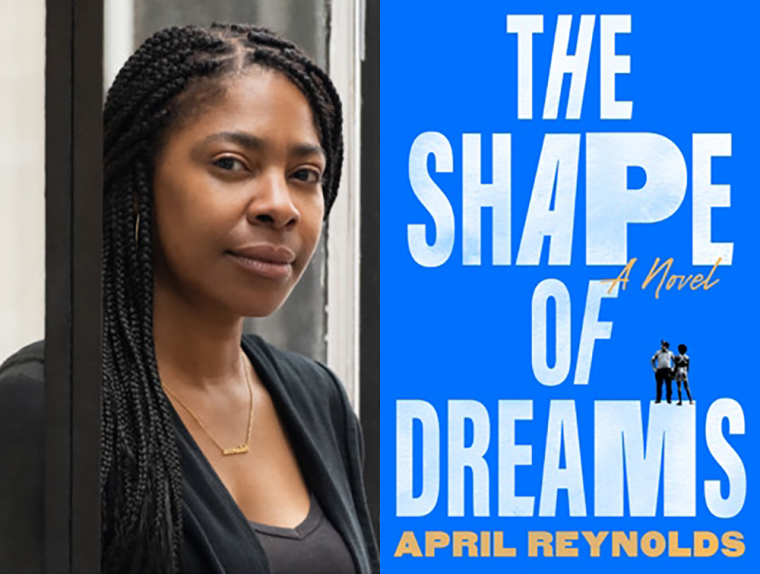
April Reynolds, author of The Shape of Dreams. (Credit: Beowulf Sheehan)
1. How long did it take you to write The Shape of Dreams?
Incredibly, twenty years. Hah! I’m still amazed at the time that passed. Granted, a lot of that time was spent raising two sons, one of whom has special needs, but yes, this book was twenty years in the making.
2. What was the most challenging thing about writing the book?
The Shape of Dreams has a host of characters and one challenge was imbuing each character with humanity and depth. I really wanted to provide compelling motivation for why they make the decisions they make. The other challenge was creating a plot where readers could grapple with the notion of justice. Justice is not a single event; it’s people colliding with each other; each person compelled to act the way they do at pivotal moments because of a series of past events.
3. Where, when, and how often do you write?
I write mainly at home in my office, in the mornings around four am and I try to write something every day. I am a big believer in thinking that writing is about cultivating a habit.
4. What are you reading right now?
Allegra Goodman’s This Is Not About Us (Dial Press, 2026), Micheal Davis’ Electras: Aeschylus, Sophocles and Euripides (St. Augustines Press, 2023), and Walter Mosley’s Gray Dawn (Mullholland Books, 2025).
5. Which author, in your opinion, deserves wider recognition?
Emily Anhalt, who has written Embattled: How Ancient Greek Myths Empower Us to Resist Tranny (Redwood Press, 2021), Enraged: Why Violent Times Needs Ancient Greek Myths (Yale University Press, 2018), and Ancient Wisdom for Polarized Times: Why Humanity Needs Herodotus, The Man who Invented History (Yale University Press, 2025). Her books are so timely! You can see I like philosophy. It’s the subject I fell in love with as an undergrad.
6. What is the biggest impediment to your writing life?
Getting enough time. My days are filled with teaching, and cleaning and cooking and helping my sons with their homework. So having quiet time to write is hard to come by.
7. What is one thing that your agent or editor told you during the process of publishing this book that stuck with you?
The process of publishing is filled with so many moments of being judged which will be followed by more judgement! Knowing any minute now I might be crushed by negative appraisals of my work, I developed self-doubt. But Deborah, my editor at Knopf said something that stuck with me. “Obviously, I believe in this book; and this house believes in your book. But what’s most important is that you believe in the book you wrote.”
8. If you could go back in time and talk to the earlier you, before you started The Shape of Dreams, what would you say?
Look around, have courage, and learn to say yes to things you are unfamiliar with from time to time. So much of writing means observing the world. I learned so much from talking with my neighbors in East Harlem, I wish I had befriended them sooner. My novel would have come together faster.
9. Outside of writing, what other forms of work were essential to the creation of The Shape of Dreams?
For a while I helped people write their stories. Marcus Sameulsson’s The Red Rooster Cookbook: The Story of Food and Hustle in Harlem (Harvest, 2016) and Brenda Myers-Powell’s Leaving Breezy Street (Henry Holt, 2021). Both of these books are wildly different: One is a cookbook; the other is a memoir about a prostitute who becomes a crack addict and then turns her life around by opening a nonprofit that helps young girls who are in similar situations. Both projects were profoundly impactful on my writing.
10. What’s the best piece of writing advice you’ve ever heard?
Jennifer Lyons, my agent said, “Embrace the edit.” We all bristle at being edited. Or at least, I do. Don’t these folks know how hard and long I’ve worked? But I think Jennifer’s advice has stayed with me. Even if you don’t like a particular edit, at least give it real thought. More often than not, you will deepen your character or further complicate your plot. The advice, embrace the edit, forces me to engage in the act of persuasion. I want my readers to not only see what my characters experienced; I want them to understand why my characters make the decisions they do.