This week’s installment of Ten Questions features Bianca Stone, whose poetry collection The Near and Distant World is out today from Tin House. Early in the book, a grinning teenager asks, “What’s poetry like?” The question forms the backbone of the collection, as Stone considers “the lucky fallout of words // said in a certain order.” In poems that span the bliss of writing students laying aside their debate in favor of harmonizing to Fleetwood Mac and the torment of poets “wrecked against meaning, starved / on the beach of meaning,” Stone honors the act of incantation as perpetually unfinished. “How can we inscribe experience that never knows its whole?” she wonders. Publishers Weekly called The Near and Distant World “a psychically rich and attentive work,” while Peter Gizzi praised the collection as “a deep pleasure, fueled by a necessary restlessness in the service of discovery, creating a gorgeous tapestry of introspection and seemingly endless creative expression.” Bianca Stone is the author of four poetry collections, most recently What Is Otherwise Infinite (Tin House, 2022), winner of the Vermont Book Award for poetry. Her writing has appeared in the Best American Poetry series and in magazines such as the New Yorker, the Atlantic, and the Nation. Stone lives in Vermont, where she serves as the state’s poet laureate.
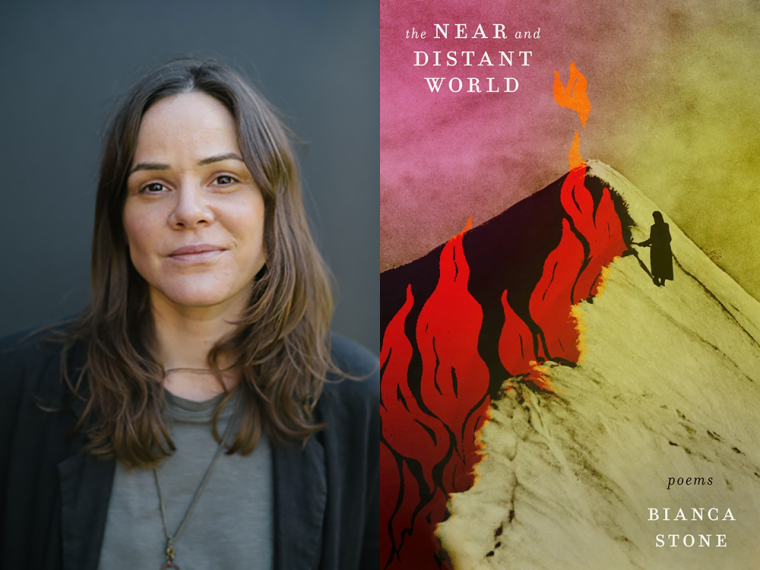
Bianca Stone, author of The Near and Distant World. (Credit: Daniel Schechner)
1. How long did it take you to write The Near and Distant World?
It’s hard to know where something begins and where it ends when you’re talking about poetry. Fragments that have been around in me; I have been pinning them into this book for five years; a tapestry, unfinished, I kept unraveling it lest I’m wed to the wrong thing. Then, I fold it together to unfold the book. Some of those fragments I’ve realized were there long before. I edited some of these poems over the course of three years. I might still be editing them. All told, it’s about that time for a book to come to fruition for me.
2. What was the most challenging thing about writing the book?
As in all my books, it is always a matter of revealing and concealing, and how much in either direction one is going to go to get at the truth of the matter. The so-called autobiographical narratives, and how much to say from that surface-level event. Metaphor, and literality, I suppose. The trick of it. The hardest part of this book was letting go of the editing. To let the profound flaws be there.
3. Where, when, and how often do you write?
It’s impossible to say. I engage with poetry every day. I write with a mechanical pencil on paper surrounding me, on the margins of books, on scraps of paper on my desk, in my journal. In some ways, I often feel dissatisfied with the mechanisms of time and how to give it all to the pure poem.
4. What are you reading right now?
I read a lot of things at once. It’s not a good way but there it is. I have a hard time focusing on one thing. Some things I’m reading: The Qu’ran translated by Syed Vicktor Ahamed, Schattenfroh: A Requiem (Deep Vellum, 2025) by Michael Lentz translated by Max Lawton, The Lice (Copper Canyon Press, 2017) by W. S. Merwin, Only Sing (FSG, 2025) by John Berryman, edited by Shane McCray; and Life Against Death: The Psychoanalytical Meaning of History, & Love’s Body (Wesleyan University Press, 1985) by Norman O. Brown.
5. Which poet, in your opinion, deserves wider recognition?
Dara Barrois/Dixon (née Dara Wier). Her innovation in her poetry, her wit and wisdom, her pedagogy—I have learned so much from her. She is an incredible mind. How blessed I am to have her poetry, writing, and presence in my life. I will also say: Ruth Stone. Same reasons. I love that great poets are also a little secret. Poetic greatness cannot be for the mass-scale sanction. I discover, in the quiet, humble room, what great words are waiting. How lucky it feels to know. (But it’s not luck, it’s paying attention).
6. What was your strategy for organizing the poems in this collection?
To make visible the architecture of a book of poetry—an act of discovery amid the fragments. I had no strategy, but a sense of the emotional arc. I play with the ways in which one poem leads into another. I see how that order can begin to complicate and further the themes; the overall Divine Comedy-esque journey. At first, it never seems to make sense. Chaos. Nothing: “I have no book,” is the beginning. Then slowly I start to see where things rise and fall. Beginnings and endings are very important to me. Do we make them or discover them? That we cannot answer but in the poems. I find a lot of energy in playing with those ideas alone in a collection of poetry.
7. What is the earliest memory that you associate with the book?
Honestly, the moment I pretended I had a book. “I have a book,” I said to my editor. I had a lot of splinters. Where are the walls? I needed to pretend, because I had a lot of desire, which is action. I remember I was writing a letter that was a prose poem, and I felt like I was in the persona of a depressed president confined in the Black House. I associate the epistolary form with this book; its seed was a black sunflower planted in the Black House yard. It was the first call to the reader, a kind of note to no-body, and I think of that hard time hubris as the onset.
8. If you could go back in time and talk to the earlier you, before you started The Near and Distant World, what would you say?
Greedy “self-consum’d” Time? I think I would be too awed and terrified to go back because maybe I would be triumphing over death. I’d tell myself to keep going, because this is what will happen. Or I would be mute. To go back there would be right now, too. How can I go back to before something that doesn’t seem to have a beginning? But when I do talk to myself, and I’ve forgotten the work, I tell myself (and I would tell myself) to have faith and to pay attention. I want to write, even right now, a poem and a book that is utterly my own. I don’t know if I have yet.
9. Outside of writing, what other forms of work were essential to the creation of The Near and Distant World?
Walking, especially in the woods. But there’s an enormous amount of work that I’ve been doing on the interior. That work changes everything in the writing. It is a parallel project. It’s a project of analysis. And the spiritual. And that’s with another person, the Other, often. Then finding the other in yourself too. But there’s this work of reading and researching: the great big project. History, literature, philosophy, whatever you feel drawn too. Wherever your heart is pointing, to keep investigating it. It’s like an enormous and never ending dissertation for nobody. Or everybody.
10. What’s the best piece of writing advice you’ve ever heard?
“Tell all the truth but tell it slant — / Success in Circuit lies / Too bright for our infirm Delight…”
Advice for poets should be poems. Dickinson speaks to the most important element of the form: Speak the experience, but know it is not the experience. Something else is at work. Be wary about what you think you look directly at. We must know myth, the lie that conceals the truth, the noble lie—truth must be work towards. And the poet is ignorant too. The shadows on the cave wall can be useful if we know the sun is too bright to look at directly. But we must let it touch us too.