This week’s installment of Ten Questions features Andrés Cerpa, whose poetry collection The Palace is out today from Alice James Books. “I feel compelled to give you an ending, a promise of hope,” Cerpa begins the collection. But in the diasporic family history at the center of his book, happy endings are the stuff of bedtime stories. When owning land or having money for rent remains out of reach, Cerpa writes that clinging to such hopes is like being “horses at the trough, consuming the fire / in gulps.” As he navigates the gap between the optimism of the past and the disappointments of the present, the poet shifts from promise to proposal, wondering what might happen if “I could choose my own story.” Victoria Chang praised the poems of The Palace for “the way their imagery touches the reader with a gentleness and capacious questioning mind.” She added, “These labyrinthian poems that navigate memory, country, pain are stunning, original, and layered. Mostly, these poems feel true to me, not as in fact, but True.” Andrés Cerpa is the author of the poetry collections Bicycle in a Ransacked City: An Elegy (Alice James Books, 2019) and The Vault (Alice James Books, 2021), which was longlisted for the National Book Award. His writing has appeared in Ploughshares, the Kenyon Review, the Nation, and elsewhere. He serves as a faculty member in the creative writing MFA program at Randolph College.
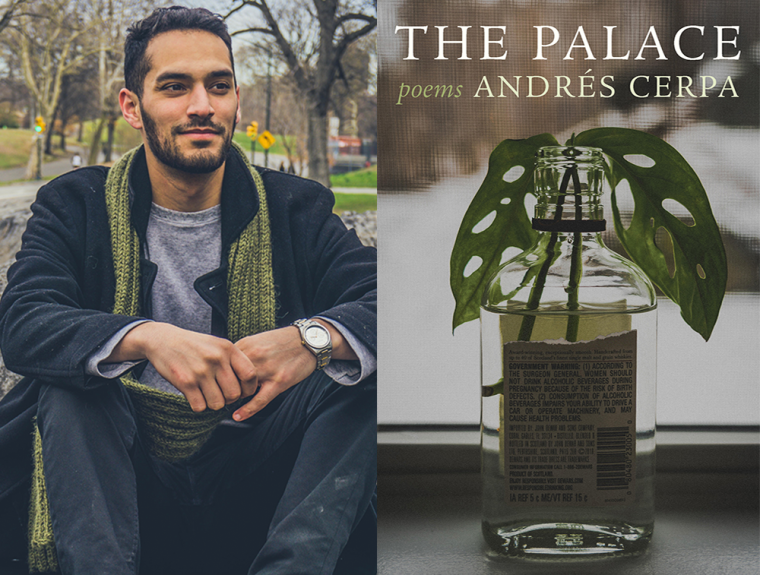
Andrés Cerpa, author of The Palace.
1. How long did it take you to write The Palace?
Four years. The earliest poem was completed in 2019 and the book was submitted to my publisher, with the necessity for some edits, in late 2023. Yet looking back through drafts this afternoon I saw that phrases and the outlines of images came much earlier.
2. What was the most challenging thing about writing the book?
Sustaining and developing the vision of the book over the course of years and many individual poems is an immense challenge. It was important for The Palace to read as a book with a trajectory and unified vision. The revelations that occur in individual poems, or in the act of creation are not isolated, they impact the whole—both poems already written and poems to be written—and are of consequence to a larger system.
Not only is it difficult to balance the poems but as the years progressed the circumstances of my life changed and those changes inevitably altered my writing. At the start of The Palace I wrote on a typewriter. But during the pandemic, when my wife and I were working from home, it wasn’t optimal for me to type loudly on the typewriter during the week, and so I wrote more by hand. Then, when I began a job working outside, I “wrote” by recording voice memos. All of these seemingly small changes lead to different types of poems. The forms changed, imagery shifted, my relationship to my own poetry developed, and gathering those changes was a constant grappling. Bringing years of poems together is a challenge but is one of the most satisfying aspects of creating a book.
3. Where, when, and how often do you write?
I love to write poems in the morning before anyone else is awake. I make coffee, keep the lights low, and sit in my living room that overlooks a courtyard with tremendous trees. Waking before or near dawn is crucial for me. The blue-black sky at that time inspires and focuses my creativity. On average I do this four days a week. I also write, very briefly, each night. I am currently in my third year of a three-year journal and so at the end of the day I write a few thoughts down—a quote, what my child said, the texture of a poem, something I saw that struck me. One to four sentences each day to help me remember my life through language.
4. What are you reading right now?
I am rereading Gilead (FSG, 2020) by Marilyn Robinson. It is an epistolary novel, in which the speaker, Gilead, is dying and writing a letter to his young child. In this letter Gilead is attempting to articulate what is important in the face of a glaringly finite amount of time, attempting to convey a few simple yet difficult things. In his inevitable absence he wants to say, with love, something to the future. Much of my work contains the epistolary impulse and I feel a deep kinship with the character’s desire to share something as simple as walking under magnificent oaks. For me, and I am cobbling together ideas from luminaries like Jack Gilbert and Rita Dove, a poem is distilled language that attempts to convey something important. Although not a poem, the letter, the novel, does just that.
5. Which poet, in your opinion, deserves wider recognition?
I believe B. H. Fairchild deserves wider recognition. Particularly the books, The Art of the Lathe (Alice James Books, 1998) and Early Occult Memory Systems of the Lower Midwest (Norton, 2002), which are deeply peopled. The clarity and breath of his vision is astonishing. I’ve learned a great deal from the work of Fairchild.
6. What was your strategy for organizing the poems in this collection?
The Palace is organized as a physical journey. The speaker moves North through both real and mythological landscapes. That movement is spurred by conflict and with each step (or poem) on the trajectory North, there is a corresponding spiritual movement. For me, the book is paced chronologically with the recognition that the past is carried in the present. Therefore, each step forward also contains the past.
Another key consideration as I ordered The Palace was the development of motifs. I ordered the work so that different motifs come to the forefront, recede, then return. The repetitions come in waves and there are many repetitions—words, phrases, forms, titles, ideas, images. I tapped into the rhythm of these appearances through the process of recording myself reading the collection aloud in full, then listening back while taking notes.
7. What is the earliest memory that you associate with the book?
It has to be writing the poem “Dear” on my 1963 Royal Safari typewriter in my one window room on Dekalb Avenue in Brooklyn. The sound of that typewriter, my money tree in the window, and how the gauzy curtain held the light are linked with my first dreams of The Palace.
8. If you could go back in time and talk to the earlier you, before you started The Palace, what would you say?
Look up from your own desperation and walk outside. No matter the weather, be outdoors each day. It will help you.
9. Outside of writing, what other forms of work were essential to the creation of The Palace?
Reading is the most essential work outside of writing. In the dedication page I thank a variety of authors that I’ve never met, many of whom are dead—Franz Wright, David Berman, Lorraine Hansberry—because they helped move the book forward, seeing what they created helped me edit and dream. In addition, watching movies was a particularly important part of writing The Palace. I’m in love with the possibilities of image and narrative in poetry. I often think of my work as lyric poems composed in narrative snippets. Pacing, scene cuts, and imagery in movies help me consider the relationship between lyric movement, narrative and image. Alejandro Iñárritu’s Biutiful (2011) was a wellspring.
10. What’s the best piece of writing advice you’ve ever heard?
The novelist Maurice Carlos Ruffin once said something akin to, Writers are often happier and more fulfilled when they are writing. Maurice is brilliant, generous, and prolific, and that idea has inspired me to spend more time writing on difficult days. If I can write, even a sentence or two, my mind is alive and engaged. His advice reminds me how lucky I am to be a writer.