This week’s installment of Ten Questions features Jordy Rosenberg, whose novel Night Night Fawn is out today from One World. Bedridden and in an OxyContin haze, elderly Barbara Rosenberg embarks on an experiment in what she calls “yenta science”: a stream-of-consciousness narration of “how people (for example, women) become things, and how things (for example, corduroy blazers) become quasi-people, or take on a vitality of their own.” The blazer in question isn’t just any old jacket, of course. It once belonged to Barbara’s husband; after his death, their tomboyish child puts on the blazer instead of the sanctioned feminine funeral attire of “a burgundy velvet knee-length duffel coat from Gimbels,” and Barbara recognizes a “golem of upside-down gender” in the making. Publishers Weekly wrote that “Rosenberg crafts his satirical portrayal of Barbara’s transphobia with a dizzying blend of broad humor and vitriol.” Kirkus Reviews called the novel “part rant, part rave, part extended Jewish joke, part queer, Marxist fever dream.” Jordy Rosenberg is the author of the novel Confessions of the Fox, a New York Times Editors’ Choice selection and shortlisted for the Center for Fiction’s First Novel Prize, a Lambda Literary Award, and a Publishing Triangle Award. He is a professor of English and an associated MFA faculty member in the Program for Poets and Writers at University of Massachusetts in Amherst.
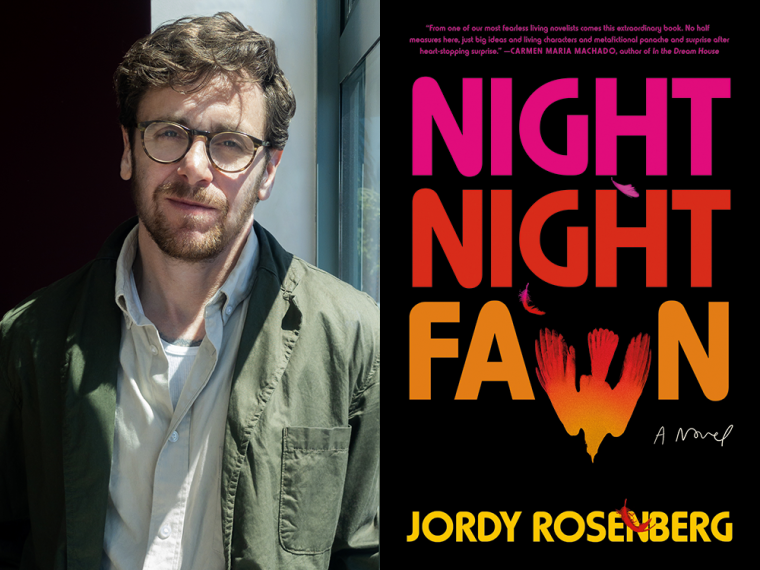
Jordy Rosenberg, author of Night Night Fawn. (Credit: Beowulf Sheehan)
1. How long did it take you to write Night Night Fawn?
Between 2014 and 2016 I published a couple memoir-essays about taking care of my estranged mother while she was dying. Then I got caught up in publishing a novel about an 18th-century prison break artist. When I returned to the essays, I came to realize that the entire project needed to be flipped on its head and written as a novel from the perspective of the mother character. So, ten years or so total.
2. What was the most challenging thing about writing the book?
The most challenging part was inhabiting the dystopian perspective of the main character—an uncensored transphobe who I think of as afflicted with what Sophie Lewis describes as a TERFy “restrictive pessimism.” Night Night Fawn is satire, and scandalizing the sensibilities of its main character was cathartic. But it was still an incredibly difficult experience to spend that much time with a character whose politics I am deeply opposed to.
3. Where, when, and how often do you write?
I am often wildly optimistic about my productivity in the mornings. This feeling lasts no later than noon.
4. What are you reading right now?
I am reading two incredible galleys. One is Pip Adam’s forthcoming novel, kluge, which is a work of outrageous genius. It would be a reduction to say it is “about” AI, though someone may be tempted to do so when it comes out. It is more accurate to say that kluge inhabits the uncanniness of code; that code functions as a setting, a character, and a style all at once. Pip has created a novel entirely without atmosphere or “world,” leaving us with only language and the trippiness of decontextualized emotion. It kind of feels as if The Employees (which I also revere) were set in inner space. It is an utterly unmooring book. I would say it is ontologically startling to read it.
The other galley is Molly Crabapple’s indispensable Here Where We Live Is Our Country: The Story of the Jewish Bund (One World, April 2026). This book combines a big, bursting history—not only of Jewish socialism in the late 19th and early 20th centuries, but its significant intersections with and influence on broader socialist movements and world history—with an incredibly focused and fine-grained parsing of the political stakes of these histories then and now. We need this book. It is meticulously researched and passionately written. It has commitments, it is urgent, and it is, needless to say, beautifully illustrated. It’s going to be very important. Okay, spiel over.
5. Which author, in your opinion, deserves wider recognition?
This is an impossible question, but I will mention two books that recently came out and deserve lots of attention. One is Megan Milks’s book of essays, Mega Milk: Essays on Family, Fluidity, Whiteness, and Cows, which was published this past January by the Feminist Press. I read it in one zealous sitting. Yes, it is about “family” and also “milk,” as advertised, but you are not (are never) prepared for the directions Megan Milks’s work will take. They are a thrillingly unpredictable writer.
The other book is by the well-known and highly awarded author of SF, fantasy, and memoir, Sofia Samatar; but her new book’s entrance into the world is deliberately low-key and kind of word-of-mouth. Friendly City: A Year of Walks (Quinx Books, 2025) collects a year’s worth of Samatar’s weekly columns in the Harrisonburg Citizen, chronicling her local walks. The book maintains Samatar’s prodigious range of philosophical and literary references, but it is more than anything an exercise in serious, detailed attention. The prose is astonishing, grounding, and gorgeous—though never baroque; it has the restraint of the best poetry. It is a deeply moving book about loving a small town.
6. What, if anything, will you miss most about working on the book?
Right now I’m very glad to get it off my plate and out into the world. This book was a purge, and I need to immerse myself in utopian thought for a good long time now to counterbalance.
7. What is one thing that your agent or editor told you during the process of publishing this book that stuck with you?
Working with my editor, Nicole Counts, was a dream. She is magnificently calm, precise, and has a capacious sensibility for fiction as well as nonfiction. She was the one who suggested that we embrace this project as a novel rather than memoir, and gave me license to do so. She also suggested that I break its one long block of ranting text into chapters. Prior to that, I had not considered letting the prose take a breath.
8. If you could go back in time and talk to the earlier you, before you started Night Night Fawn, what would you say?
To show the writing to more people, sooner (not my first time making this mistake!).
9. Outside of writing, what other forms of work were essential to the creation of Night Night Fawn?
Often the critical forms of work were not mine, but that of colleagues who (once I got over myself and asked) read the work and gave me feedback. They’re named in the acknowledgments, and include George Abraham, Andrea Lawlor, Carmen Maria Machado, Torrey Peters, and Michelle Tea. I took almost all of everyone’s advice (more sex! more horror! more weirdness! don’t try to have that one character write a poem! stop using italics!—that last one was Andrea, and I perhaps foolishly did not listen).
10. What’s the best piece of writing advice you’ve ever heard?
There has been a lot of talk lately about the limits of fiction. Specifically, the Chekhovian proposition that fiction should “pose problems” rather than “solve” them. This formulation has re-emerged as a register of intense anxiety about the place of literature at a time of accelerating fascization promoted by the West. And while it is true that literature itself cannot solve our problems—to think as much is an idealist fantasy about where social change comes from—the choice between posing and solving is deeply misleading. A recent reread of Trotsky’s Literature and Revolution clarified this for me. I love his take on the way Russia’s whiplash-inducing political chaos in the period prior to 1917 “struck the intelligentsia heavily and continuously, as with a battering-ram.” In the face of political intensity, bourgeois art insisted on its own “terrifying helplessness.” Let’s not repeat this flight into self-trumpeted impotence.
We can upend the false binary between posing or solving problems. What this framework is asking about (while also obscuring) is the relationship of literature to politics. “Each class has its own policy in art...a system of presenting demands on art, which changes with time,” says Trotsky. Essentially, all literature is political. It’s just that some of that literature is non-revolutionary and some is revolutionary. Trotsky is not arguing that literature, itself, leads us into revolution. But all the same, literature is one of the most acute sensory organs we have to grasp our material conditions. It “enlarges the volume of thought,” says Trotsky, which is not so far off from saying that literature poses problems rather than solving them. Except that, for Trotsky, posing problems is part of solving them, because those problems are part of a broader field of political action and life-making in which we are all engaged in one way or another. For example, here are some problems that literature—as Kaleem Hawa’s review of Wisam Rafeedie’s novel Trinity of Fundamentals shows us—has posed: What is “revolutionary subjectivity?” What is “political commitment?” What is “the role of culture in national liberation?” We can pose these problems, and we can also follow up on their significance. Sometimes literature helps give language to a revolutionary event. Sometimes it registers a political upheaval after the fact so as to grasp its contours more precisely. Sometimes, following Hawa again, it “expand[s] the base of popular struggle.” There is no “posing” vs “solving.” Cultural production is inextricable from the collective process of addressing problems; or, as Andrea Abi-Karam and Kay Gabriel put it, “forcing an encounter between the ideal and the actual.” None of this is exactly craft advice. But it keeps me going and (most days) believing in literature enough to write it.