This week’s installment of Ten Questions features Siew Hii, whose debut poetry collection, Entered Some Aliens, is out today from the University of Wisconsin Press. Dedicated to “anyone who is not so sure about home,” the collection probes what it means to live in the American South as a queer Asian American. “For my mother,” Hii writes, “I’d like to say I sank my roots / into Kentucky’s bluegrass.” But the image of Southern soil leads the poet to the thought of Southern sport, and then to the memory of baseball bats and Vincent Chin: “Soil can be picky.” Offsetting this haunted narrative of home is the camaraderie of homies, the people who “fill up the Toyota and sing / all the way to hot pot.” In lines that might equally address parent, past, or place, Hii promises to one day grow an “adult heart that can say / I love you without needing / to hear it back.” Sumita Chakraborty wrote, “To read these poems is to have a zany, inventive, and heartrending conversation with a fellow galaxy roamer, and to know that in that conversation’s exquisite quirks lives the truest meaning of the word home.” Siew Hii’s poetry and prose can be found in AGNI, Electric Literature, Story, and the Georgia Review. Hii’s parents hail from Kentucky and Sibu, Malaysia; she grew up in Mobile, Alabama, and later lived in Mississippi and North Carolina. Hii now lives in Orlando, Florida, where she teaches creative writing at the University of Central Florida.
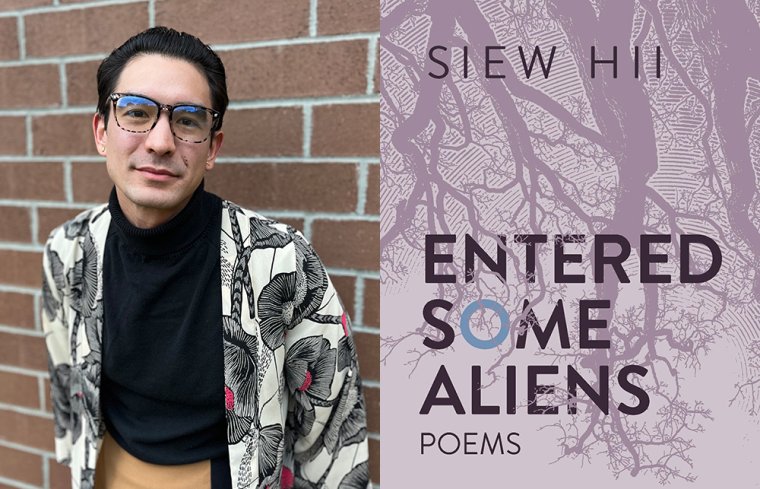
Siew Hii, author of Entered Some Aliens. (Credit: Rochelle Hurt)
1. How long did it take you to write Entered Some Aliens?
About ten years. It felt longer. So much happened between 2016 and 2026.
2. What was the most challenging thing about writing the book?
The most honest answer is money. At several points while writing this book, I was a lot more concerned with where I was going to sleep and what I was going to eat than I was with poetry. I’ll also add that because I wrote the poems over such a long period of time that it was a challenge to unite the project and, relatedly, to sequence the pieces.
3. Where, when, and how often do you write?
In the summer, I’ll write—usually at my kitchen table—anywhere from one to ten hours. I teach at a university right now, so in the semester, I just try to write about three days a week. Usually that means waking up at 5 AM and writing at my table for two-ish hours, but sometimes I am lucky and get to go write in the garden in the afternoon.
4. What are you reading right now?
Anjali Sachdeva’s wonderful short story collection, All the Names They Used for God (The Dial Press, 2019), which I recommend highly. I’m listening to the audiobook of Brian Greene’s The Hidden Reality: Parallel Universes and the Deep Laws of the Cosmos (Knopf, 2011). Also Drifting House (Penguin Books, 2012) by Krys Lee; it’s excellent.
5. Which poet, in your opinion, deserves wider recognition?
Wong May.
6. What was your strategy for organizing the poems in this collection?
The first attempt consisted of printing all the poems and throwing the pile into the air. The order I picked them up was the first order the book was in. I just needed to start somewhere. In the final order, poems that complement one another thematically appear in clusters. One of my questions for sequencing that I’d ask myself: How do time and space flow when they aren’t flowing according to the master narrative’s shape and rhythm? The sequence in the final version of the collection is part of that answer.
7. What is the earliest memory that you associate with the book?
The really intense dread I felt when the first cases of coronavirus were confirmed in Wuhan.
8. If you could go back in time and talk to the earlier you, before you started Entered Some Aliens, what would you say?
1) Ask better questions. 2) Try and make a little time each week to do something that you like and that you aren’t good at. 3) Being gentle may not make it better, but it rarely makes it worse.
9. Outside of writing, what other forms of work were essential to the creation of Entered Some Aliens?
Music by Nina Simone, Otis Redding, Carly Rae Jepsen, Japanese Breakfast (Michelle Zauner), Caroline Rose, and Lil Nas X, to name just a few.
& Skincare. Having skin is not easy.
10. What’s the best piece of writing advice you’ve ever heard?
Complexity in one area often requires simplicity in another.