This week’s installment of Ten Questions features Adrian Matejka, whose poetry collection Be Easy: New and Selected Poems is forthcoming from Liveright on May 5. Be Easy places new poems alongside a selection of Matejka’s previously published writing, dating back to his debut collection, Devil’s Garden (Alice James Books, 2003). These two decades of poetry span childhood revelations and rebellions (banished to a remedial English class, the young poet looks up “authenticity” in the dictionary and reads “Blackness”); the life of world heavyweight champion Jack Johnson, who strokes his scars for luck; and the “em dashery” of Emily Dickinson repurposed as a record needle, the flick of shoelaces through suede kicks, and “the dash from one hoop to the other.” In a recent poem, Matejka acknowledges, “Every part of me // acts differently after 50”; nonetheless, in a moment of pride, the poet recognizes that “the unreliable timepiece inside me” might have “finger picked this whole shebang.” In a starred review, Publisher’s Weekly praised the collection for putting Matejka’s “agile, musical voice, vivid imagery, and talent for cultural critique on full display.” Tracy K. Smith wrote: “In the vivid intoxication of each poem’s heartbeat and mouthfeel is something that sounds to me like marrow music, flowing toward what stirs at the core of us.” Adrian Matejka is the author of six poetry collections and the graphic novel Last on His Feet: Jack Johnson and the Battle of the Century (Liveright, 2023). He has been nominated for the National Book Award and the Pulitzer Prize, served as the poet laureate of the state of Indiana from 2018 to 2019, and is editor in chief of Poetry magazine. He lives in Chicago.
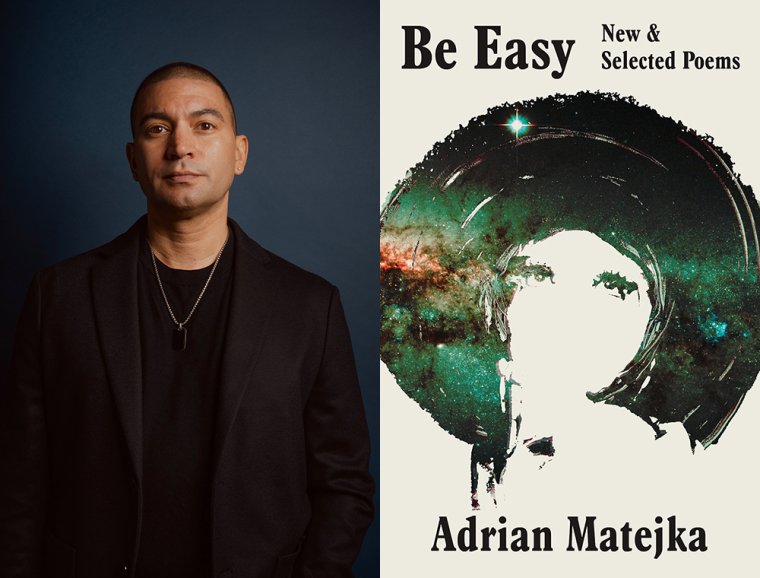
Adrian Matejka, author of Be Easy: New and Selected Poems. (Credit: Diana Solís)
1. How long did it take you to write Be Easy?
Be Easy is a new and selected so it’s nearly a lifetime endeavor. It includes poems from six books published between 2003 and 2021. But if I was going to imagine a starting point, it would be a poem called “Miles Runs the Voodoo Down.” I wrote it back in 1993, when I used to draft complete poems in my head. I could never compose that way now, which maybe speaks to my own cognitive clutter and the pace at which we all move and evaluate in 2026. I wrote the poem walking home from the great jazz composer David Baker’s jazz history class after he talked about Miles Davis’s Bitches Brew.
2. What was the most challenging thing about writing the book?
Putting together a new and selected was tough because it required that I reckon with so many previous versions of myself. I mentioned the poem I wrote when I was twenty-one; the rest of my first book was written by the time I was thirty. Back then, I was still living a meandering kind of life with no real direction except poetry. So it was complicated to go back and evaluate those poems even with the help of an excellent editor. There were moments rereading the early poems when I thought, “What’s this dude’s modus operandi?” It was just so long ago, and maybe that’s the point of a book like this. Yusef Komunyakaa said that revision is to resee, and sometimes relive, the moment of the poem. Selecting the poems required a lot of reliving. Sometimes it was wonderful, but other times I was reminded that some important poems—important to me, anyway—come from unsavory or difficult things.
3. Where, when, and how often do you write?
I’m so lucky because I write all the time in my day job as editor in chief of Poetry. The only down side is I’m usually writing copy for newsletters, editor’s notes, policy documents, and e-mails. I realized early in my tenure at the magazine that I needed to create space between my editorial work and my poetry to be able to bring my full self to both. That’s why I mainly end up working creatively on weekends and during vacations. As a practical thing, I’ve also become adept at leaving myself voice notes while on the bus or during walks when I have poem ideas or fragments. Which is maybe a contemporary version of the interior composition I did when I was younger.
4. What are you reading right now?
I had so many creative epiphanies while working on Last On His Feet and I’m getting ready to write another graphic novel. So I’ve been watching a lot of anime and reading graphic novels in my free time. Big Jim and the White Boy (Ten Speed Graphic, 2024) by David F. Walker and Marcus Kwame Anderson is a retelling of Adventures of Huckleberry Finn and came out the same year as Percival Everett’s James (Doubleday, 2024), which might say something about how Jim is thriving in the 21st century. I just started reading Feeding Ghosts (MCD, 2024) by Tessa Hulls and it’s been a revelation, both the writing and the expressive art. If this question is about poetry, I keep returning to Gabrielle Calvocoressi’s The New Economy (Copper Canyon Press, 2025). I think it shows that Gaby is writing on some other, brilliant planet from the rest of us. I’m also reading a beautiful book forthcoming in July, Maya C. Popa’s If You Love That Lady (W. W. Norton). I’m enamored with her sophistication and craft. Among other things, the poems are elegant epistolaries, made from the anticipation of correspondence. Her poems make me wish I was a better poet.
5. Which poet, in your opinion, deserves wider recognition?
There are so many unsung poets who deserve a wider readership, so here are three. Harryette Mullen is a longtime favorite of mine. Her 2025 book Regaining Unconsciousness (Graywolf Press) is fantastic, as are her previous books, especially Sleeping With the Dictionary (University of California Press, 2002). Catherine Barnett is another; she’s the kind of sophisticated poems everyone should be talking about. Also, her 2024 book Solutions for the Problem of Bodies in Space (Graywolf Press, 2024) is heartbreaking. Tim Seibles is one more. He’s a poetic boss in any mode, but I especially love his persona poems. His 2022 new and selected, Voodoo Libretto (Etruscan Press), shows the incredible range of his poetic imaginary.
6. What was your strategy for organizing the poems in this collection?
This book needed to follow a basic, chronological pattern, but was also informed by the individual poem’s composition. I’m a constant reviser. My reading copies are marked up with edits and additions. Along the way I’ve realized that continual revision keeps poems active and alive for me. Picasso said a whole lot of suspect things, but he also said that finishing a painting is like killing the painting. It makes sense to me to never imagine a poem to be finished, if for no other reason than to give it room to continue to grow. We decided to use the revised versions of the poems from my reading copies in the new and selected so people can read the version of the poems I carry around with me.
7. What is the earliest memory that you associate with the book?
Mostly I carry memories of the books themselves—getting the call that Kevin Young had selected Mixology for the 2008 National Poetry Series, for example. Or the lunch conversation with my editor at Penguin, Paul Slovak, about how to shape The Big Smoke into a novel-in-verse. Or sitting on the couch in the front room of my house in Indianapolis during the second week of COVID quarantine, writing the opening of what became Somebody Else Sold the World after realizing it wasn’t a divorce book but a quarantine book—and that I had no model for it. What I’m trying to say is that there are early memories of the poems, and then there are early memories of the books. I’m grateful to have all of them.
8. If you could go back in time and talk to the earlier you, before you started Be Easy, what would you say?
I don’t really have a good answer for this because we just started putting this book together in late 2024. I didn’t feel wise then and I feel even less so now.
9. Outside of writing, what other forms of work were essential to the creation of Be Easy?
Music is always a big thing for me, in form and function. I live in an apartment now, but when I lived in a house, I had a DJ setup and I would make mixes and playlists to help the writing along. Those mixes served two purposes: 1) to get me thinking about connectivity in sound and sense, and 2) to give myself a soundtrack for my writing. I always have music playing while I’m writing. Even now I’m listening to a song called “Oh Dove” from Men I Trust. Before that it was Miles Davis: “In a Silent Way.”
10. What’s the best piece of writing advice you’ve ever heard?
In a conversation about how to start a poem, Al Young once told me, “You’re born into the middle of it, so why not start there?” I love that idea. We are never the beginning of the story, any more than our poems begin at the beginning of the story. It makes so much more sense to start in medias res since we really don’t have any other choice.