Genre: Poetry

After Decades-Long Hiatus, a Return to Poetry Brings a First Book

The Poetry Foundation announced yesterday the winner of its 2012 Emily Dickinson First Book Award, given occasionally for a poetry collection by a writer over forty.

Maryland writer Hailey Leithauser, born in 1954, received this year's honor for her collection, Swoop, which comes with a ten-thousand-dollar prize and publication of the book by award-winning indie Graywolf Press next year.

Leithauser, who returned to poetry in 2000 after taking decades off from writing post-college, has seen her poetry published in Antioch Review, Gettysburg Review, Poetry, and Sou'wester, as well as in The Best American Poetry 2010. In 2004 she won a "Discovery"/The Nation Award (now the "Discovery"/Boston Review Award). The poet, who studied English as an undergraduate and now holds a master's of library and information science, has worked most recently as senior reference librarian at the Department of Energy in Washington, D.C., though she's also taken turns as a salad chef, purveyor of gourmet foods, real estate office manager, copy editor, phone surveyor, and bookstore clerk.

“Leithauser is a risk-taker," says Graywolf editor Jeff Shotts. "She is innovative—with spirited titles and musical outbursts—but also nods to poetic tradition with rhyming sonnets and other lyric techniques...I am engaged, throughout, and admire her wide-ranging talent.”

The Poetry Foundation will honor Leithauser along with 2012 Ruth Lilly Poetry Prize winner W. S. Di Piero at a ceremony in Chicago on June 11.

WriterHouse

The mission of WriterHouse is to promote the creation and appreciation of literature and to encourage the development of writers of all levels by providing an affordable, secure workspace and meeting space, high-quality writing instruction, and literary events for the public.

Writers’ Room of Boston

The Writers’ Room of Boston is a welcoming and supportive community, workspace and virtual presence for writers in all genres. Founded in 1988, the workspace houses 10 working carrels and an office meeting room. It is located in a secure and accessible building in the heart of downtown Boston that is available to members, 24x7 every day and augmented by a vital virtual presence. The Room sponsors fellowships which provide a year of free access to emerging writers, but as a matter of policy no committed writer is turned away for financial need.

West Side Books

West Side Books is an independent bookstore located in the historic Highlands neighborhood of northwest Denver. Since 1998, the store has been carrying new, used, rare, and collectible books. West Side Books hosts concerts, readings, and other literary events open to the public for free.

Tags: 

Strange in Common

5.14.12

Make a list of commonly used phrases or idioms (e.g. “don't let the cat out of the bag,” “beat a dead horse,” “no strings attached”). Choose one or two and examine them closely, particularly their literal meaning. Write a poem in which at least one line attempts to reveal the strangeness of a commonly used idiom. Read Dora Malech’s “Love Poem” for inspiration. 

Ama Codjoe Teaching Artistry

Social justice activist and Cave Canem fellow Ama Codjoe blogs about her work as a teaching artist with the P&W-supported Girls Educational Mentoring Services (G.E.M.S.), a New York City based organization that aims to support young women who have been commercially sexually exploited and domestically trafficked.

I teach social justice and poetry through asking myself the same big questions I pose to students. As a teaching artist I am invested both in my life as a teacher and in my life as an artist. These two pieces of my identity inform one another. When I assign the group a poem to write, I often do the assignment myself. While G.E.M.S. participants were interrogating what it means to be woman, I was asking myself similar questions in my artistic practice.

The inspiration flows in both directions. Just as frequently as I find myself using my teaching practice to inform my artistic practice, I also bring strategies, poems, questions, and obsessions from my writing life back into the classroom. If I look back at periods when I have been teaching a particular group of students and then examine the poems that I wrote during that time I can often find traceable themes and continuities. For five weeks of teaching and five weeks of writing we seemed to return to these central questions: What do we invoke? What do we want? What do we dream?

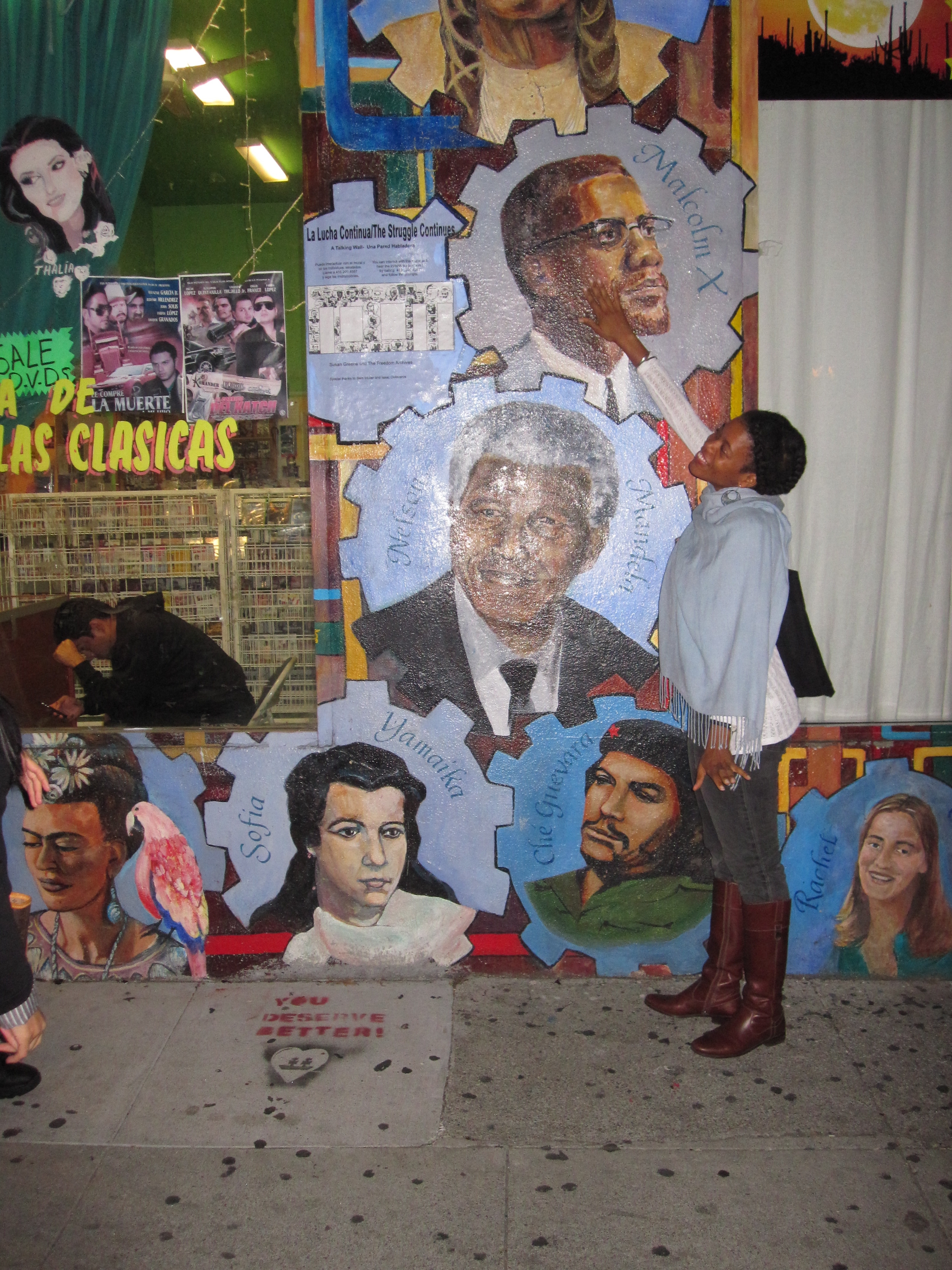
To close our time together, young women who participated in the P&W-supported workshops read their poems at an art exhibit that also featured their visual art. Listening as their confidence, nervousness, clarity, and power filled the room, I was impressed by how these young women had turned to me, turned to each other, and turned to the page. The space where we write, discuss, reveal, and revel is a space of courage and power—is a political space. The work of self-reflection, writing, and creativity is worthy work, and as Audre Lorde insists, poetry is not a luxury. In other words the work of a poet is dangerous and life-changing work.

Photo: Ama Codjoe. Credit: Evelyn Bojorquez.

Support for Readings/Workshops in New York City is provided, in part, by public funds from the New York State Council on the Arts, and the Department of Cultural Affairs, with additional support from the Louis & Anne Abrons Foundation, the Axe-Houghton Foundation, the A.K. Starr Charitable Trust, and Friends of Poets & Writers.

Pages

Subscribe to Poetry