Genre: Poetry

Poetic Fruit

9.30.25

“Forget about apples and oranges—nothing rhymes with orange anyway. Never mind those plums that William Carlos Williams sneaked from the icebox. The most poetic fruit of all is the blackberry,” writes A. O. Scott, critic at large for the New York Times Book Review, citing blackberry-inclusive works by poets such as Margaret Atwood, Emily Dickinson, Robert Hass, Seamus Heaney, Galway Kinnell, Yusef Komunyakaa, and Sylvia Plath. Compose a poem inspired by what you consider the most poetic fruit, describing the textures and tastes of your selection, and its associations in the world and in other works of art. Spend some time thinking about the name of the fruit itself, its sounds and component parts and etymological roots. Does conjuring words and phrases that recall the qualities of the fruit take your poem in a surprising or unexpected direction?
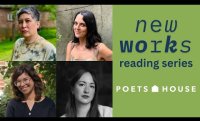
Kimberly Alidio, Courtney Bush, Natalie Shapero, and Emily Skillings

Caption: 

In this Poets House event, four poets read from their new books: Kimberly Alidio, author of Traceable Relation (Fonograf Editions, 2025); Courtney Bush, author of A Movie (Lavender Ink, 2025); Natalie Shapero, author of Stay Dead (Copper Canyon Press, 2025); and Emily Skillings, author of Tantrums in Air (The Song Cave, 2025).

Genre: 

World Poetry Salon: Colm Tóibín With Martin Hayes and Leonard Schwartz

Caption: 

In this World Poetry Salon event hosted by the New York Public Library and Limelight Poetry, Colm Tóibín reads from his collection Vinegar Hill (Beacon Press, 2022) while accompanied by musician Martin Hayes and joins Leonard Schwartz in a conversation about Ireland’s history and sense of place.

Genre: 

How It Ends

9.23.25

“This is how the text exchange ends. / Not with an explicit farewell but with a two-day pause followed by a thumbs-up-emoji reaction,” writes Reuven Perlman in “How Other Things End” recently published in the New Yorker with an epigraph of T. S. Eliot’s famed last lines from “The Hollow Men.” “This is how the career ends. / Not with a retirement party and a gold watch but with a second career in the gig economy.” Taking inspiration from Perlman’s comedic perspective of dark times, write a humorous poem that consists of your own inventions of anticlimactic contemporary situations in which the outcome is a letdown, with more of a fizzle than a gratifying conclusion. What modern references would you include to put your own stamp on this concluding episode?

Rattlecast: Richard Siken

Caption: 

In this Rattlecast episode, host and editor of Rattle Timothy Green introduces Jennifer Manthey, who reads her poem “Locker Room Annunciation,” and Richard Siken, who reads from his latest collection, I Do Know Some Things (Copper Canyon Press, 2025), and reflects upon his decision to write prose poems as a means of grounding himself in the aftermath of a stroke.

Genre: 

Sound and Sense

9.16.25

“We live in such a fast-paced world: Poetry helps us slow down, deepen our attention, connect and live more fully,” says Arthur Sze in our online exclusive announcing his appointment as the twenty-fifth poet laureate of the United States. Taking inspiration from Sze’s insights on poetry’s ability to help us appreciate each moment, compile a cluster of words and phrases that come to mind when you recall the soundscape of a recent observation. As you jot down the grouping of words, allow the sounds of what’s already on the page to contribute to associative rhythms and any consonance or assonance in your brainstorm. Then, compose your poem using the full range of the page’s space, deprioritizing any urgency for ease of meaning-making for a piece that is first and foremost inextricable from its sound.

Pages

Subscribe to Poetry