P&W-supported poet Koon Woon, October’s Writer in Residence, was born in a timeless village in China in 1949. In 1960 he immigrated to Washington State, first to the logging town of Aberdeen, then to Seattle, where he now resides. He turned to poetry while he was a mathematics and philosophy student coping with mental illness. Later he attended the workshops of Nelson Bentley at the University of Washington. At the age of forty-eight, Koon’s first book, The Truth in Rented Rooms, was published by Kaya Press.

When I reached the age of fifty-six, I joked, “I have outlived Theodore Roethke by one year already, but he is immortal.” Now that I am sixty-four, am I a little bit jaded as far as poetry is concerned? I’ve received some small recognitions and awards for my poetry, but more than anything, poetry enabled me to weather the storms of life, gave me an aesthetic sense, and encouraged me to ask questions. I am glad that some young people today are as fervent as I was back in my early thirties about poetry. Now I am passing the torch to younger poets, as well as publishers, organizers, and advocates of poetry.
It seemed fitting, for my final post, to hand that torch to one such up-and-comer. When Amber Nelson was fresh out of college in 2005, she and Will and Sarah Gallien hatched the e-journal alice blue review. They sought to give a voice to poets that “major” print journals ignore. Amber also created handmade chapbooks published by alice blue books. She’s worked with such innovative Seattle groups as APRIL (Authors, Publishers, and Readers of Independent Literature).
These young people have merged information science and technology with poetics. They give webinars and organize online Google hangouts. Their poems are tweeted and texted, nimble fingers portraying nimble minds. I’m sad when I imagine my books going out of print, but I’m excited that new innovators are populating the scene. What they do—I am banking my last poetry dollar on it—is crucial to our survival.
And now, here’s Amber in her own words:
Will Gallien, Sarah Gallien (then Burgess), and I founded alice blue review in a shared apartment in the Northgate neighborhood of Seattle. It was founded out of a desire to see and publish more of the work we really liked. We were interested in taking good writing seriously, but not taking ourselves too seriously. As such, we wrote up our mission statement:
We’re a confused collective of marble designers who, after discovering a set of encyclopedias, decided to stick our pinkies into the asphalt parking-lot of words. We seek innovative poetry and prose, work that quivers nervously for attention, work that teethes endlessly on doorknobs. We could toss out a grocery-list of writers—from Spicer to Borges, or O’Connor to O’Hara—but that would confuse you. alice blue is published on a hidden mountain-top between Portland, Oregon, and Seattle, Washington.
We also wrote silly bios for our masthead, for example: “I want to be just like you when I grow up. I figure all I need is a lobotomy and some tights.”
That was my own bio—a quote from The Breakfast Club. And our rejection letters, which we spent a lot of time working on, were a combination of the “standard form letter” and language stolen from writers we love. We had a ridiculous shared blog, where we posted our first rejection letters (among other ridiculous things).
In starting alice blue, we were also responding, in a way, to what we saw as a serious lack of literary community in Seattle. That’s not to say that there weren’t people writing, and writing communities in Seattle, but they weren't involved in or interested in the work that was compelling to us. There were (and still are) plenty of open mics catering to the slam/spoken word community. There was a lot of "nature writing.” They weren’t, however, “our” community. So we hit the Internet and made one for ourselves.
We split up—geographically—for a while, but kept publishing alice blue, which became better known. After graduate school at Boise State, I moved back to Seattle and got involved with some of the writers Koon mentioned. With Greg Bem, I founded the Seattle Poetry Panels (SPP), influenced by his experiences in the world of library science and an invitation to him from Google to host an online reading via Google hangout. So we started SPP and invited Paul Nelson to host our first panel on the “State of Seattle Poetry.” You can watch that here:
Simultaneous to all of this, I was working on alice blue review and alice blue books. I was working on a chapbook called MONSTER: A GLOTTOCHRONOLOGY that really was a monster to make. There was a letter M hand cut from the cover, a velum slip, and a double-signature. As a palate cleanser, I decided to do Shotgun Wedding, a quick and dirty chapbook series—something that would just be photocopied and saddle stapled. I focused on writers from the Pacific Northwest whom I thought everyone should know about. I’m working on the next batch of this series now.
I have several readings coming up, and a book release party for my first full-length book (out from Coconut Books) on November 1 at Open Books. I have my friends in the literary community to thank. We are a supportive bunch here, I think. Everywhere I turn, it seems, one writer is reaching out to another.
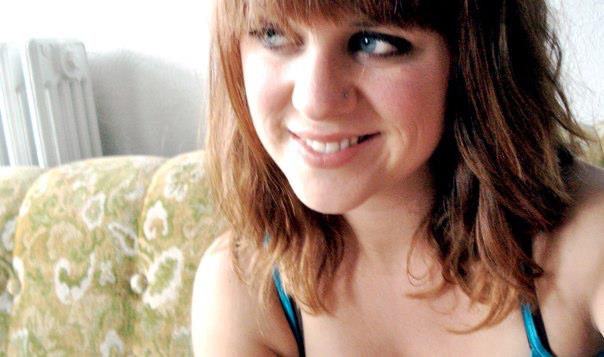
Photos: Top: Koon Woon reads with Beacon Bards at the Station coffee shop in Seattle. Credit: Greg Bem. Below: Amber Nelson. Credit: Amber Nelson.
Support for Readings/Workshops events in Seattle is provided by an endowment established with generous contributions from the Poets & Writers Board of Directors and others. Additional support comes from the Friends of Poets & Writers.



