



Marianne Moore and W. H. Auden
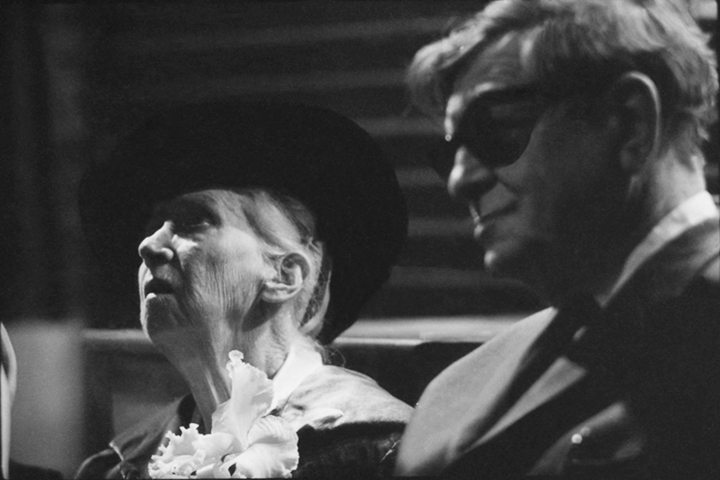
Poets Marianne Moore and W. H. Auden at the Poetry Center in 1966.
Jump to navigation Skip to content
Poets Marianne Moore and W. H. Auden at the Poetry Center in 1966.
Susan Stamberg recounts conversations with famed New Yorker editor William Shawn about J. D. Salinger; one year after Barry Diller, Scott Rudin, and Frances Coady aligned themselves with multimedia startup The Atavist—Atavist Books is set to launch; the latest Other People with Brad Listi features a conversation with novelist Cari Luna; and other news.
A new study indicates that reading literature improves empathy and social skills; the Guardian looks at the life and work of the great Max Perkins; Lisa Alber details her bumpy road to publication; and other news.
The Rona Jaffe Foundation has announced the winners of its nineteenth annual Writers’ Awards, given to emerging women writers. The program offers grants of $30,000 each to writers of poetry, fiction, and creative nonfiction.
The 2013 winners are fiction and nonfiction writer Tiffany Briere of San Diego, California; fiction writer Ashlee Crews of Durham, North Carolina; nonfiction writer Kristin Dombek of Brooklyn, New York; poet Margaree Little of Tuscon, Arizona; fiction writer Kirstin Valdez Quade of Palo Alto, California; and nonfiction writer Jill Sisson Quinn of Scandinavia, Wisconsin. Visit the website for the winners’ complete bios.
 The Rona Jaffe Foundation Writers’ Awards program was established by author Rona Jaffe in 1995 “in recognition of the special contributions women writers make to our culture and society.” Since the program began, the Foundation has awarded more than $1.5 million to women writers in the early stages of their careers. Past recipients have included Rachel Aviv, Eula Biss, Lan Samantha Chang, Rivka Galchen, ZZ Packer, Sharifa Rhodes-Pitts, and Tracy K. Smith. In addition to providing time to write, the program also offers assistance for things like research, travel, and child care. Nominations for the annual awards are solicited by the Foundation from writers, editors, critics, and other literary professionals.
Rona Jaffe (1931–2005) was the author of sixteen books, including Class Reunion, Family Secrets, The Road Taken, and The Room-Mating Season. Her 1958 bestselling debut novel, The Best of Everything, was reissued by Penguin in 2005.
Listen to a podcast of the 2013 winners reading from their work during a recent awards ceremony at New York University.
Gawker examines the critical adulation and controversy surrounding Dave Eggers’s The Circle; the Center for Jewish History in New York City will to open a rare books room; the New York Times speaks with poet Tess Taylor, a descendent of Thomas Jefferson; and other news.
We all have scars. Though most do not conjure welcome memories, scars are an important part of our lives—both physically and metaphorically. Scars reveal our vulnerability and human frailty, but also represent our resilience and toughness. Write about a scar you have, how you got it, and what it means to you.
Is it not expedient to send a sample chapter of a novel-in-progress, to find out where interest might lie, rather than wait until you've got it all done, and then maybe spend the next five years sending out queries?
Since we agents have such heavy reading (and the lion's share of that reading is material we won't ultimately take on) you shouldn't go on a fishing expedition with a work-in-progress (unless it's non-fiction, where a proposal/sample can be enough to sell). Either way, you're going to finish your novel if you're committed to it, so my advice is to use submission energy wisely. Most agents won't offer to represent fiction without digesting the complete project, so you don't stand to gain much from reaching out prematurely.
Tom Clancy, bestselling author of military novels, dies; Famous writers observe government incompetence; Joy Castro discusses the perils of writing about family; Website tips to help authors connect with readers; and other news.
Life is stressful. How our characters handle—or don’t handle—stress reveals much about them. Write a scene in which your protagonist is stressed due to a death in the family, a financial crisis, or an unraveling relationship. Place your protagonist in a grocery store at the express lane for customers with fewer than 10 items. Have a lady, pushing a cart full of groceries, jump in line just before your protagonist. “Sorry, but I’m in a hurry,” she explains. Write six hundred words.
The Library of Congress is closed; Amazon announced it’s creating seventy thousand full-time jobs for the holidays; Scribd and HarperCollins are launching a Netflix-like subscription service for books; and other news.
